

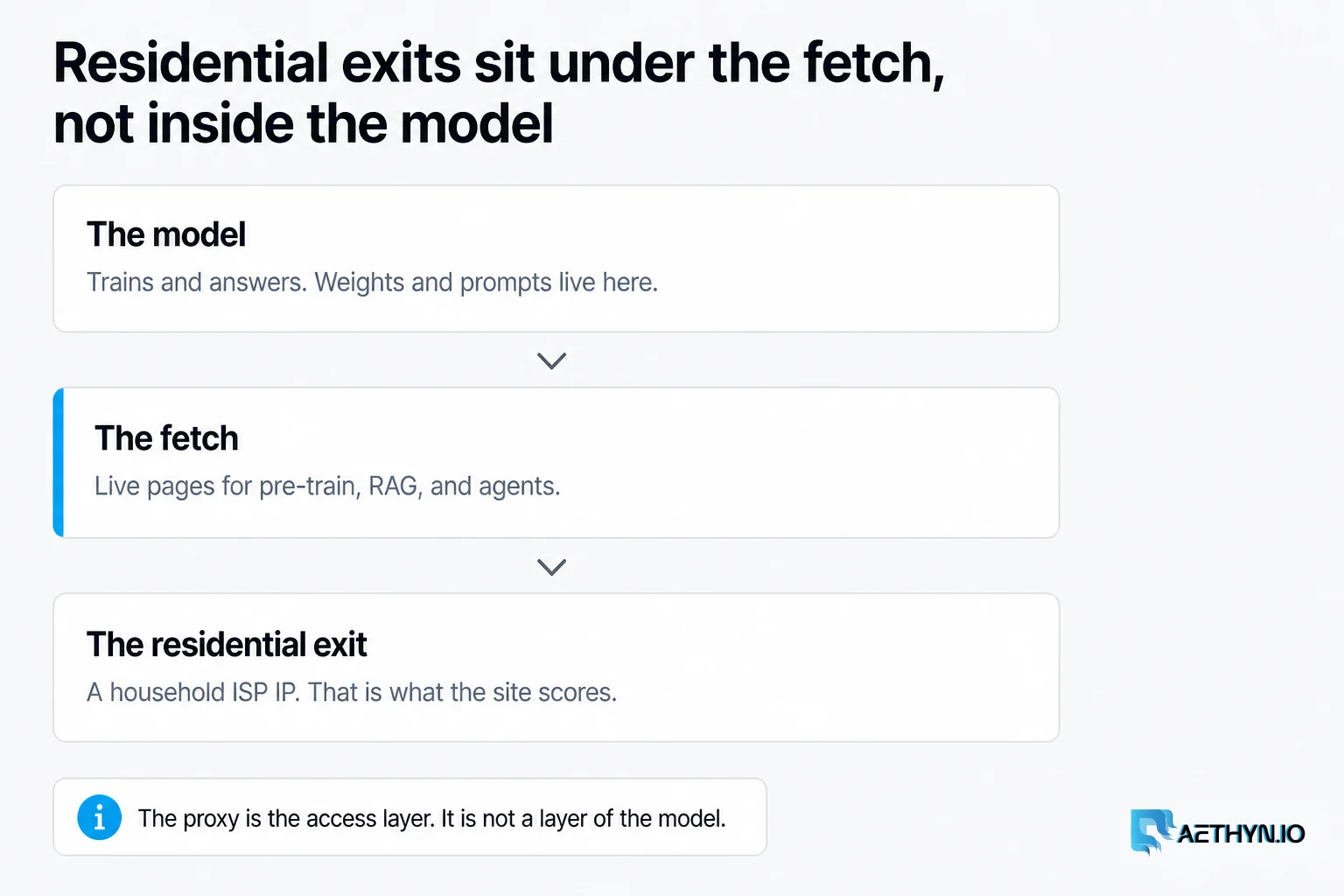
Search "AI and proxies" and you'll drown in phrases like self-healing networks and predictive rotation. Most of it is marketing. The real relationship between artificial intelligence and residential proxies is more concrete — and more useful — than the buzzwords suggest. It comes down to three things genuinely happening in 2026: AI runs on web data, the web now fights back with machine learning, and AI agents are becoming real traffic. Here is what each means if you actually build with proxies.
1. AI runs on web data — and the web isn't handed over freely
Every large language model, retrieval system, and fine-tuned domain model is downstream of one thing: a large, fresh, representative corpus of web data. Pre-training needs breadth. Retrieval-augmented generation (RAG) needs current pages. Fine-tuning needs clean, domain-specific examples. None of that arrives as a tidy download — it has to be collected from the live web, at scale.
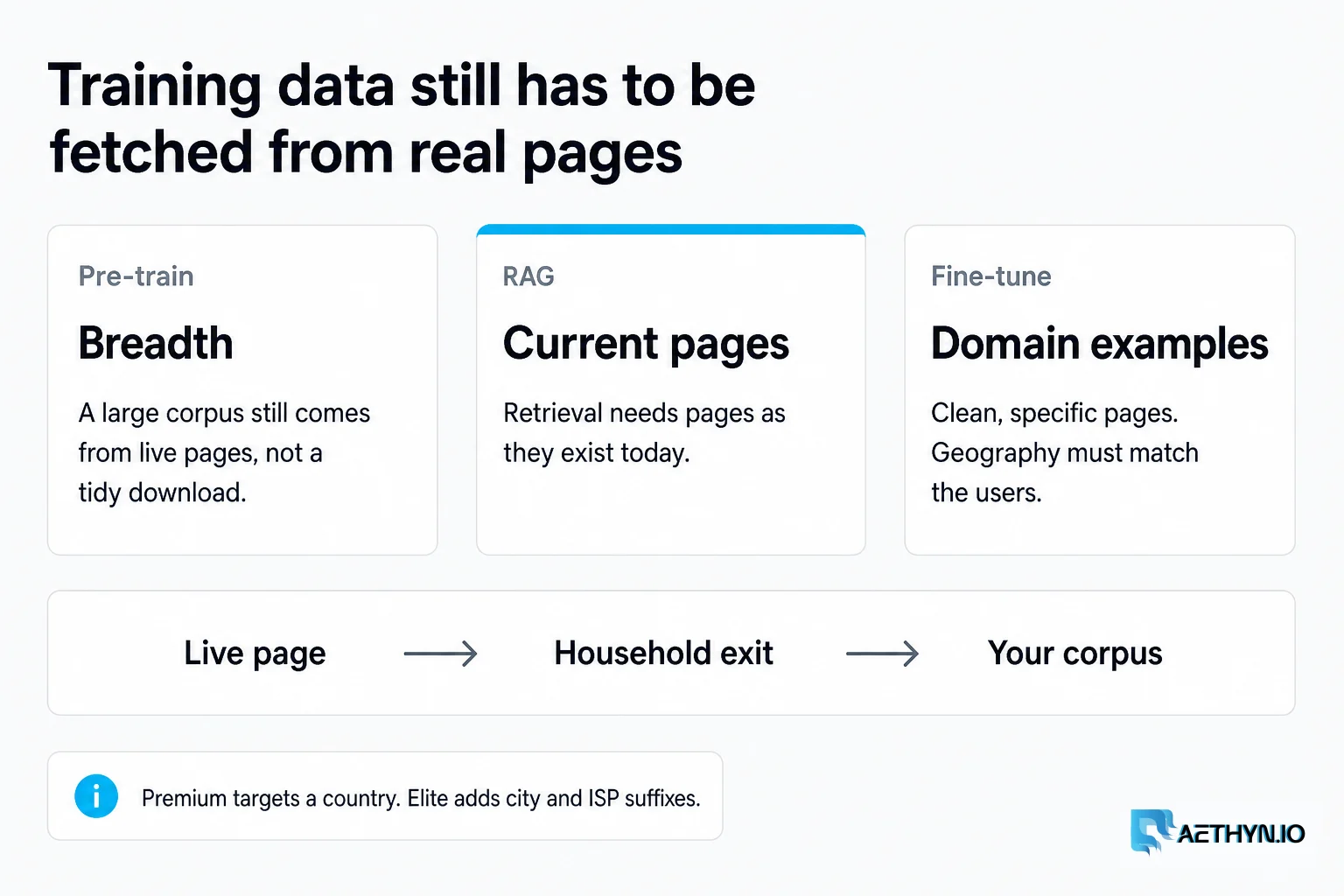
That is where the friction starts. Collect a few thousand pages from a datacenter IP and you're fine. Collect a few million, across thousands of domains, on a schedule, and you hit the wall every serious data team hits: datacenter IP ranges are known and rate-limited or blocked outright. Their ASNs are public, and anti-bot systems treat traffic from AWS, GCP, or a hosting provider as guilty until proven otherwise.
A residential proxy routes the request through a real consumer connection, so the target sees an ordinary visitor rather than a server farm. For AI data work, two properties matter most:
- Reputation. The IP has a history of normal human browsing, so it isn't pre-flagged.
- Geography. A model meant to serve US users should learn from what US visitors actually see. Prices, search results, availability, and even article copy vary by country. Collecting German SERPs from a US IP quietly poisons your dataset. Geo-targeted residential exits let you sample the web as your users experience it.
If this is your use case, the end-to-end playbooks are collecting web data for AI training and building LLM training datasets.
2. The web now defends itself with machine learning
Here is the part that actually changed. Five years ago, bot detection was mostly static rules: block this user-agent, rate-limit this IP, require this cookie. Today the leading anti-bot vendors — Cloudflare Bot Management, DataDome, Akamai, Kasada, PerimeterX — run machine-learning models that score every request against dozens of signals in real time. The web didn't get AI-proof scrapers; it got AI-powered defenders.
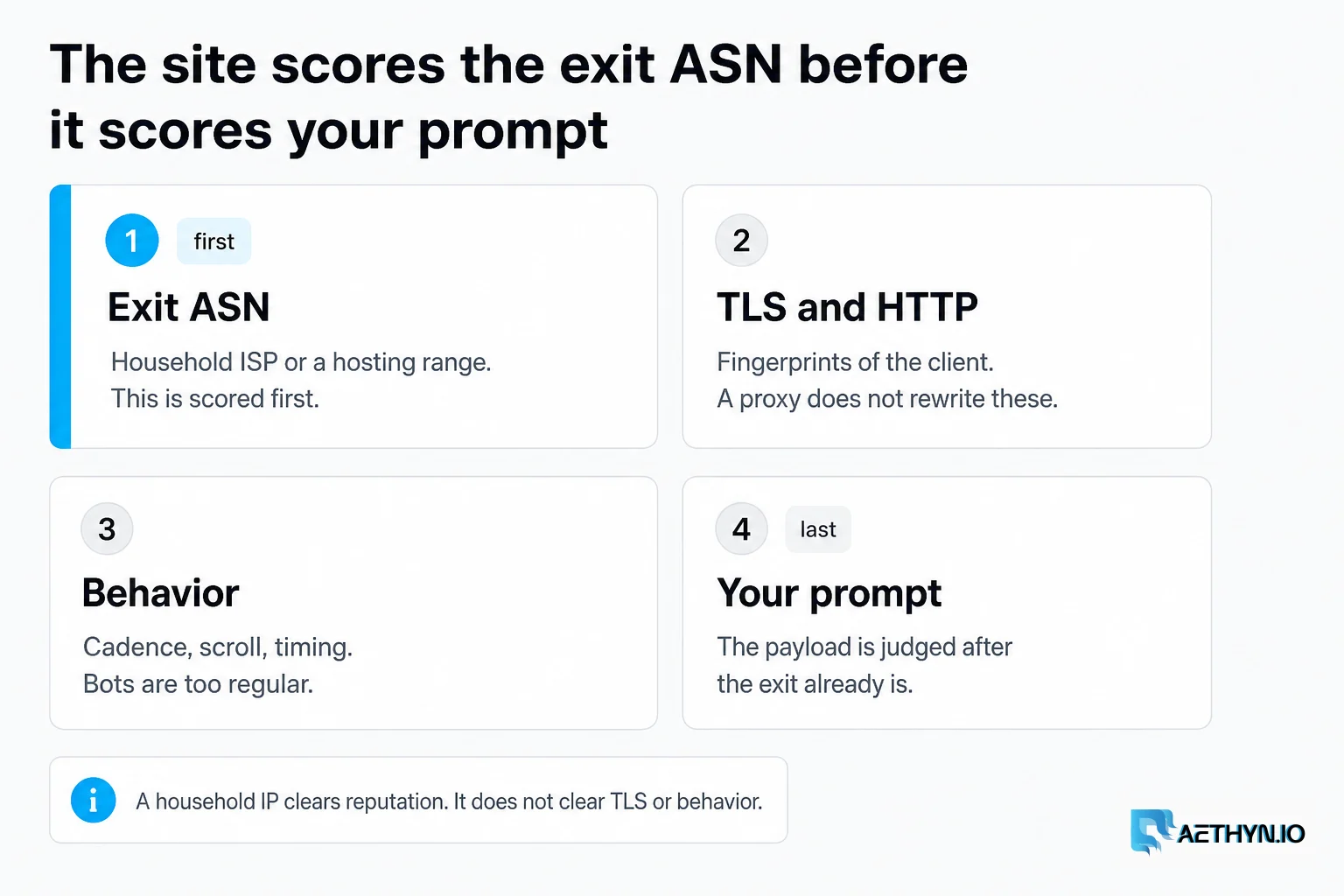
What those models look at:
- TLS fingerprints (JA3/JA4). The exact way a client negotiates TLS — cipher order, extensions — is a fingerprint. A Python HTTP call and real Chrome look nothing alike at the TLS layer, and the model knows it.
- HTTP/2 fingerprints. Frame settings and header order leak your client library even when your visible headers look human.
- Behavioral signals. Request cadence, mouse movement, scroll depth, timing between actions. Bots are too regular.
- IP reputation. Where the request originates and whether that IP has behaved like a human before — which loops straight back to why residential IPs matter.
The important consequence: a 200 OK is no longer proof of success. Modern defenses "soft-block" — they serve a page that looks fine but is actually a decoy, a stripped response, or a challenge, all with a 200 status. If your pipeline counts HTTP status codes as success, your model is being trained on garbage without you knowing. (That is exactly why a serious proxy benchmark asserts on content, not status codes.)
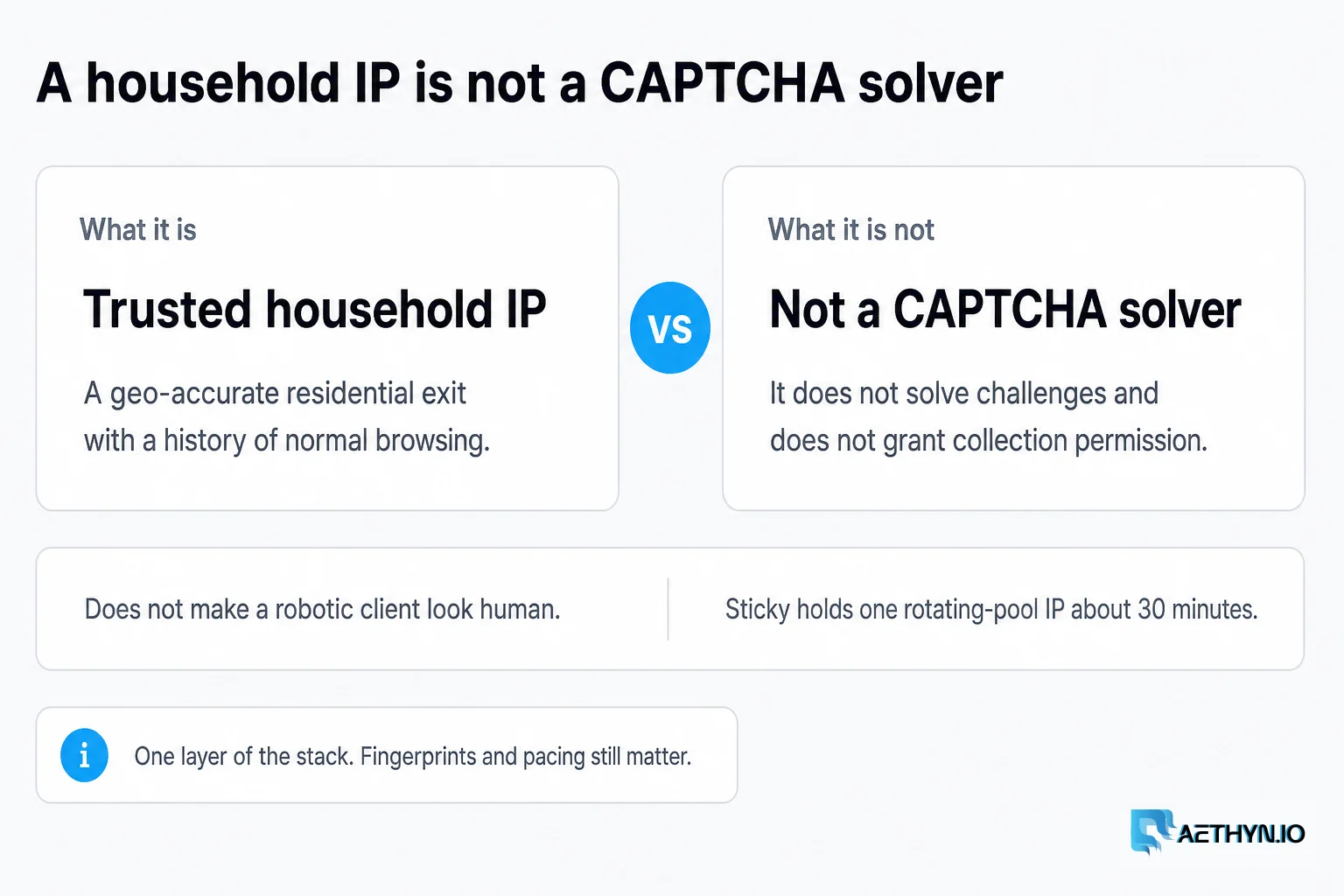
A residential IP with good reputation clears the IP signal, but not the others by itself. You still need a client that presents a realistic fingerprint and behaves at a human pace. Proxies are one layer of the stack, not the whole stack — see how to scrape behind Cloudflare and how to prevent IP blocking for the full picture, plus the fingerprinting and anti-bot system glossary entries for the underlying concepts.
3. AI agents are becoming a first-class client of the web
The newest shift isn't about training data at all — it's about inference. Autonomous AI agents now browse the web to do real work: compare prices, gather sources, book travel, fill carts, monitor listings. From the target site's perspective, an agent looks exactly like… a bot. It meets the same geo-walls, the same rate limits, and the same ML anti-bot models as any scraper.
That makes proxies quietly essential infrastructure for anyone deploying agents at scale:
- Stable identity per task. An agent running a multi-step task (log in, navigate, extract, act) can't have its IP rotate mid-session — that trips security checks. A sticky session pins one residential IP for the life of the task, then rotates for the next.
- Geography that matches intent. An agent booking a hotel "in Tokyo for a Japanese user" needs to see Japanese pricing and availability — which means a Japanese exit IP.
- Graceful backoff. Agents fan out fast and can hit a target far harder than a human. Respecting rate limits (and robots.txt) isn't just courtesy — it's what keeps the identity trustworthy.
Most teams building agents discover the proxy layer the hard way, after their first fleet gets blocked in an afternoon. Designing it in from the start is far cheaper than retrofitting it.
What this actually means if you're building
Strip away the hype and the takeaways are simple:
- Use residential egress for anything touching a defended target at scale — AI data collection and agent traffic both qualify. Datacenter IPs are fine (and cheaper) for open APIs and your own infrastructure, so don't over-buy.
- Match geography to intent. Train and act on the web your users actually see.
- Validate content, not status codes. Build soft-block detection into your pipeline or your model learns from decoy pages.
- Treat the proxy as one layer. Realistic client fingerprints, human-paced behavior, and honest rate limits do the rest.
- Rotate deliberately. Sticky sessions for stateful tasks; fresh IPs for independent requests. Rotating IPs correctly is a strategy, not a toggle.
The honest limits
Proxies are not magic, and anyone selling them as an AI cure-all is the buzzword problem. A residential proxy gives you a trusted, geo-accurate IP. It does not solve CAPTCHAs, it does not grant permission to collect data, and it does not make an obviously-robotic client look human on its own. Collection still has to respect a site's terms, robots.txt, and applicable law — see our guide to legal and ethical scraping. Used responsibly, proxies are the access layer that lets legitimate AI work happen at scale. That's the real intersection — no self-healing networks required.
Where Aethyn fits: our Elite residential pool carries the highest-reputation exits for hard, ML-defended targets, while Premium keeps large-volume collection cost-efficient. Both support geo-targeting and sticky sessions out of the box. Compare Premium and Elite, or start with the beginner's guide to residential proxies.
Common questions about this article
Do I need residential proxies to collect AI training data?
Why do datacenter proxies get blocked when residential ones don't?
Can a proxy bypass CAPTCHAs or AI bot detection on its own?
What kind of proxy does an AI agent need?
Guides, integrations & docs
Continue reading
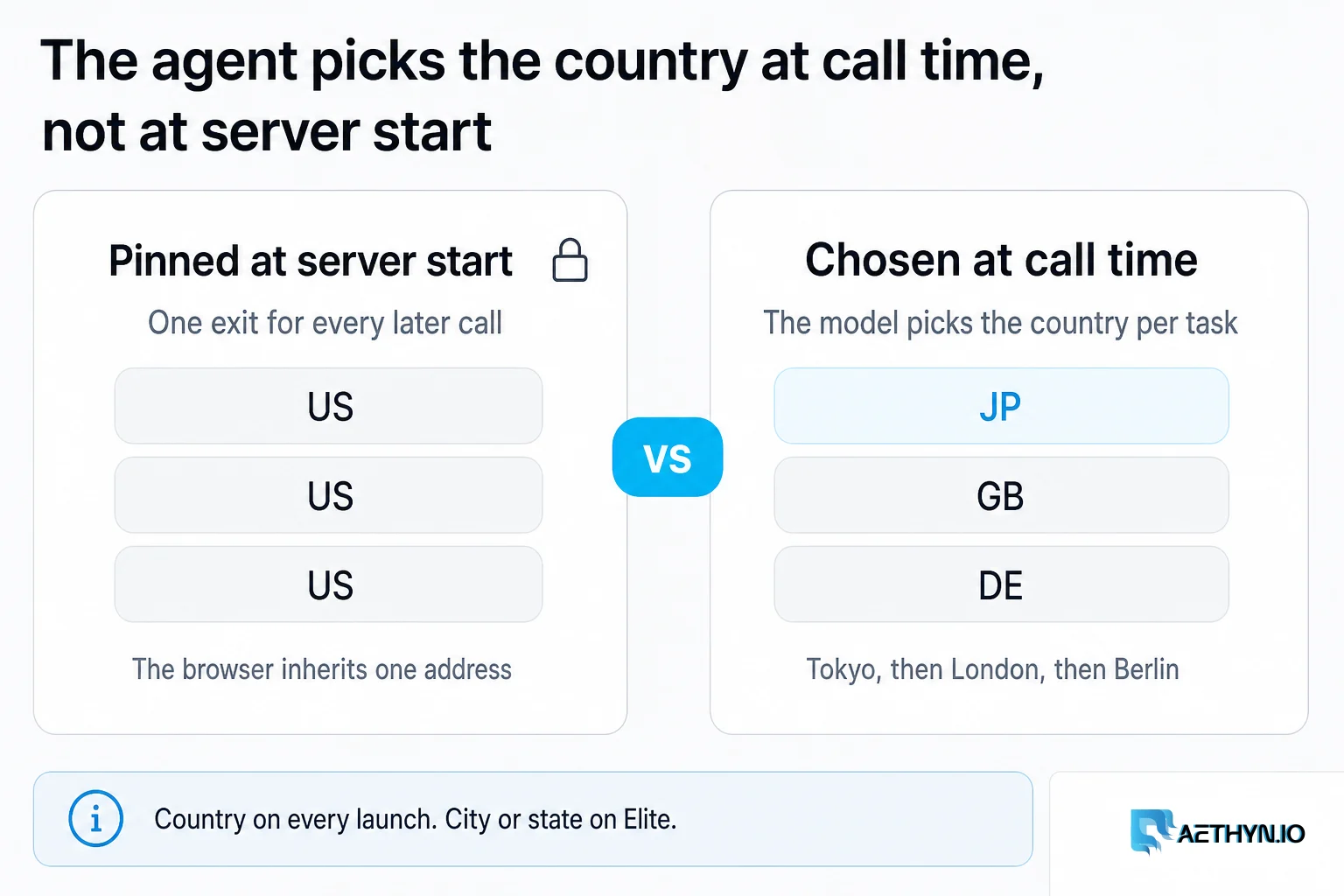
The Browser MCP Where the Agent Picks the Country
Most browser MCPs pin one exit at server startup or hide geo behind hosted infrastructure. Aethyn Browser MCP lets the AI agent choose the exit country and hold one sticky identity per task, at call time, then verify the exit actually landed before it trusts the page.
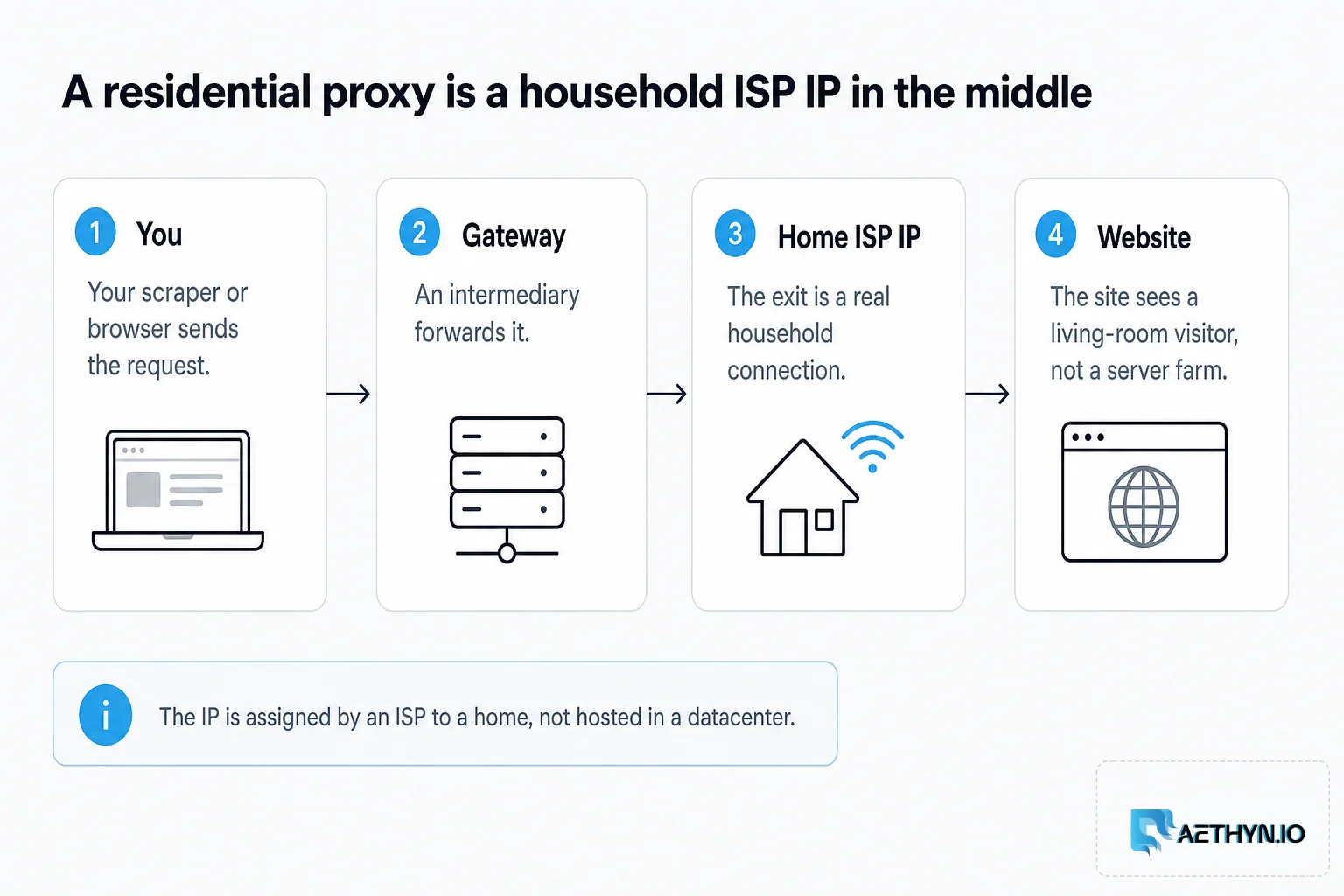
What Are Residential Proxies? Complete Beginner Guide (2026)
Learn everything about residential proxies: how they work, why they are more reliable than datacenter IPs, and how to use them for your business in 2026.
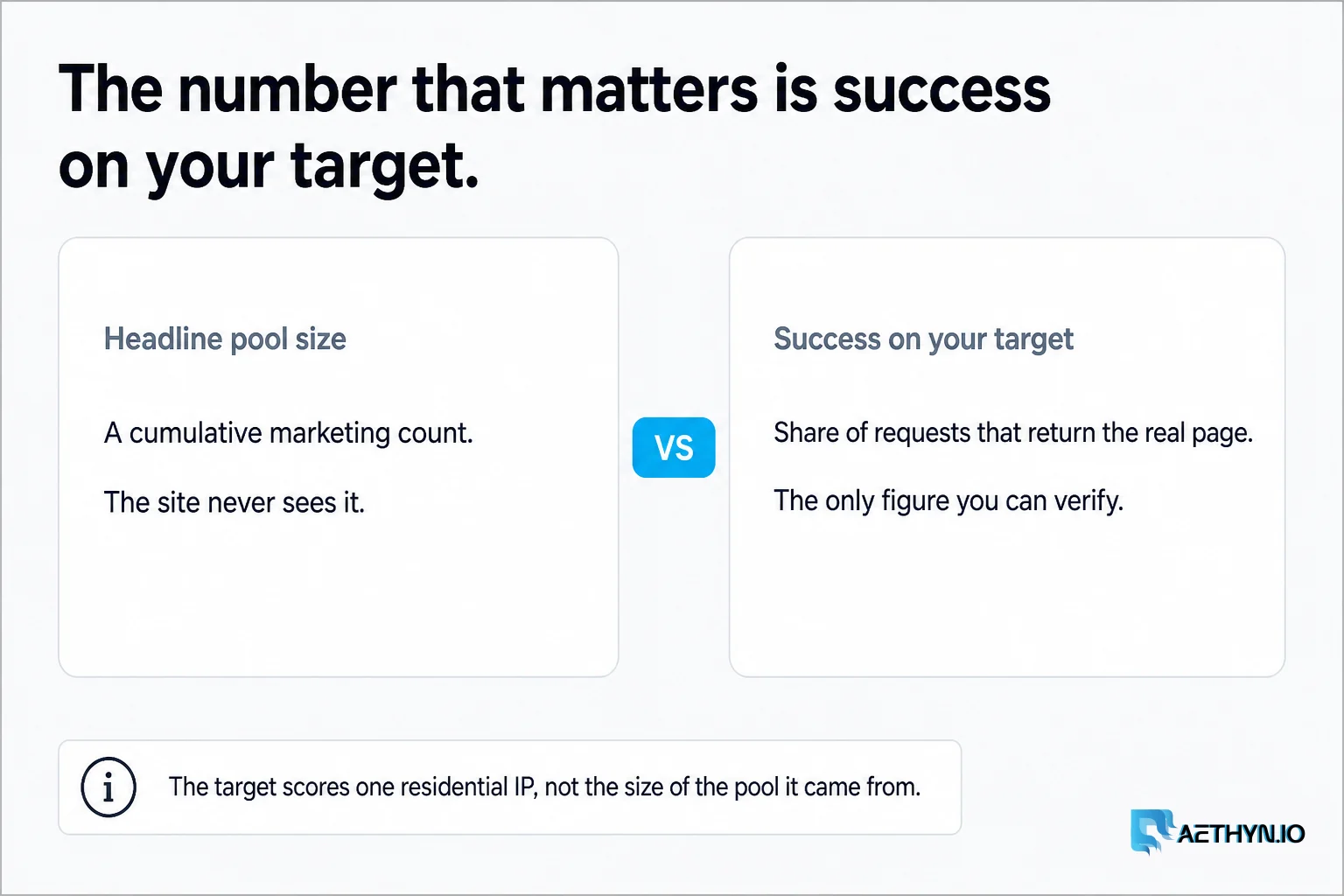
Residential Proxy Statistics 2026: Market Data & Network Trends
A data-driven look at the residential proxy market in 2026 — adoption, success rates, latency, pricing, and traffic patterns drawn from Aethyn network data and industry estimates.
Collect the web your AI needs — without the blocks
Geo-targeted residential IPs with sticky sessions and elite-reputation exits for the hard, ML-defended targets AI pipelines depend on.