

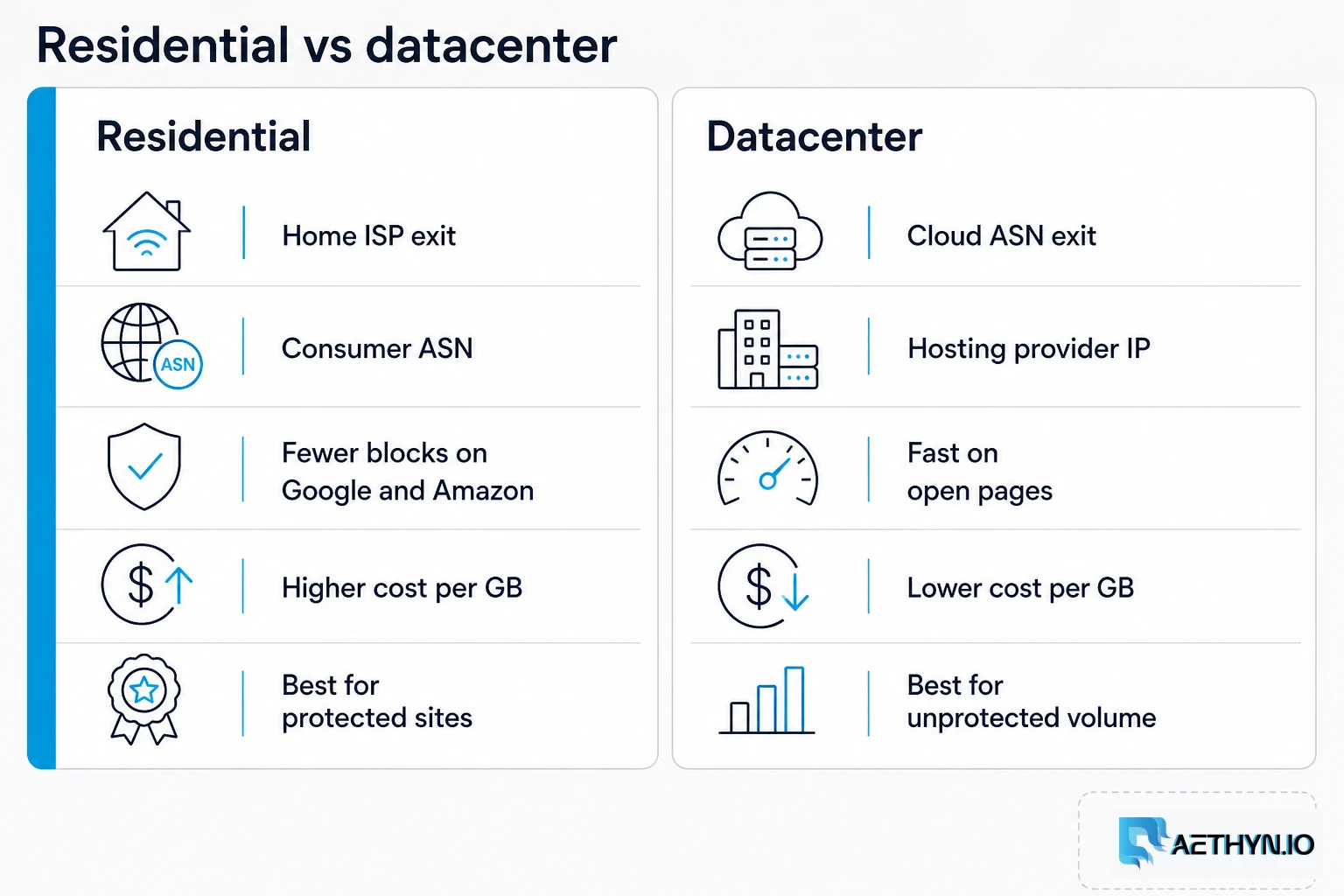
A residential proxy is a proxy that exits through an IP address an internet service provider assigned to a real household. A datacenter proxy is a proxy that exits through an IP address a hosting or cloud provider assigned to a server. That single difference — household ISP versus cloud ASN — is why one pool sails through a Google SERP and the other is blocked before the HTML arrives.
This guide is the routing decision, not a product catalog. Aethyn sells Premium and Elite residential only. Datacenter still belongs in many pipelines; we just do not sell it. If you are comparing sticker prices across vendors, read residential proxy pricing in 2026 next. If you are wiring a browser, jump to Playwright + residential proxies.
What is a residential proxy?
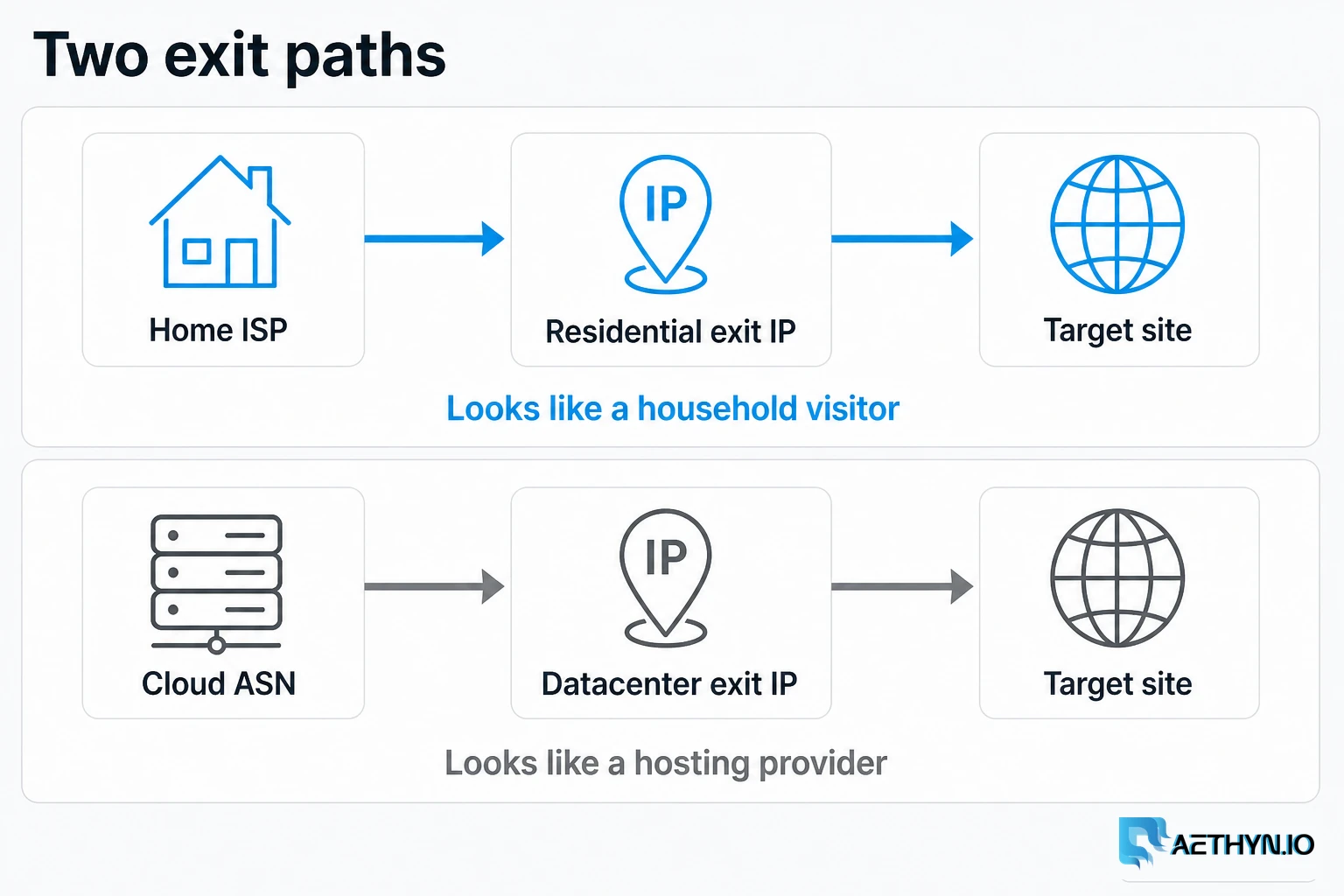
A residential proxy is a proxy whose exit IP belongs to a consumer ISP range — Comcast, BT, Deutsche Telekom, NTT — rather than Amazon, Hetzner, or DigitalOcean. The destination website sees a request that looks like a person at home. Reputation databases, ASN blocklists, and CDN bot scores are built around that distinction. They cannot cheaply block every Comcast subscriber in Ohio without collateral damage to real shoppers, so they score residential exits more gently and lean on behaviour, TLS, and cookies for the rest of the decision.
That is why residential traffic is the default for SERP tracking, ad verification, marketplace collection, and social workflows. It is also why it costs more: the network is assembled from opted-in peers and KYC-verified partners, not from a rack you already own. Aethyn meters that traffic per byte on two reputation tiers. Premium is the volume pool with country targeting; Elite adds city and ISP targeting for the targets that score the exit more aggressively. Both speak HTTP and SOCKS5 from proxy.aethyn.io on dedicated ports, with rotation by default and sticky sessions when a login or cart must hold one IP.
See the residential proxy glossary entry for the one-sentence definition, and the beginner guide if you are new to the product.
What is a datacenter proxy?
A datacenter proxy is a proxy whose exit IP lives in a hosting or cloud autonomous system. The hardware is fast, the path is short, and the unit price is low — often billed per IP rather than per gigabyte. Those properties make datacenter the correct tool for unprotected public pages, your own properties, uptime checks, and bulk crawls where the destination does not run a serious bot program.
The same properties make it a poor fit for defended sites. Anti-bot vendors publish datacenter ASN lists. Cloudflare, Akamai, DataDome, and Kasada can classify an AWS or Hetzner range in the handshake, before they look at headers. Success rates that look fine on a marketing site collapse on Google, Amazon, Instagram, or a Cloudflare-proxied retailer. Rotating faster inside the same ASN rarely helps: the reputation is on the range, not on the individual address. That is the moment teams "switch to residential" — not because datacenter is fake, but because it is the wrong trust class for that target.
Aethyn does not sell datacenter proxies. If you need them, buy them from a datacenter vendor and keep this page as the rule for when to escalate the failing slice. Our datacenter provider roundup exists to mark that hand-off, not to pretend we run a DC pool.
Why anti-bot systems treat the two ASNs differently
Every request arrives with an origin ASN. Reputation products (MaxMind, IPinfo, the CDN's own tables) already know which ASNs are consumer ISPs and which are hosting. Datacenter ranges are shared across thousands of scrapers, so a single noisy neighbour can poison the subnet for everyone. CDNs therefore pre-discount those ranges: a clean TLS fingerprint on a Hetzner IP still starts from a hole. Residential ranges are mixed with real humans. Blocking them wholesale is expensive, so the CDN spends its budget on behaviour — velocity, header order, cookie reuse, JA3/JA4 — instead of on the IP alone.
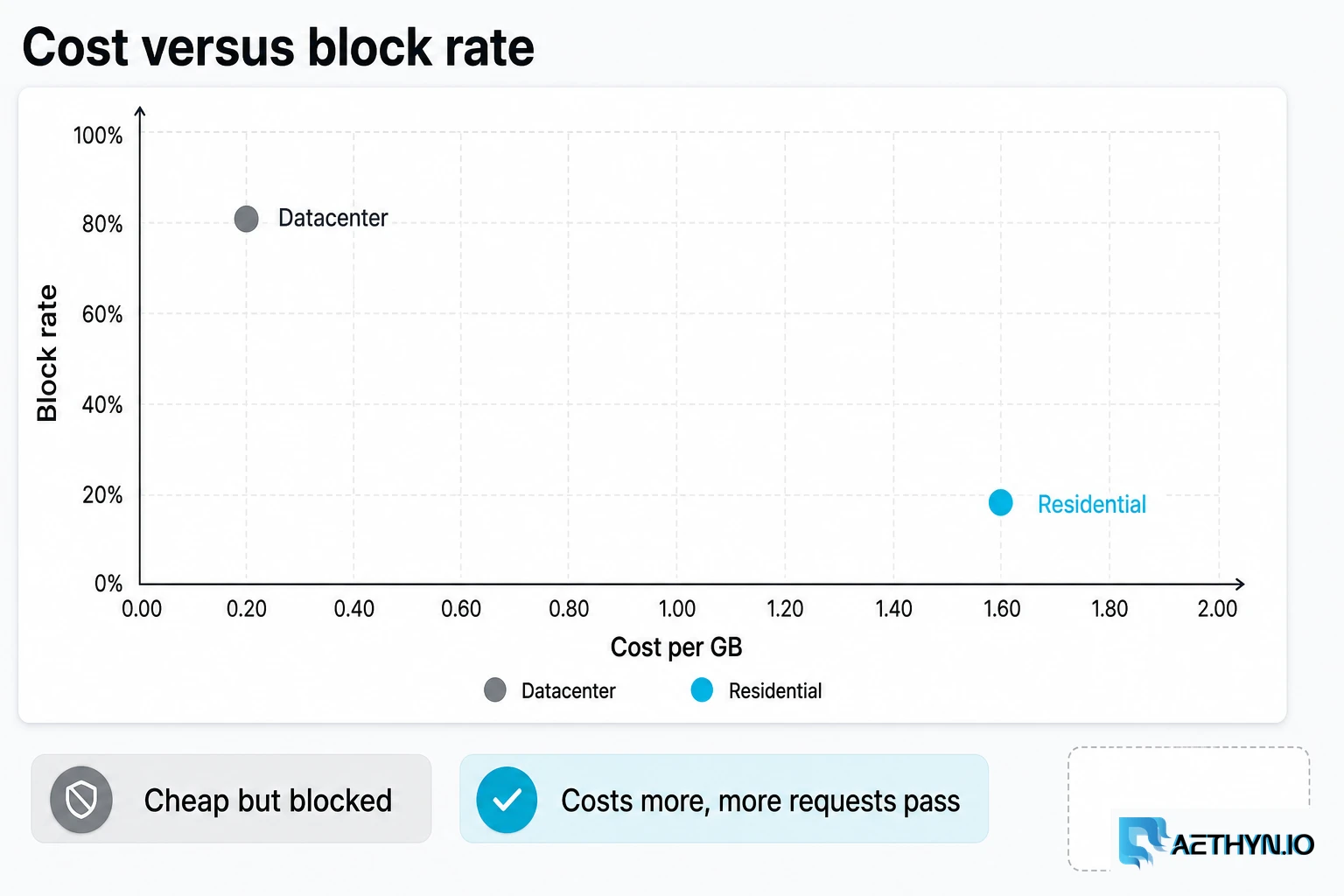
That is why a datacenter pool can return 20–40% usable pages on a Cloudflare site while a residential pool on the same URL returns 90%+, and why the cheap pool is not actually cheap once you count retries, CAPTCHA HTML, and soft-blocked 200s. Industry ranges, not a lab claim: unprotected sites are a wash; standard e-commerce splits toward residential; social, retail, and search almost always require it. Treat the table below as directional. Measure on your URLs with content asserts, then compute cost per successful request before you lock a vendor.
Success rate by target class (industry ranges)
These bands are compiled from public 2025–2026 vendor write-ups and operator reports, not from a single Aethyn lab run. Use them to pick a starting pool, then replace them with your own content-verified rates.
| Target class | Residential (typical) | Datacenter (typical) |
|---|---|---|
| Unprotected / first-party | 99%+ | 99%+ |
| Standard e-commerce | 90–98% | 60–80% |
| Cloudflare-protected | 90–96% | 20–40% |
| Social platforms | 85–95% | 10–30% |
| Search / SERP | 85–95% | Poor — often unusable |
| Limited-drop retail | 75–90% | 5–15% |
(Industry estimates. A 200 with a challenge body is a failure.)
A Playwright scraper with a datacenter exit and a perfect stealth plugin still fails the ASN check. Pairing a residential exit with requests and no TLS impersonation fails the fingerprint check. You need both layers on hard targets; see TLS fingerprinting for scrapers and the Playwright guide.
Speed, cost, and geo
Datacenter latency is usually 1–20 ms to nearby origins; residential adds the last-mile path of a home connection, often 50–200 ms. For HTML collection that difference is noise next to parse time. For streaming or thousands of tiny API calls per second, it is not.
Cost models also diverge. Datacenter is commonly sold per IP per month. Residential is sold per GB. Aethyn Premium is €2.90/GB at 1–15 GB and €2.00/GB at 90 GB+; Elite is €6.50/GB down to €4.50/GB. PAYG is a flat +10% and does not expire. We publish the ladder on /pricing. Datacenter stickers look smaller until a 30% success rate triples the bytes you actually burn. That arithmetic lives in the pricing article.
Geo is the third split. Datacenter "cities" are cities that host racks. Residential cities are cities where people live. Ad verification, local SERPs, and store-level pricing need the second. Elite encodes city and ISP in the username; Premium is country-wide.
When to use datacenter, when to use residential
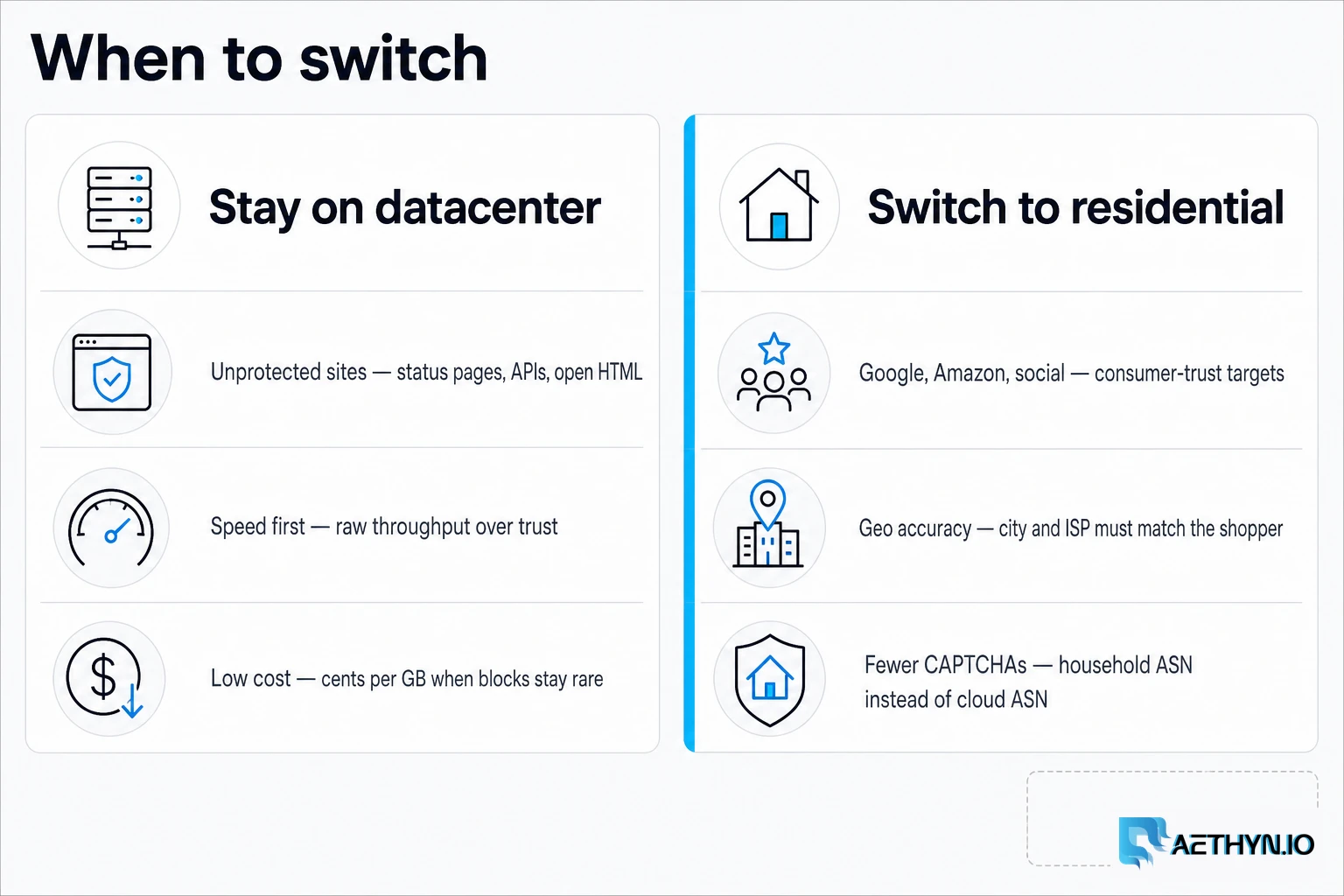
Use datacenter when the destination does not run a bot program, you control the origin, you are fetching robots-allowed sitemaps, or speed-per-dollar is the only KPI.
Use residential when the destination is Google, Amazon, a social network, a ticketing site, or anything behind Cloudflare / Akamai / DataDome / Kasada; when the page must match a real city; when a sticky identity must survive a login; or when datacenter success has already fallen below the cost-per-success threshold.
Do not "fix" a burned datacenter ASN by buying a second datacenter vendor in the same cloud. Change trust class.
Hybrid routing (the production default)
Most teams should not pick one pool for the whole crawl. Split by URL class. Send product listing pages on a lightly defended catalog through datacenter. Send the product detail pages, the SERP, and the checkout-adjacent views through residential. One parser, two exits, one success budget.
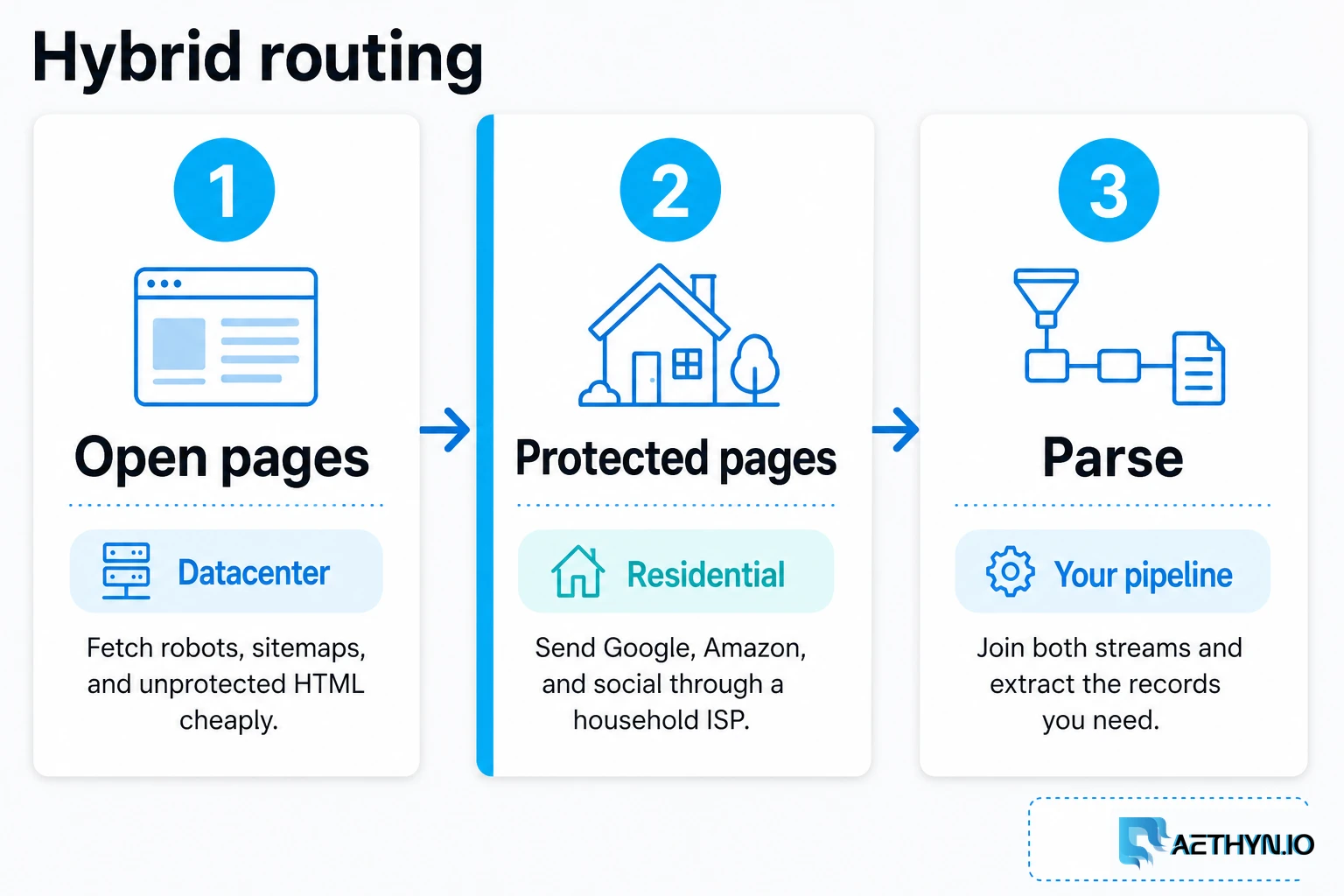
In Aethyn that second hop is a username change, not a new vendor. aethyn-XXXXX-country-us on port 2099 (Premium HTTP) or 5499 (Elite HTTP). Sticky: add -session-ID-lifetime-N (1–1440 minutes, default 30). Playwright, Scrapy, and Requests all consume the same credential. That is the point of a proxy-only product: you already have the scraper.
If you are leaving an enterprise platform rather than a datacenter pool, the choice is different — Bright Data and Oxylabs alternatives covers proxy-layer versus full-stack.
Comparison summary
| Metric | Datacenter | Residential |
|---|---|---|
| IP source | Cloud / hosting ASN | Consumer ISP / household |
| Trust with CDNs | Low | High |
| Typical latency | Very low | Higher (last mile) |
| Billing | Often per IP | Per GB (Aethyn: per byte) |
| Geo granularity | Rack cities | Country; city/ISP on Elite |
| Best for | Unprotected volume | Defended targets, SERP, social, retail |
| Aethyn SKU | Not sold | Premium + Elite |
Common questions about this article
What is the difference between residential and datacenter proxies?
Which is better, residential or datacenter proxies?
Are datacenter proxies vs residential a speed or a block-rate tradeoff?
Does Aethyn sell datacenter proxies?
When should I switch from datacenter to residential proxies?
Are residential proxies the same as ISP or static residential proxies?
Guides, integrations & docs
Continue reading
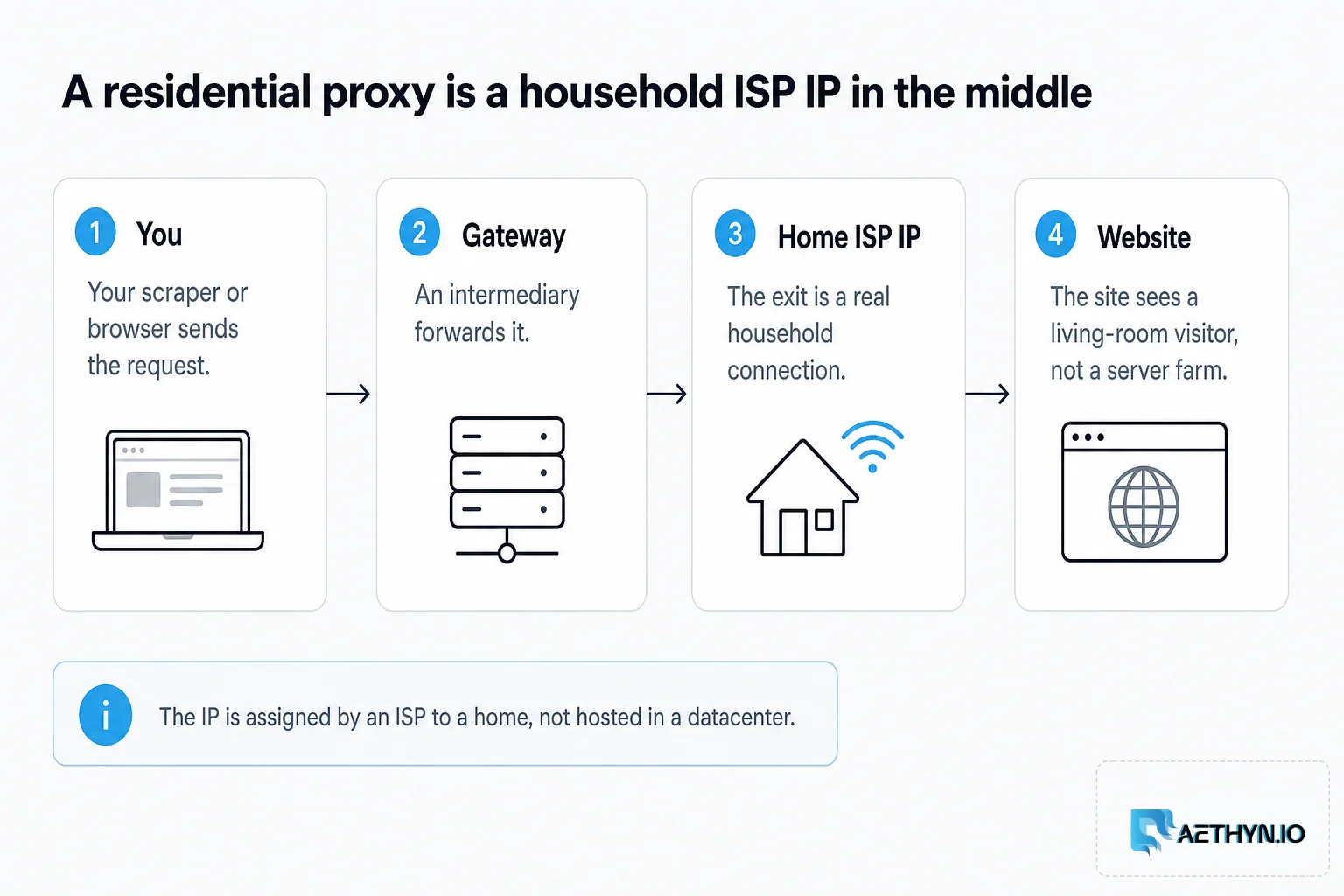
What Are Residential Proxies? Complete Beginner Guide (2026)
Learn everything about residential proxies: how they work, why they are more reliable than datacenter IPs, and how to use them for your business in 2026.
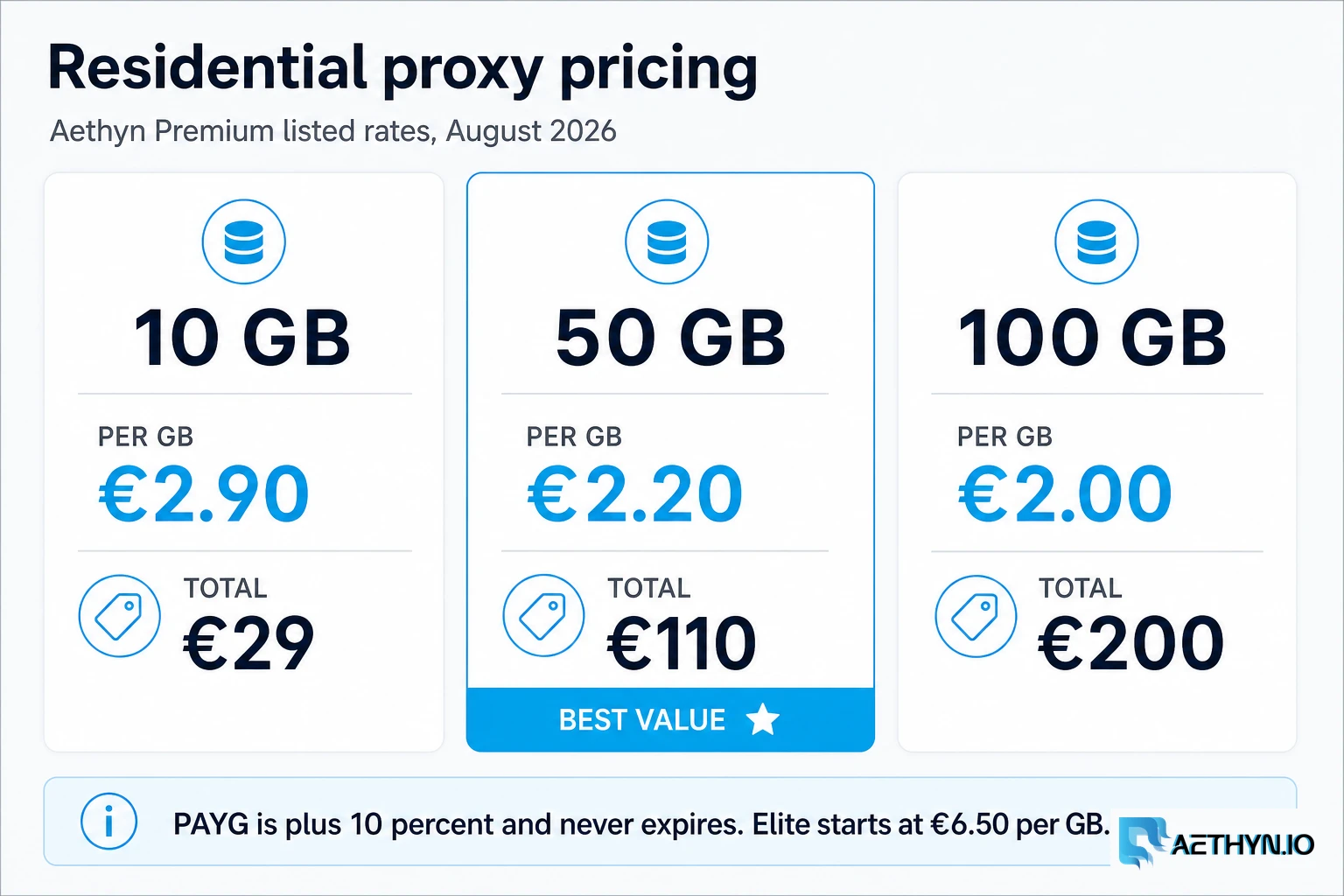
Residential Proxy Pricing in 2026: What You Actually Pay per GB
Residential proxy pricing is the published euros or dollars you pay per gigabyte of household-ISP traffic. Here is a dated 10 / 50 / 100 GB sticker table — then why sticker is not the bill.
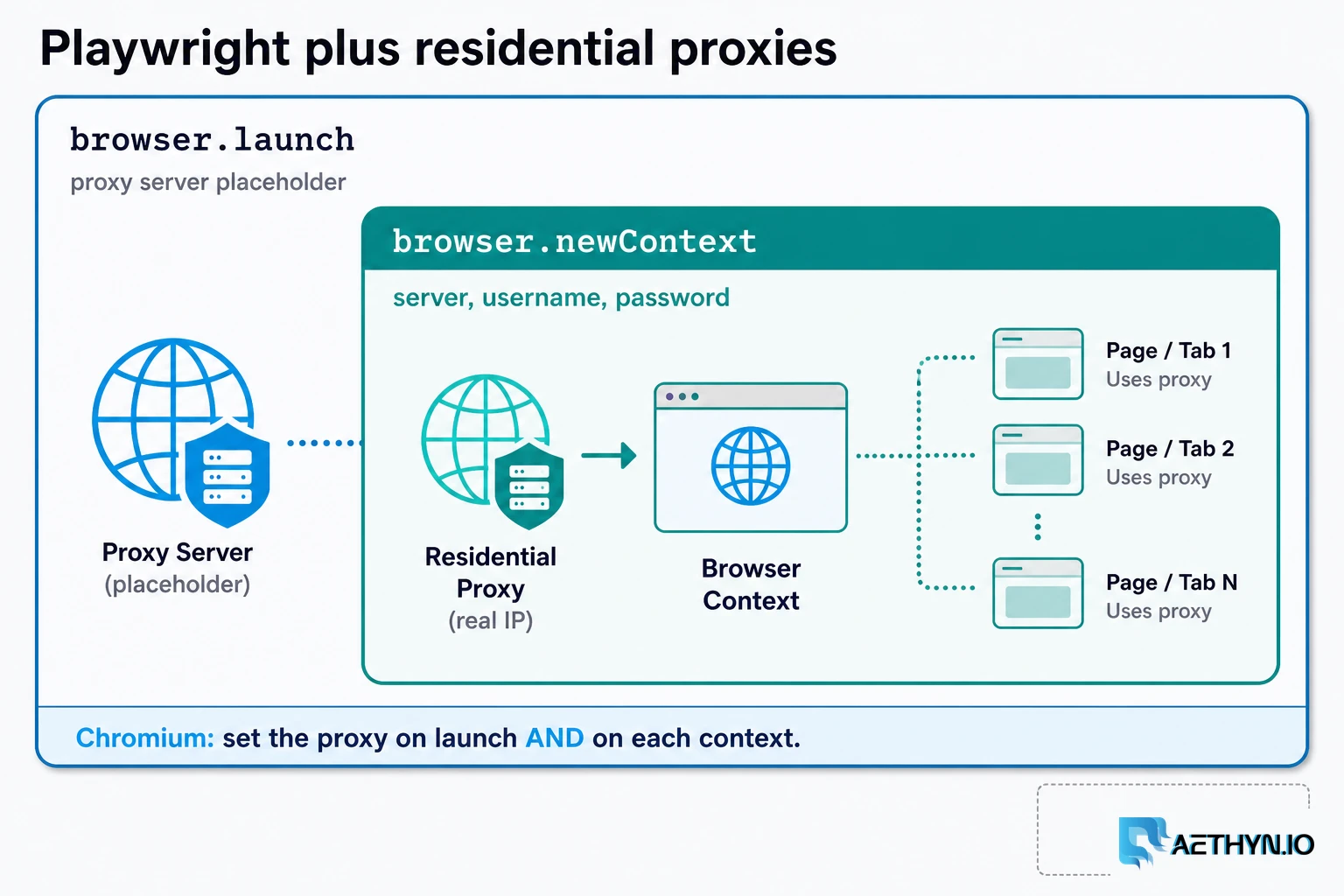
How to Use Residential Proxies with Playwright (2026)
A Playwright residential proxy is a browser context whose traffic exits through an ISP-assigned household IP. Credentials go in fields, rotation is a new context, and locale must match the exit.
Premium or Elite residential proxies
Join developers scaling scraping and automation with Aethyn Premium and Elite pools from €2.00/GB.