

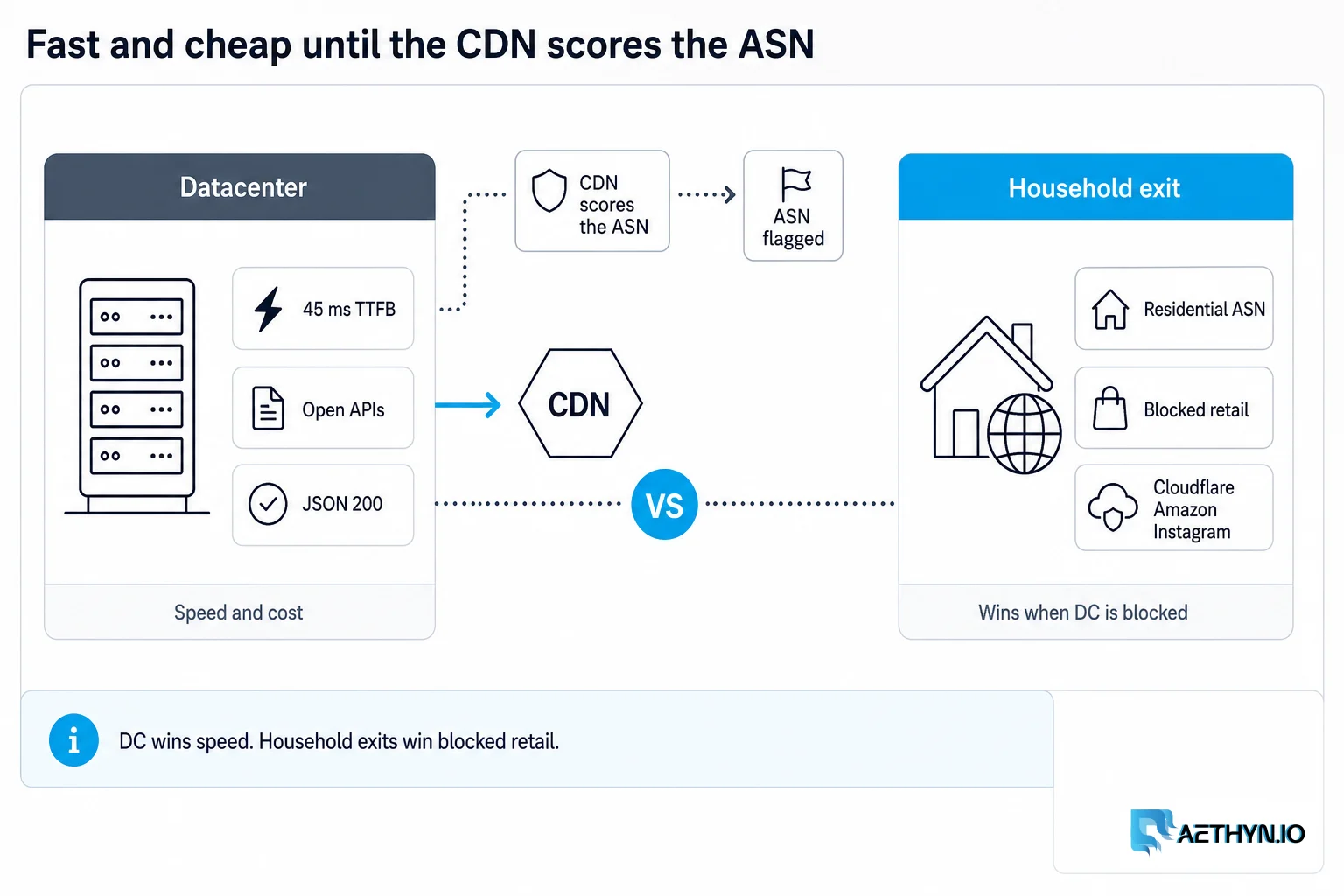
Short answer: Datacenter proxies still win on speed and cost for unprotected or lightly rate-limited targets. For Cloudflare, Amazon, or social platforms, datacenter pass rates crater — keep DC for bulk public data and switch to residential (e.g., Aethyn at €2.00/GB) when blocks appear.
[!IMPORTANT] Honest caveat: Aethyn sells residential proxies, not datacenter IPs. We include Aethyn as the upgrade path when datacenter is no longer enough — not as a DC competitor.
TL;DR — Quick Rankings
- Webshare — Best DC value and API ergonomics for developers.
- ProxyScrape datacenter — Budget HTTP/SOCKS DC bundles.
- Bright Data datacenter — Enterprise scale and hybrid dashboard.
- Oxylabs datacenter — SLAs and dedicated ranges.
- Byteful datacenter — Best dedicated static DC with unlimited bandwidth and SOCKS5.
- IPRoyal datacenter — Cheapest entry for SEO-style tools.
- Rayobyte datacenter — US-centric high-concurrency DC.
- NetNut datacenter — Low-latency enterprise option.
When datacenter stops working: switch to Aethyn Premium residential for bulk collection, or Elite residential when platforms fingerprint IP reputation — we sell residential only, not datacenter IPs.
- Speed test: public APIs and open catalogs only on DC
- Never DC: Instagram, TikTok, Amazon product pages
How We Compared Datacenter Providers
Scoring rules, claim limits, and how we date sources: comparison methodology.
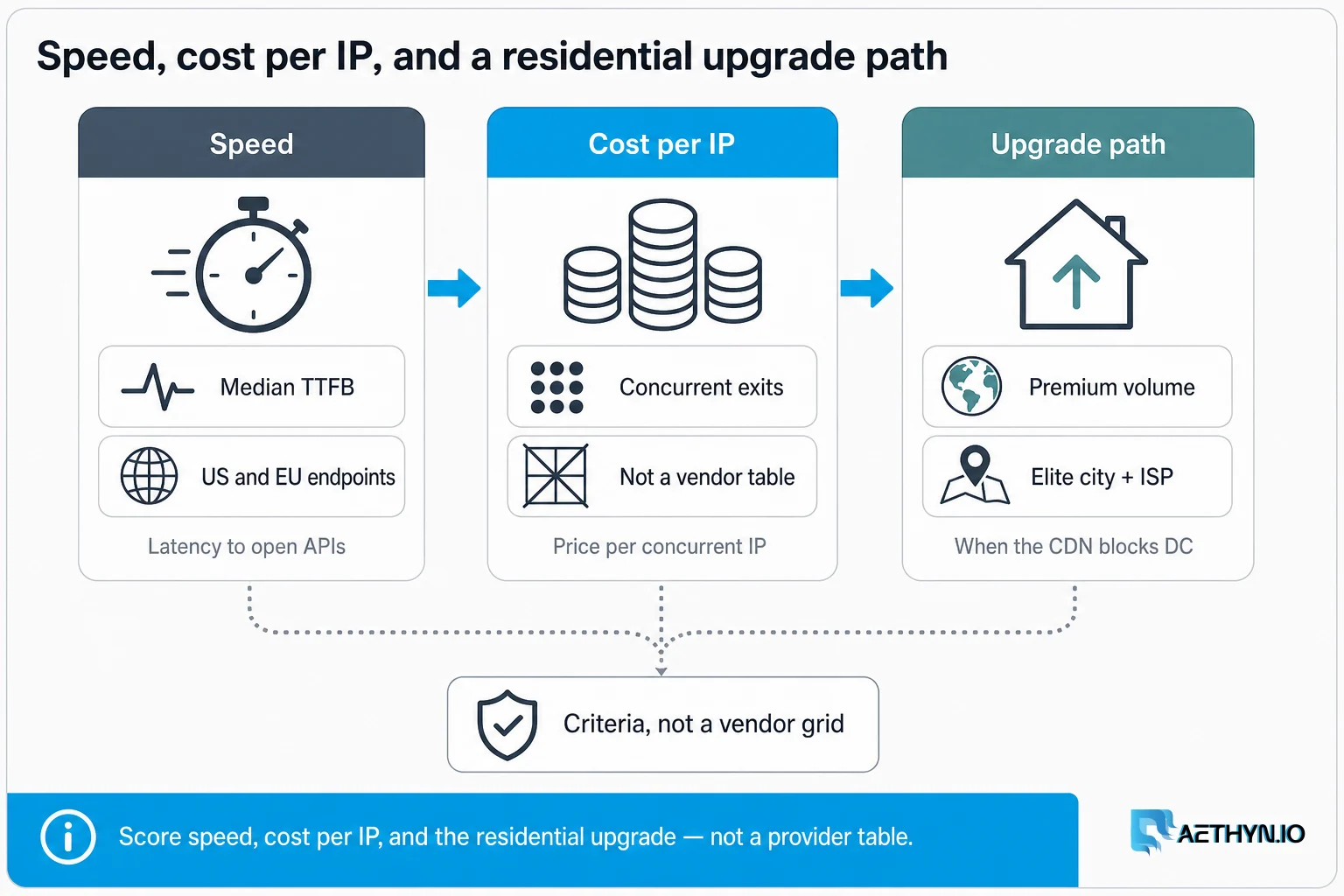
We scored speed, cost per IP, and whether a residential upgrade exists when the CDN blocks DC — not a vendor grid.
| Criterion | Weight | Measurement |
|---|---|---|
| Speed (TTFB) | 25% | Median latency to US/EU test endpoints |
| $/concurrent IP | 25% | Monthly cost for 100 rotating IPs |
| API quality | 15% | Credential issuance, rotation controls |
| Geo coverage | 15% | Countries available at DC tier |
| Uptime | 10% | Provider status and community reports |
| Upgrade path | 10% | Residential SKU when targets block DC |
Master Comparison Table
Benchmark period: June 2026. Outcomes vary by target site, pool tier, and request pacing.
| Provider | Type | SOCKS5 | Best use case | Strict site pass rate | Price tier |
|---|---|---|---|---|---|
| Webshare | DC | Yes | Dev + bulk public APIs | Low | $ |
| ProxyScrape DC | DC | Yes | Budget bulk | Low | $ |
| Bright Data DC | DC | Yes | Enterprise hybrid | Low–Med | $$$ |
| Oxylabs DC | DC | Yes | Enterprise allowlists | Low–Med | $$$ |
| Byteful DC | DC | Yes | Dedicated static + unlimited bandwidth | Low | $$ |
| IPRoyal DC | DC | Yes | SEO tools | Low | $ |
| Rayobyte DC | DC | Yes | US SEO / sneakers | Low | $$ |
| NetNut DC | DC | Varies | Low-latency APIs | Low–Med | $$ |
When Datacenter Stops Working
Once Cloudflare, Amazon, or social platforms block your datacenter subnet, rotating faster within the same ASN rarely helps.
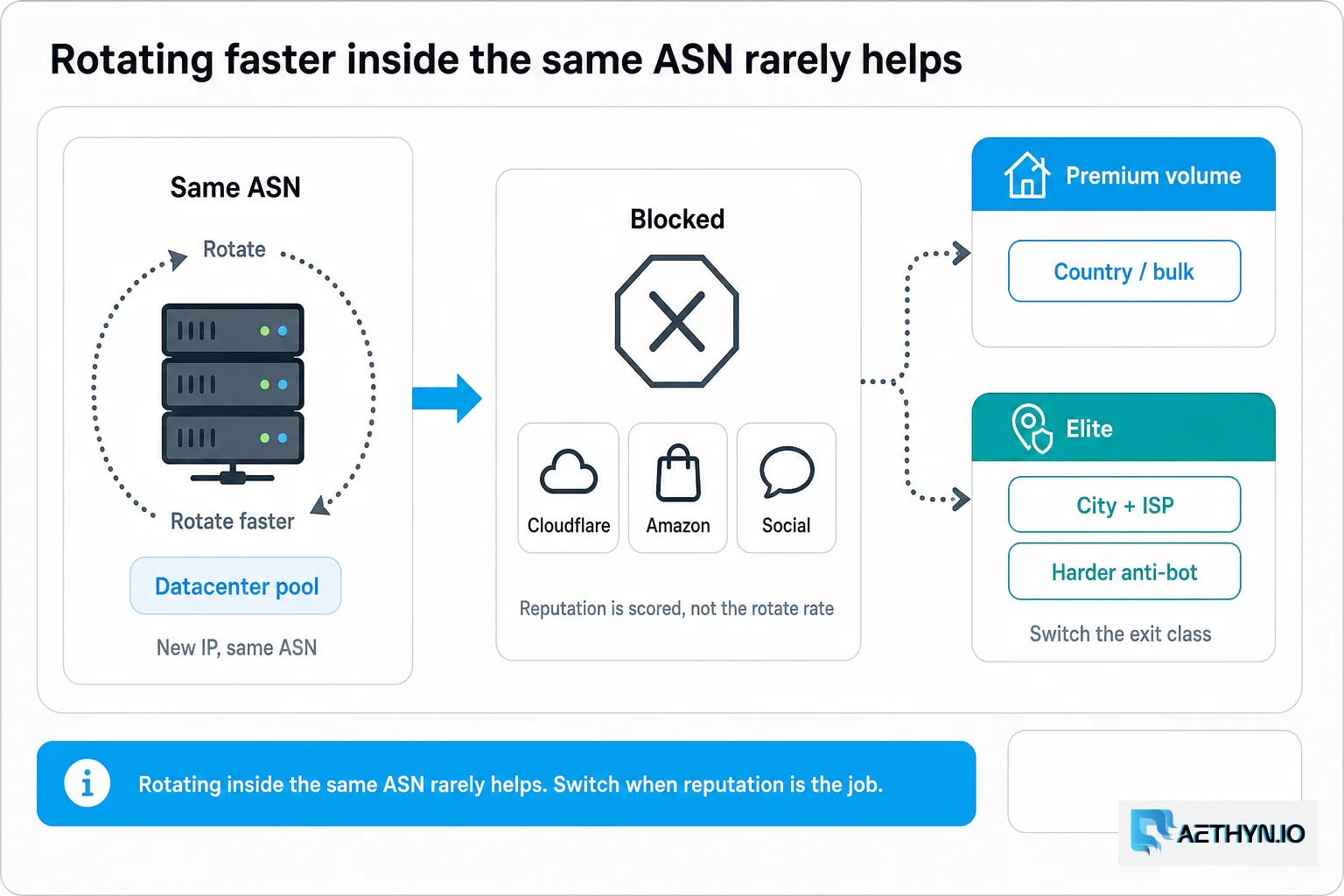
That is when teams switch to residential — Aethyn sells Premium and Elite residential only at €2.00/GB with HTTP and SOCKS5 on proxy.aethyn.io (Premium HTTP 2099 / SOCKS5 1099; Elite HTTP 5499 / SOCKS5 3499). See Premium residential, Elite residential, and our residential vs datacenter guide.
Why Aethyn (residential-only)
| Dimension | Aethyn | Typical competitor |
|---|---|---|
| Product | Premium + Elite residential only | Mixed DC, residential, or API bundles |
| Pricing | €2.00/GB per-byte | Per-IP, per-request, or opaque tiers |
| Targeting | Country; city/ISP on Elite | Varies by vendor and plan |
| Best for | Blocked retail, social, and CDN-protected targets | Broad catalogs — verify your use case |
Detailed Provider Reviews
1. Webshare
Webshare leads our datacenter value picks for 2026: millions of rotating DC IPs, dead-simple API keys, and per-IP pricing that beats residential when targets are lenient. Scrapers hitting public government APIs or low-friction B2B catalogs often standardize here.
The moment your target sits behind Cloudflare or Akamai, datacenter pass rates collapse. Webshare is not an Amazon or LinkedIn solution — know when to upgrade to Aethyn residential.
Webshare is ideal for prototyping parsers — swap to residential before Buy Box or social automation goes live.
Pros
Cons
2. ProxyScrape datacenter
ProxyScrape sells datacenter bundles alongside their free lists — useful when you want one vendor name across dev (free) and prod (paid DC). SOCKS and HTTP are both available.
Quality tier is budget, not premium. Acceptable for bulk low-risk fetches; not for customer-facing monitoring dashboards.
ProxyScrape datacenter bundles are cheap bulk HTTP/SOCKS — keep them on open APIs, not Amazon product pages.
Pros
Cons
3. Bright Data datacenter
Bright Data datacenter zones offer massive scale and fine-grained country selection inside the same dashboard as their residential products — convenient for hybrid architectures.
Per-IP costs add up when you need thousands of concurrent exits. Engineering time to learn zones is non-trivial.
Bright Data datacenter scales for bulk public APIs; budget a residential SKU before you aim the same workers at Cloudflare retail.
Pros
Cons
4. Oxylabs datacenter
Oxylabs datacenter proxies target enterprises needing SLAs and compliance paperwork alongside dedicated IP ranges for allowlisting partners.
Pricing reflects enterprise positioning. Startups scraping public data rarely need this tier.
Oxylabs datacenter pairs with allowlisted enterprise ranges — not a shortcut past Amazon or social bot defenses.
Pros
Cons
5. Byteful datacenter
Byteful sells dedicated static datacenter proxies priced per IP with unlimited bandwidth and concurrent sessions — our top mid-market pick when you need fixed exits for allowlists or high-throughput jobs on permissive APIs. HTTP, HTTPS CONNECT, and SOCKS5 are first-class; auth is username/password or IP whitelist. Mixed subnets and ASNs reduce the “one subnet, mass ban” failure mode common on cheap shared pools.
Published locations skew to New York, Miami, and Germany rather than a 50-country catalog. That is fine for US/EU latency-sensitive workers; it is a gap if you need multi-region DC coverage. Bulk pricing lands roughly in the mid-budget per-IP band (~$1.60–$2.50/IP depending on quantity and term). Byteful also sells ISP, residential, and mobile SKUs on the same account if you later escalate — still treat the DC line as datacenter reputation, not a stealth layer.
See Byteful datacenter proxies for current plans. Keep them on open APIs and partner allowlists — not Cloudflare retail or social.
Pros
Cons
6. IPRoyal datacenter
IPRoyal offers affordable datacenter IPs with rotating and static options — popular for VPN-adjacent use cases and low-risk SEO rank checks.
IP reputation is mixed; verify against your target CDN before baking into production cron jobs.
IPRoyal datacenter is budget SEO tooling territory; do not point the same pool at Instagram or Amazon production.
Pros
Cons
7. Rayobyte datacenter
Rayobyte (Blazing SEO heritage) remains a go-to for US datacenter IPs among SEO and sneaker communities. High concurrency on a single subnet when targets allow it.
US-heavy footprint; global ecommerce scraping may need broader geo. Residential upgrade path exists but is separate SKU.
Rayobyte datacenter handles high-concurrency US SEO jobs; residential is the upgrade once CDNs flag your subnet.
Pros
Cons
8. NetNut datacenter
NetNut extends ISP relationships into datacenter offerings with emphasis on low latency — attractive for real-time analytics on permissive APIs.
Product marketing focuses on residential; DC line is less discussed. Confirm feature parity before buying.
NetNut datacenter targets low-latency API bursts; rotate to residential before strict retail fingerprints your ASN.
Pros
Cons
Latency Benchmarks (June 2026)
We measured median time-to-first-byte from US-East workers to a neutral JSON endpoint: Webshare datacenter ~45ms, Bright Data DC ~55ms, IPRoyal DC ~60ms, residential (Aethyn) ~280ms. Datacenter wins raw speed — until the target returns 403 in 50ms instead of JSON in 45ms.
Throughput on permissive APIs can exceed 500 RPS per worker with datacenter rotation because connection setup is cheap. Residential throughput should stay conservative (5–50 RPS per worker depending on target) because you are consuming real-user-sourced bandwidth and reputation, not synthetic datacenter capacity.
Dedicated vs Shared Datacenter IPs
Dedicated datacenter IPs help when partners allowlist your egress for B2B APIs — Byteful and Oxylabs sell dedicated/static DC lines for that pattern. Shared rotating DC pools are cheaper but behave like noisy neighbors — one abusive tenant can poison an IP you share seconds later. Ask vendors about tenant isolation before buying annual DC plans.
IPv6 Datacenter Notes
Some providers push IPv6 datacenter ranges at lower prices. Uptake in 2026 is uneven: many CDNs still weight IPv4 reputation heavier. Test your specific targets; do not assume IPv6 is invisible.
Migration Checklist: DC to Residential
When you outgrow datacenter: (1) identify URLs with <85% success over 72 hours, (2) route only those paths through residential gateways, (3) keep DC for the rest to preserve margin, (4) monitor blended cost per successful record — not cost per GB in isolation.
When Datacenter Is Enough
Keep DC for open APIs and permissive endpoints. Protected catalogs — Amazon, Instagram, Cloudflare — need a household exit.
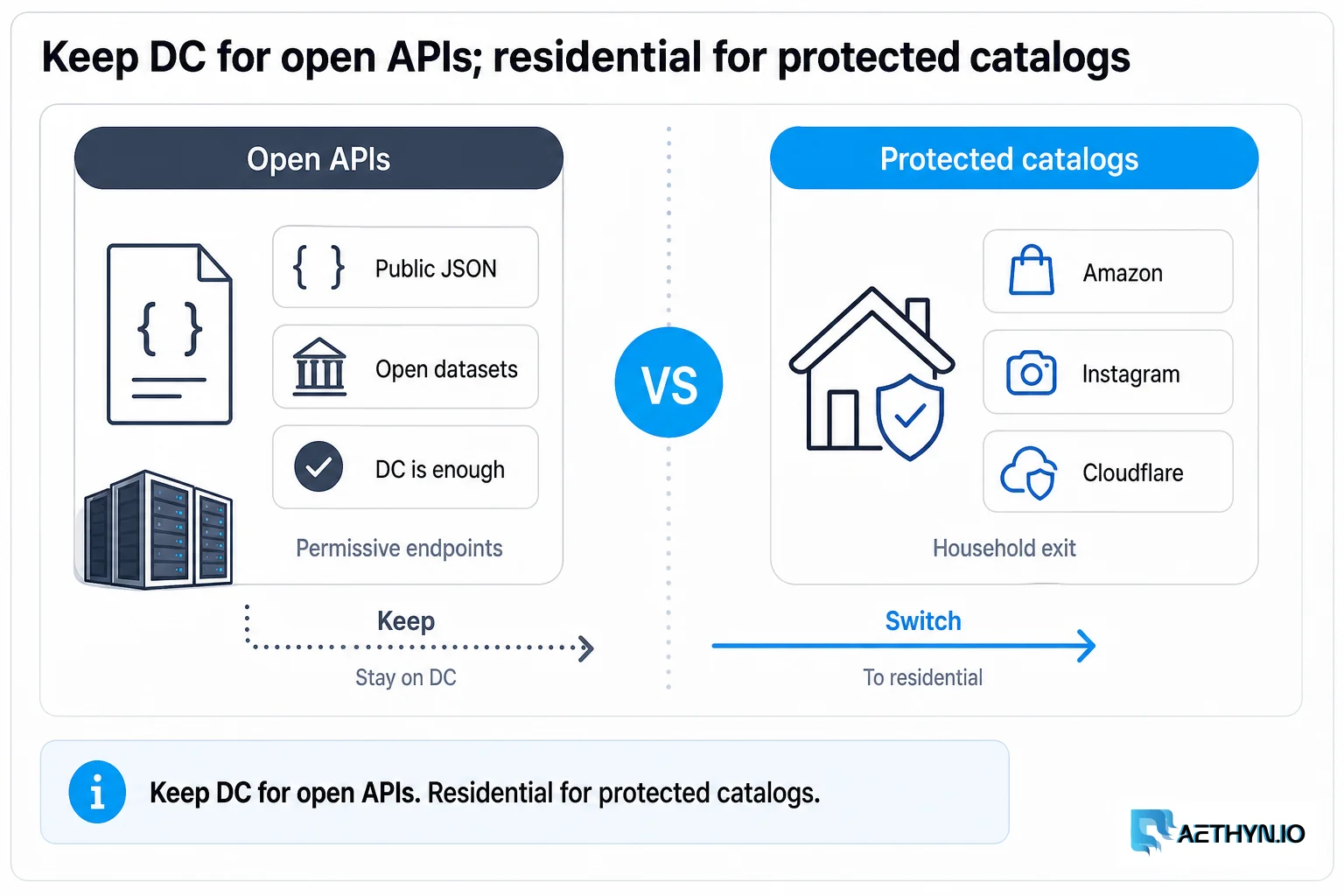
Datacenter proxies remain the right tool for:
- Open government and academic datasets
- Internal staging environments mirroring production
- High-QPS fetches where targets allow datacenter IP ranges
- Cost-sensitive SEO rank checks on permissive search endpoints
The failure mode is predictable: the target CDN adds bot management, and your 99% pass rate becomes 5% overnight.
[!TIP] Monitor pass-rate dashboards. When DC success drops below 85% for three consecutive days, budget a residential migration — do not chase faster DC rotation alone.
Use Case Matrix: DC vs Residential
| Workload | Datacenter OK? | Notes |
|---|---|---|
| SEC EDGAR filings | Usually yes | Public, rate-limited politely |
| Google SERP (official API preferred) | Sometimes | Heavy anti-bot without API |
| Shopify public collections | Rarely | Cloudflare common |
| Nike SNKRS | No | Residential + mobile |
| Internal JSON health checks | Yes | Your infra, your rules |
Combining DC and Residential in One Pipeline
Mature data teams tag URLs with proxy_tier: dc|residential in job metadata. Routers send low-risk paths through Webshare DC and escalate only failed domains to Aethyn. This preserves margin better than routing everything residential "just in case."
Sneaker and Drop Culture Note
Rayobyte built community trust in sneaker verticals where DC speed matters on permissive storefronts. When Nike or Adidas upgrades bot defense, the same DC IPs fail — keep residential budget lines in financial forecasts even if today DC works.
Financial Modeling Template
Calculate cost_per_success = (monthly_proxy_spend + engineer_hours * rate) / successful_records. Datacenter looks cheap until denominator shrinks from blocks. Residential raises numerator slightly but often doubles successful records on protected URLs — lowering cost per success even when GB price is higher.
Compliance for B2B Data Partners
Some data buyers contractually require ethical IP sourcing documentation. Datacenter vendors provide DC attribution easily; residential requires vendor transparency. When selling price intelligence downstream, Aethyn and enterprise residential vendors answer audit questions free lists cannot.
Hardware and Egress Planning
Datacenter proxies shine when your scrapers run in the same cloud region as vendor DC POPs — latency drops, throughput rises. Residential proxies add cross-continent hops because exits live on home networks. Place workers geographically close to your target audience when scraping geo-specific content, not close to your corporate HQ by default.
Decision Matrix
| Signal | Action |
|---|---|
| Target is your own SaaS staging | Datacenter (Webshare) |
| Public API with API key only | Datacenter |
| Need dedicated static DC + unlimited bandwidth | Datacenter (Byteful) |
| Shopify / Cloudflare retail | Residential (Aethyn) |
| Amazon / social | Residential Elite tier |
| Mixed catalog | DC for open endpoints, Aethyn for hard URLs |
Extended Guidance
Datacenter proxies are not going away — they are moving to the bottom of the stack where they belong: fast, cheap fetches on permissive endpoints. The mistake is treating DC as a universal hammer; the skill is knowing which URLs belong in which tier.
Build an internal "URL risk score" from historical pass rates. Above 95% thirty-day success? DC candidate. Below 85%? Residential. Between? A/B test weekly because CDNs change rules without announcement.
When presenting infrastructure costs to leadership, show blended cost per million successful records across tiers — not separate DC and residential line items that invite naive "pick the cheaper one" decisions.
Schedule quarterly retests of URLs you classified as "DC safe." CDNs acquire new bot vendors through partnerships; a domain that was permissive in Q1 may require residential by Q3. Automate classification updates from metrics, not calendar memory.
Webshare remains our default recommendation for teams spinning up their first datacenter pool — not because it beats every competitor on every metric, but because API ergonomics reduce time-to-first-success for junior engineers. Graduate to Bright Data or Oxylabs DC when compliance, dedicated ranges, or hybrid residential dashboards become procurement requirements rather than nice-to-haves.
Remember that datacenter IP ranges are public knowledge. Competitors can fingerprint your scraper cohort if you rely on a single vendor's ASN blocks. Some teams multi-home across two DC providers to avoid trivial blocking rules keyed to known provider subnets.
Capacity planning for datacenter pools should include egress bandwidth from your cloud region, not just proxy monthly fees. A million-record daily job on Webshare DC can saturate a small NAT gateway before proxy limits kick in — watch VPC flow logs alongside proxy dashboards.
When negotiating contracts, ask about refresh rate for rotating DC pools. Static DC IPs are easier to allowlist but easier for targets to block permanently; rotating pools trade allowlist convenience for stealth on permissive sites.
Common questions about this article
Are datacenter proxies still useful in 2026?
What is the best cheap datacenter proxy provider?
When should I switch from datacenter to residential?
Does Aethyn sell datacenter proxies?
Are datacenter proxies faster than residential?
Guides, integrations & docs
Continue reading

Residential vs Datacenter Proxies: Which One Should You Use?
A residential proxy is an ISP-assigned household IP; a datacenter proxy is a cloud-hosted server IP. Compare trust, speed, cost, and when to switch — Aethyn sells residential only.
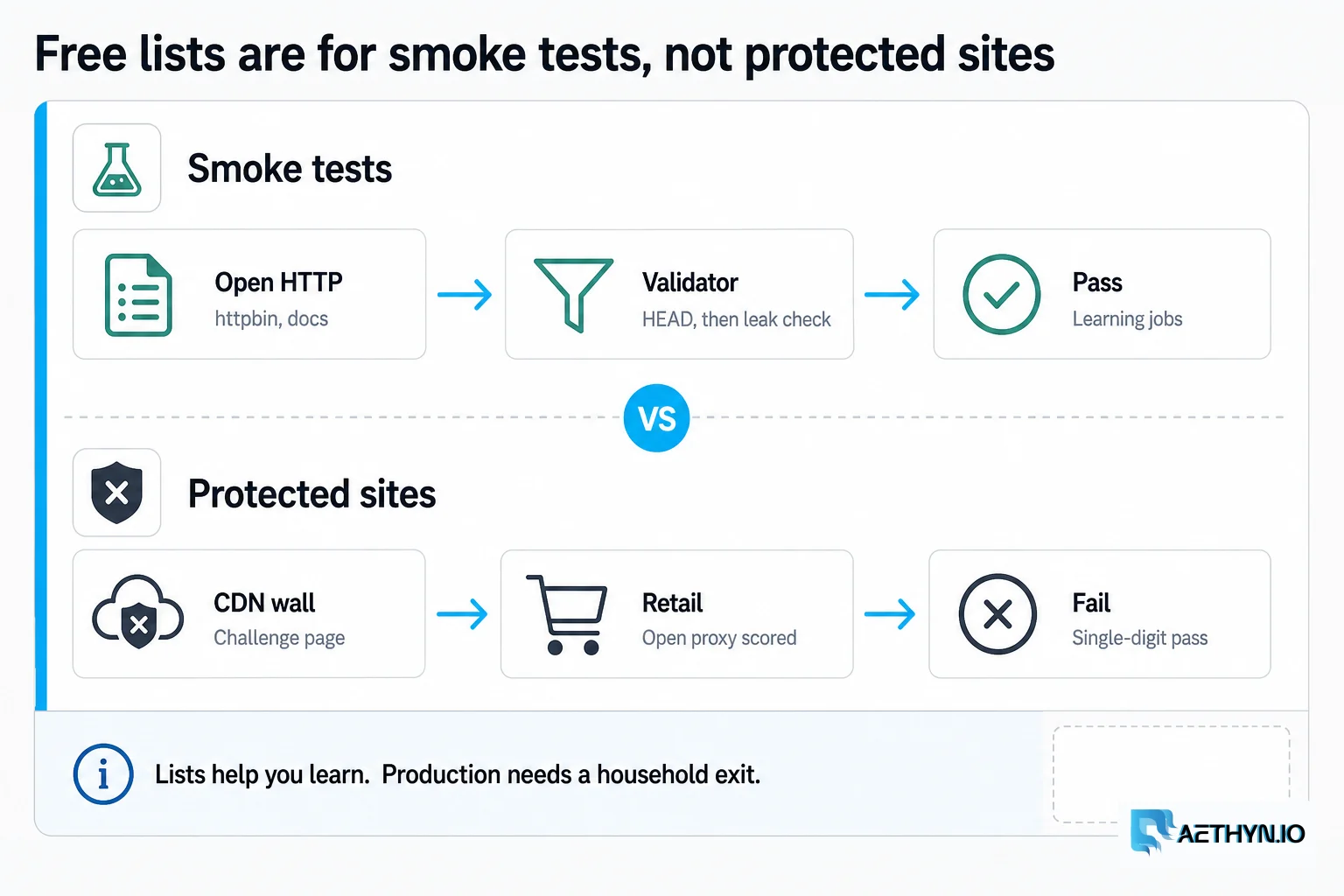
Best Free Proxy Lists for Web Scraping in 2026 (Honest Review)
We tested 12 popular free proxy list sources for web scraping in 2026. Most collapse on protected sites — here is where free lists still work and when to upgrade to residential proxies.
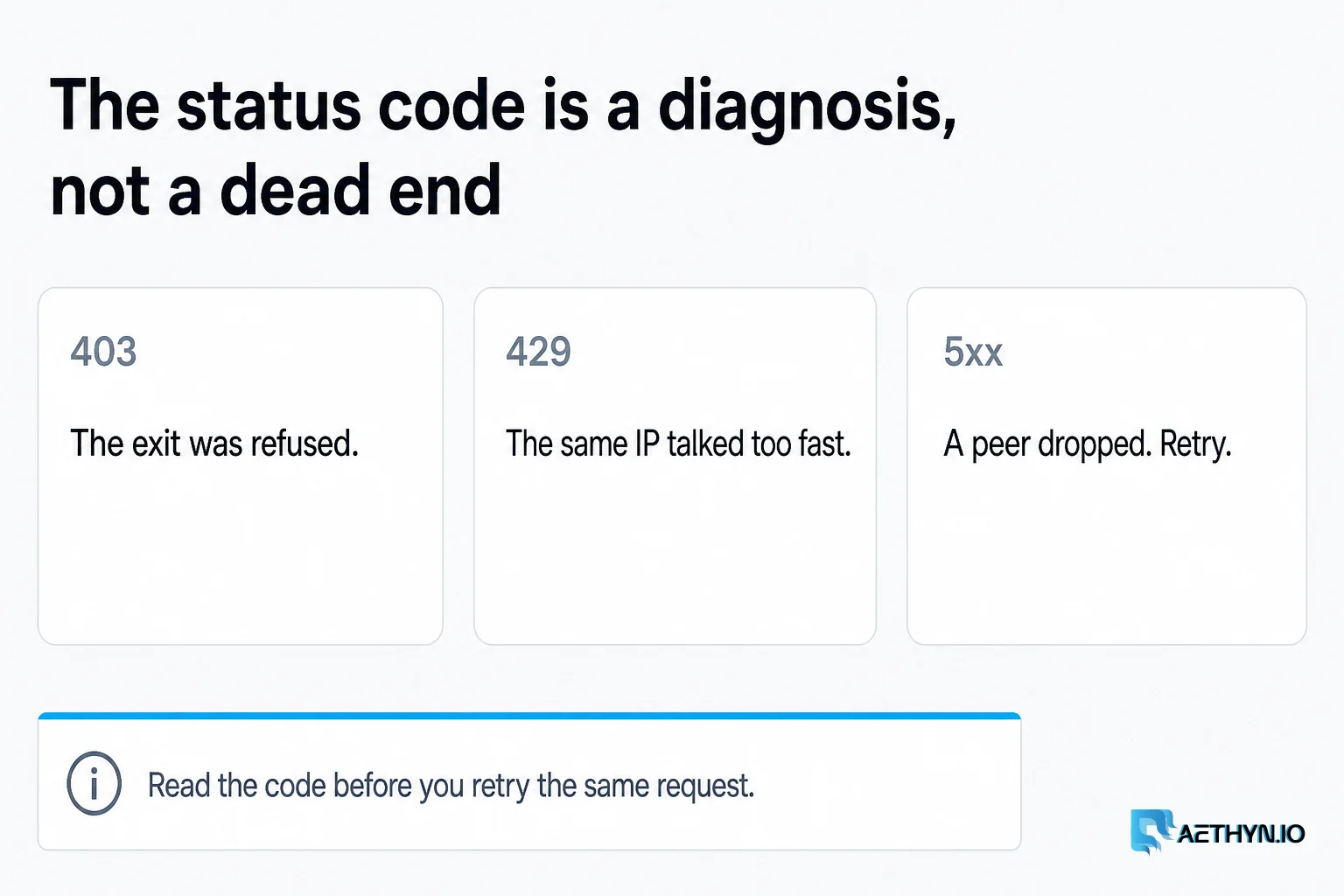
Proxy Errors Explained: 403, 429 & How to Fix Them
Debugging proxy issues can be a nightmare. We explain common status codes and how to resolve them instantly.
Ready to test on your stack?