

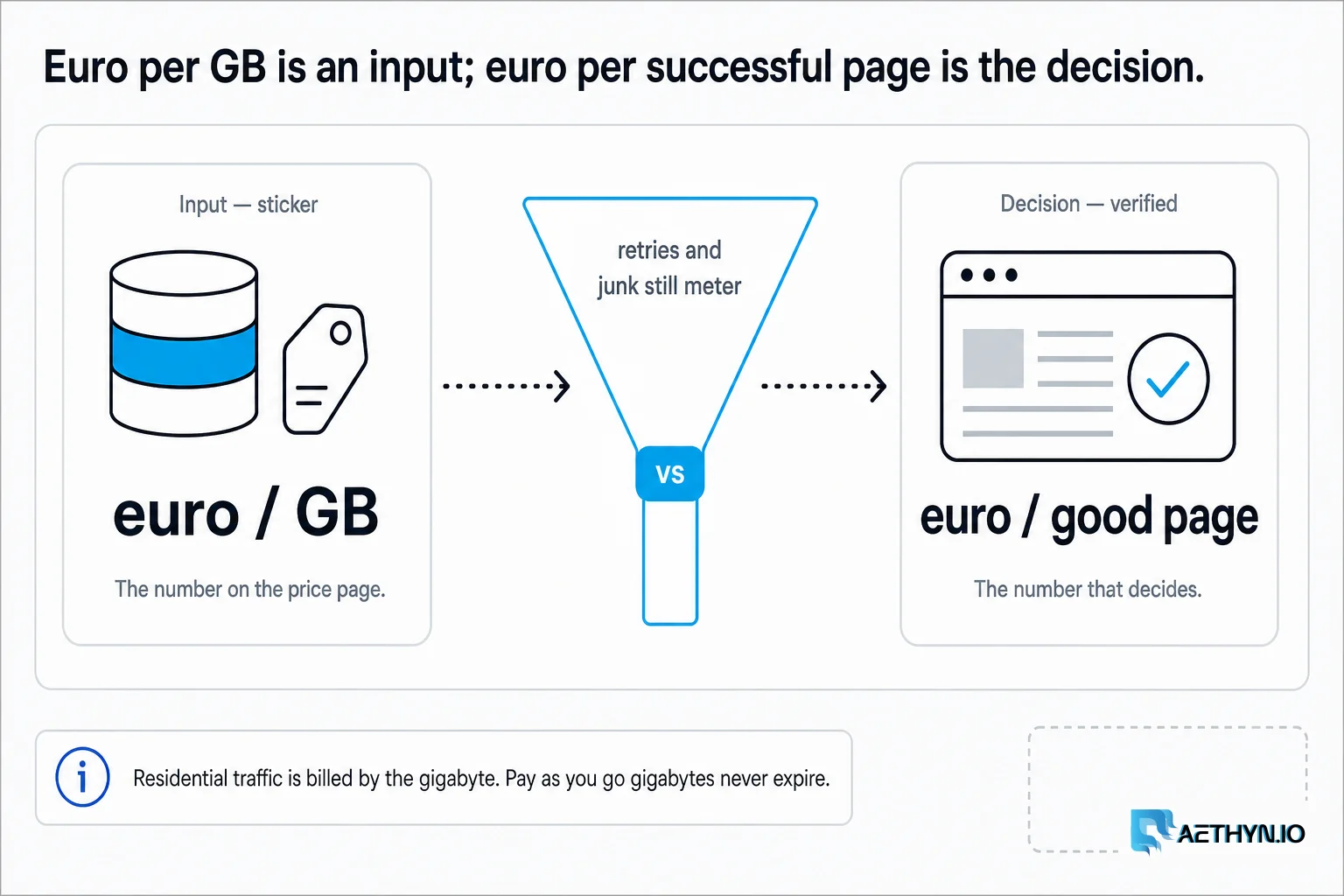
Open ten residential proxy homepages and you will see the same contest: who can print the lowest €/GB. Procurement spreadsheets lock onto that number. Pipelines then quietly burn money on retries, CAPTCHAs, and soft-blocked pages that still meter bandwidth.
Aethyn's pricing concept is different on purpose: transparent per-GB rates, two reputation tiers, and a bias toward success rate on your targets over vanity pool size. This article turns that into arithmetic you can put in a spreadsheet.
The sticker price is not the bill you pay
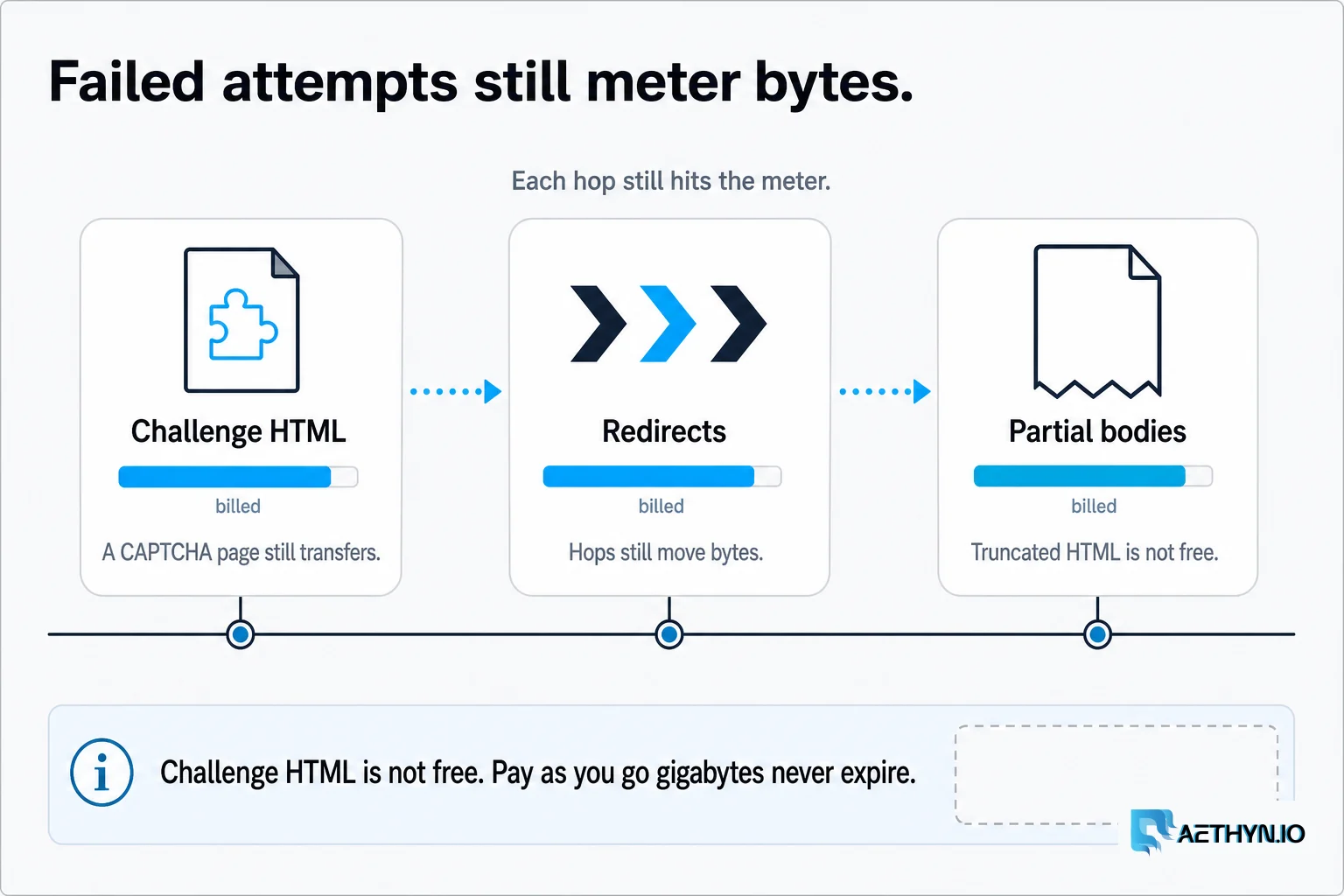
Residential traffic is billed by bytes. Failed attempts often still transfer challenge HTML, redirects, or partial bodies. Engineering time spent debugging a "cheap" pool is real cost too — but even on bandwidth alone, success rate multiplies the sticker.
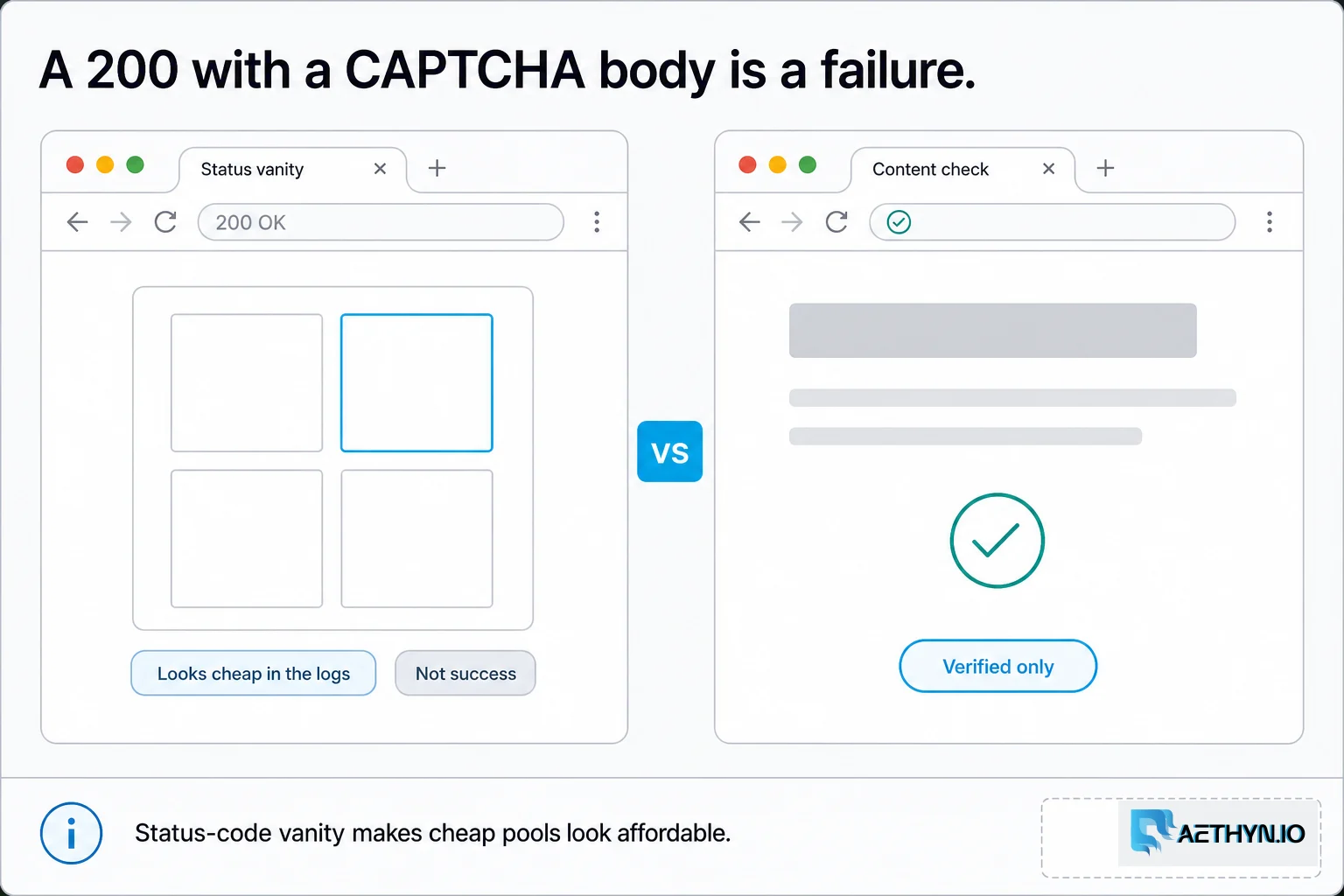
[!IMPORTANT] Define success as usable content. A HTTP 200 that is a CAPTCHA, consent wall, or empty shell is a failure for cost accounting. Status-code vanity metrics make bad pools look affordable.
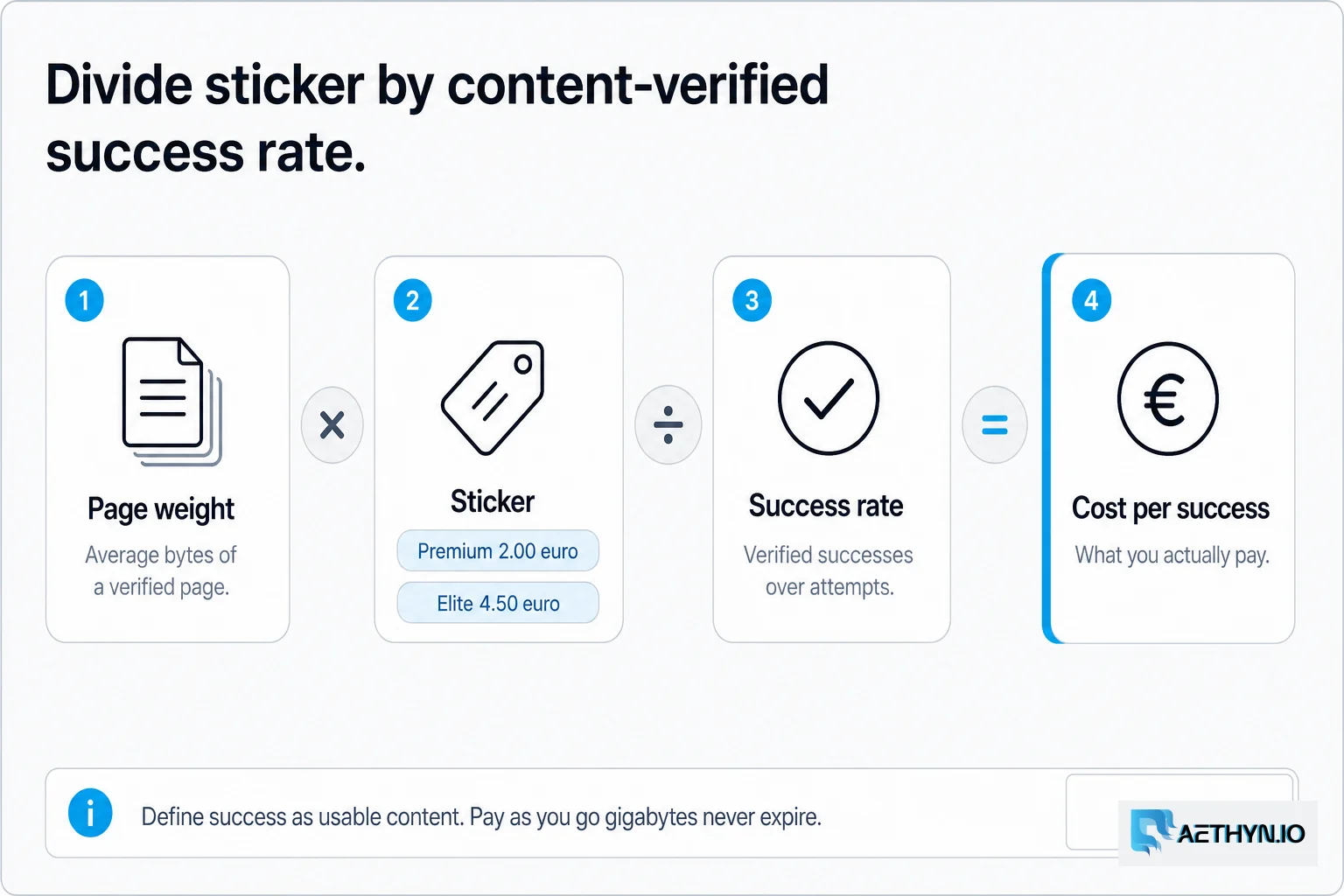
The formula
From a real sample run on your targets:
page_bytes— average response size of content-verified successespage_GB = page_bytes / 1e9sticker = € per GB(e.g. Premium €2.00, Elite €4.50 — see pricing)success_rate = content_ok / attempts(0–1)€ per successful page ≈ (page_GB × sticker) / success_rate
A lighter form some teams use for ranking providers: effective €/GB ≈ sticker / success_rate. That ignores page weight but still ranks pools correctly when page size is similar across vendors.
Worked example (illustrative)
Assume a catalog page averages 500 KB (0.0005 GB) of useful HTML when it succeeds.
| Pool | Sticker | Success rate | € / successful page |
|---|---|---|---|
| "Bargain" residential | €1.50/GB | 50% | (0.0005 × 1.50) / 0.50 = €0.00150 |
| Aethyn Premium | €2.00/GB | 90% | (0.0005 × 2.00) / 0.90 ≈ €0.00111 |
| Aethyn Elite | €4.50/GB | 97% | (0.0005 × 4.50) / 0.97 ≈ €0.00232 |
On this soft target, Premium wins on effective cost even though it is not the cheapest sticker — and the €1.50 pool loses because half the bandwidth buys garbage. On a hard retail domain where Premium falls to 60% and Elite holds 95%, redo the row: Elite often becomes the cheaper successful page despite €4.50/GB.
[!TIP] Pro Tip: Compute the table per domain, not as one global average. A pipeline can look fine overall while one money site quietly doubles your effective cost.
How this maps to Aethyn's Premium vs Elite
| Question | Answer |
|---|---|
| What are we optimizing? | Cost per verified success, not lowest €/GB |
| When is Premium right? | High volume, open/moderate targets — Premium at €2.00/GB |
| When is Elite right? | Hard anti-bot, city/ISP needs, success-rate recovery — Elite at €4.50/GB |
| How do we decide? | Trial both on the same URL sample; keep each source on the cheapest tier that holds |
That is the same philosophy as the residential proxy pool size myth: we would rather be measured on reputation, consented sourcing, and success you can verify than on an unaudited IP count. Benchmarks and market context: 2026 proxy benchmarks, statistics 2026.
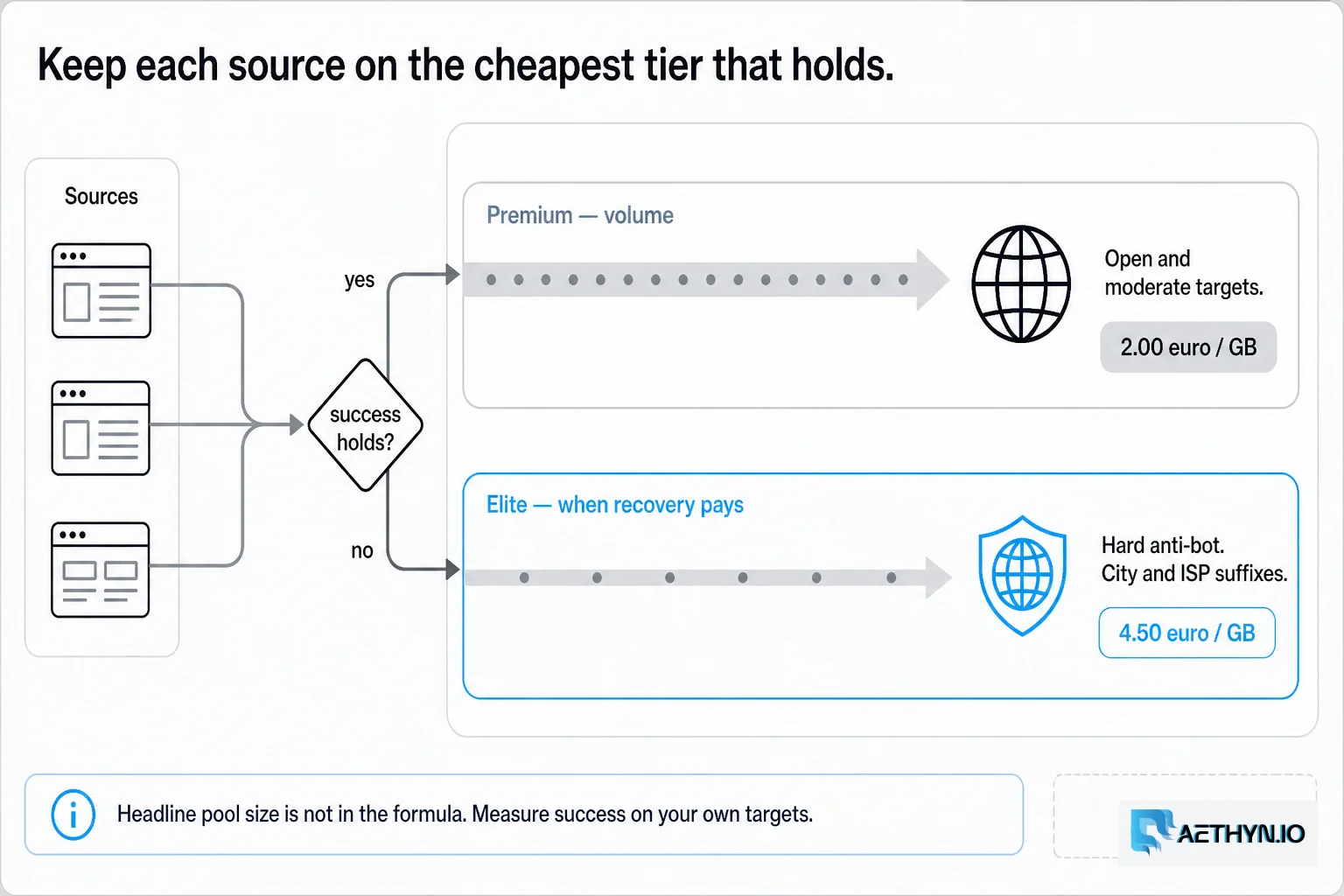
What to exclude from the spreadsheet (or add deliberately)
- Retries — if your client retries three times on 403, bandwidth multiplies; fold retry policy into measured
success_rateor into total GB - Headless browsers — Playwright pages weigh more than
requestsHTML; measure the stack you will run in production - Human time — a pool that needs constant session babysitting loses even if €/success looks fine on paper
- Opaque "contact sales" pricing — if you cannot plug a number into the formula, you cannot forecast. Transparent per-GB is a feature.
A 30-minute measurement protocol
- Pick 3–5 representative URLs (easy, medium, hard)
- Send a few hundred requests through the candidate pool with Python Requests or Playwright as you will in prod
- Mark content-verified successes; record GB from the dashboard meter
- Plug into the formula; compare Premium vs Elite vs any incumbent
- Route each host to the winning tier
Use the provider checklist for sourcing and support questions the formula does not cover.
The takeaway
€/GB is an input. € per successful page is the decision. Aethyn publishes clear Premium and Elite rates so you can run that math without a sales call — then prove it on your own targets.
Common questions about this article
Why is the lowest price per GB a bad way to buy residential proxies?
What is the formula for effective proxy cost?
How do Aethyn Premium and Elite fit this model?
Does a 200 OK count as success for cost calculations?
How does this relate to pool-size marketing?
Guides, integrations & docs
Continue reading
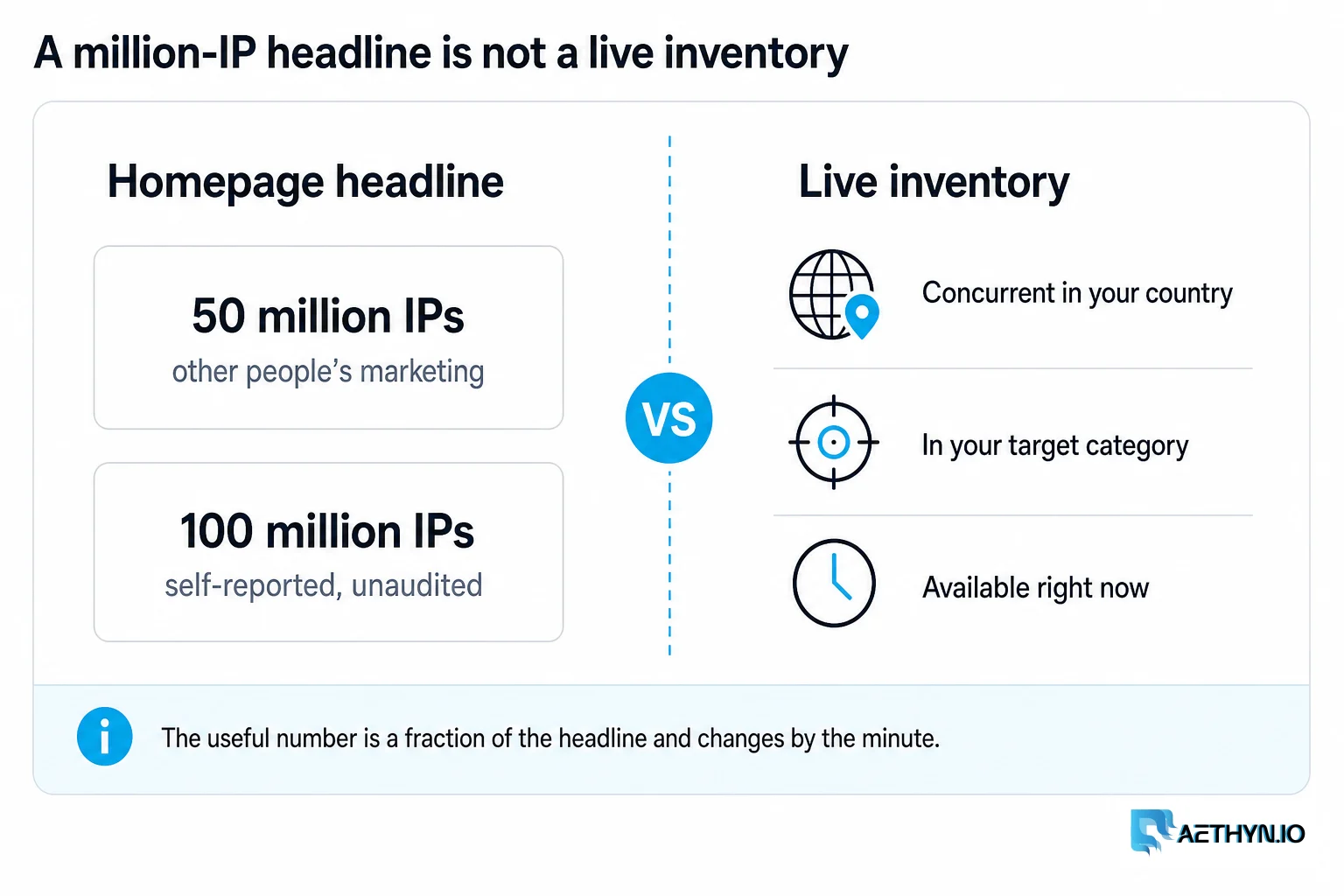
The Residential Proxy Pool Size Myth
Every provider opens with an IP count — 50 million, 100 million. We're not going to. Here's why the number is meaningless, and what we stand behind instead: IP quality.
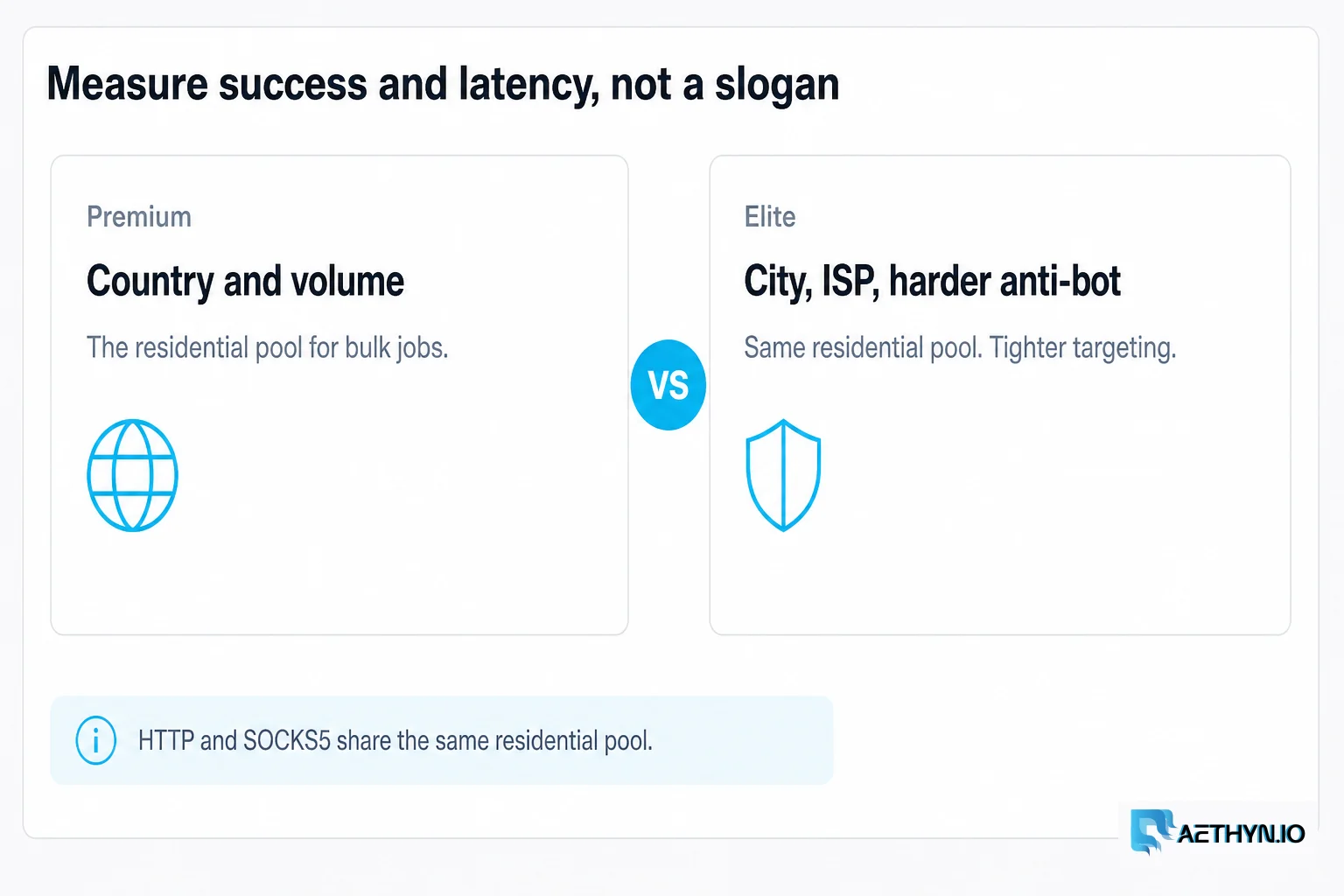
2026 Residential Proxy Benchmarks: Elite vs Premium Pools
We put our own network to the test. See the latest performance data on success rates, latency, and throughput across different pool types.
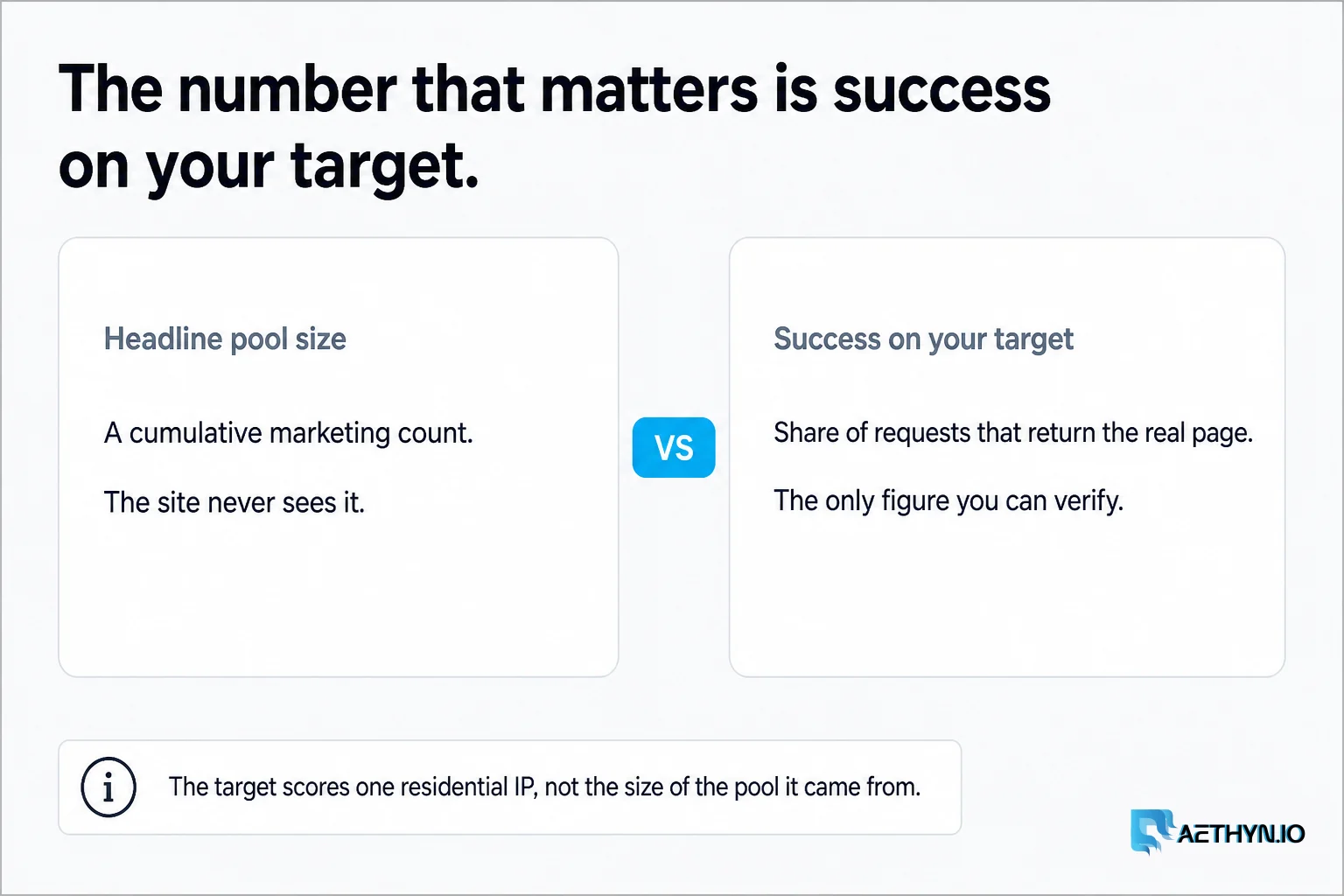
Residential Proxy Statistics 2026: Market Data & Network Trends
A data-driven look at the residential proxy market in 2026 — adoption, success rates, latency, pricing, and traffic patterns drawn from Aethyn network data and industry estimates.
Measure effective cost on your targets
Transparent €2.00/GB Premium and €4.50/GB Elite. Run a free trial, count content-verified successes, and pick the tier that wins on cost per success — not sticker price.