

What goes wrong when this scraper fails
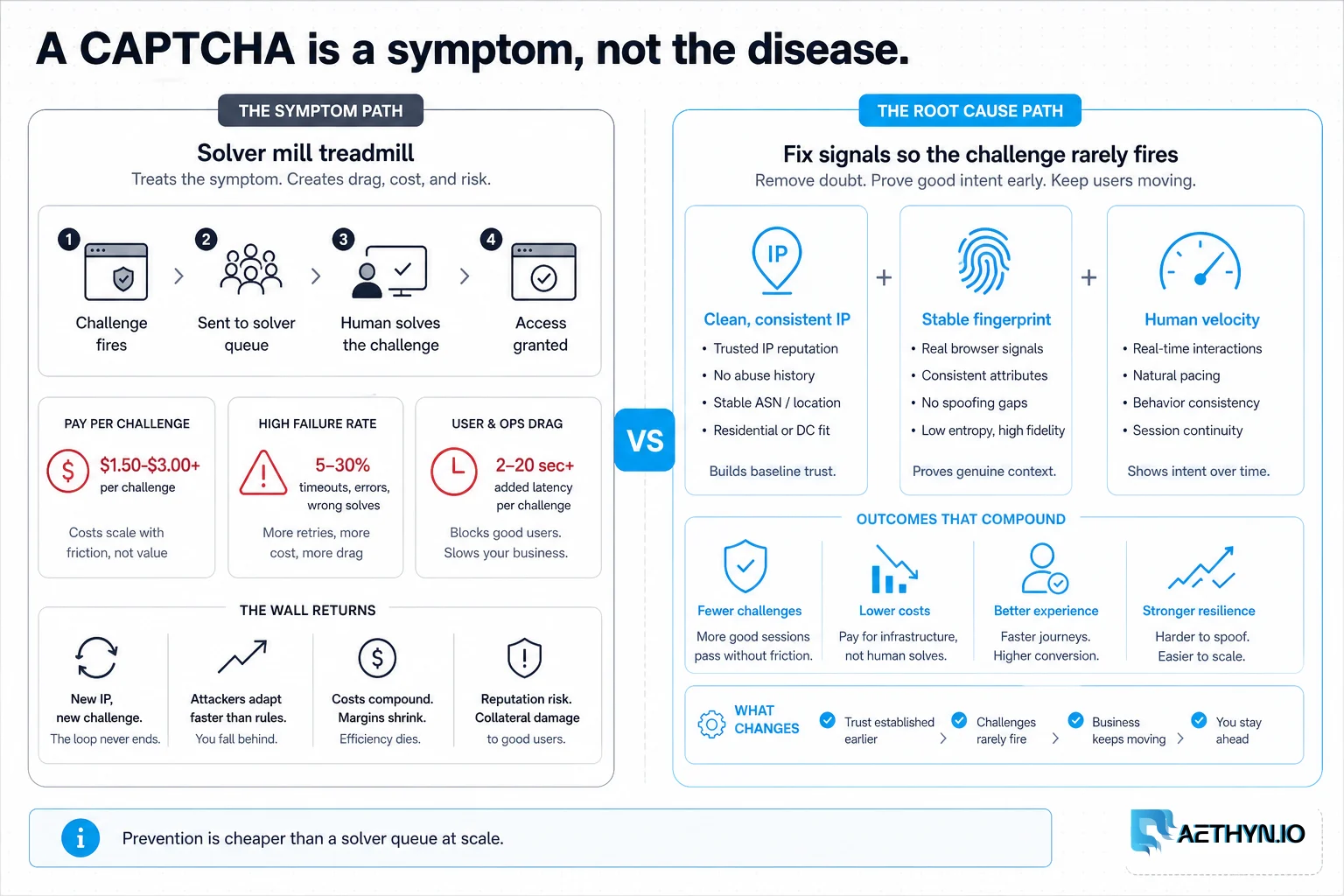
Scrapers hit CAPTCHAs and reach for a solver service — paying per challenge to type or click through walls that keep reappearing. That treats the symptom. A CAPTCHA fires only after a site's bot-management layer scores your request as likely automated, based on IP reputation, TLS/browser fingerprint, behavior, and how fast you're going. The durable fix is to stop tripping those signals so the challenge rarely appears, reserving any solving as a rare fallback rather than the core strategy.
Why this failure mode happens
Anti-bot systems (reCAPTCHA, hCaptcha, Cloudflare Turnstile, PerimeterX/HUMAN) compute a risk score from many inputs: whether the IP is residential or a flagged datacenter range, whether the TLS/HTTP/2 and browser fingerprints look like a real client, whether mouse/timing behavior is human, and whether request velocity is plausible. A high score shows a CAPTCHA. Most scrapers score high on several axes at once — datacenter IP, header-only client, machine-gun pacing — so they get challenged constantly.
Challenges that make this hard to automate
- Datacenter IP reputation that triggers challenges on sight
- Fingerprint mismatches (TLS/HTTP2/browser) that flag non-browsers
- Robotic behavior and timing that read as automated
- Velocity spikes from one IP crossing rate thresholds
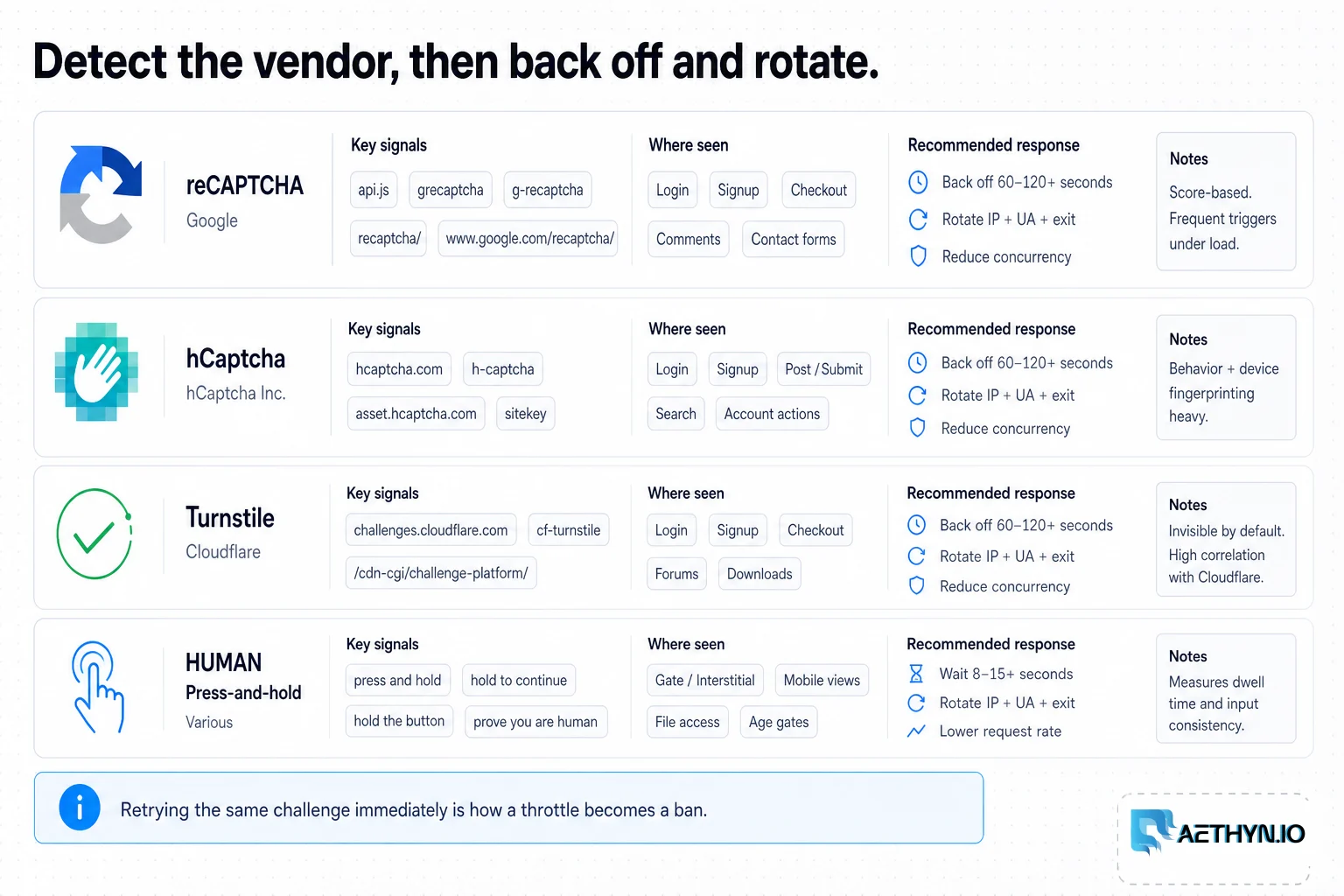
- Multiple CAPTCHA vendors, each with different triggers and tells
Approaches that usually fail
- CAPTCHA solver services — pay per challenge, slow, fragile, treats the symptom
- Datacenter proxies — cheap but trigger challenges constantly
- Hard-coded delays — predictable patterns that detection learns
- Header-only clients on protected sites — easily fingerprinted as bots
When residential proxies fix this — and when they cannot
IP reputation is the largest single trigger, so routing through high-trust residential IPs removes the input that most often pushes the risk score over the line — challenges drop sharply versus datacenter ranges. Spreading load across a rotating pool keeps per-IP velocity below thresholds, and geo-appropriate IPs avoid the 'unexpected location' heuristics that some systems penalize.
How Aethyn residential proxies help here
Preventing CAPTCHAs is mostly about reputation, velocity, and geography — exactly what Aethyn controls through the username.
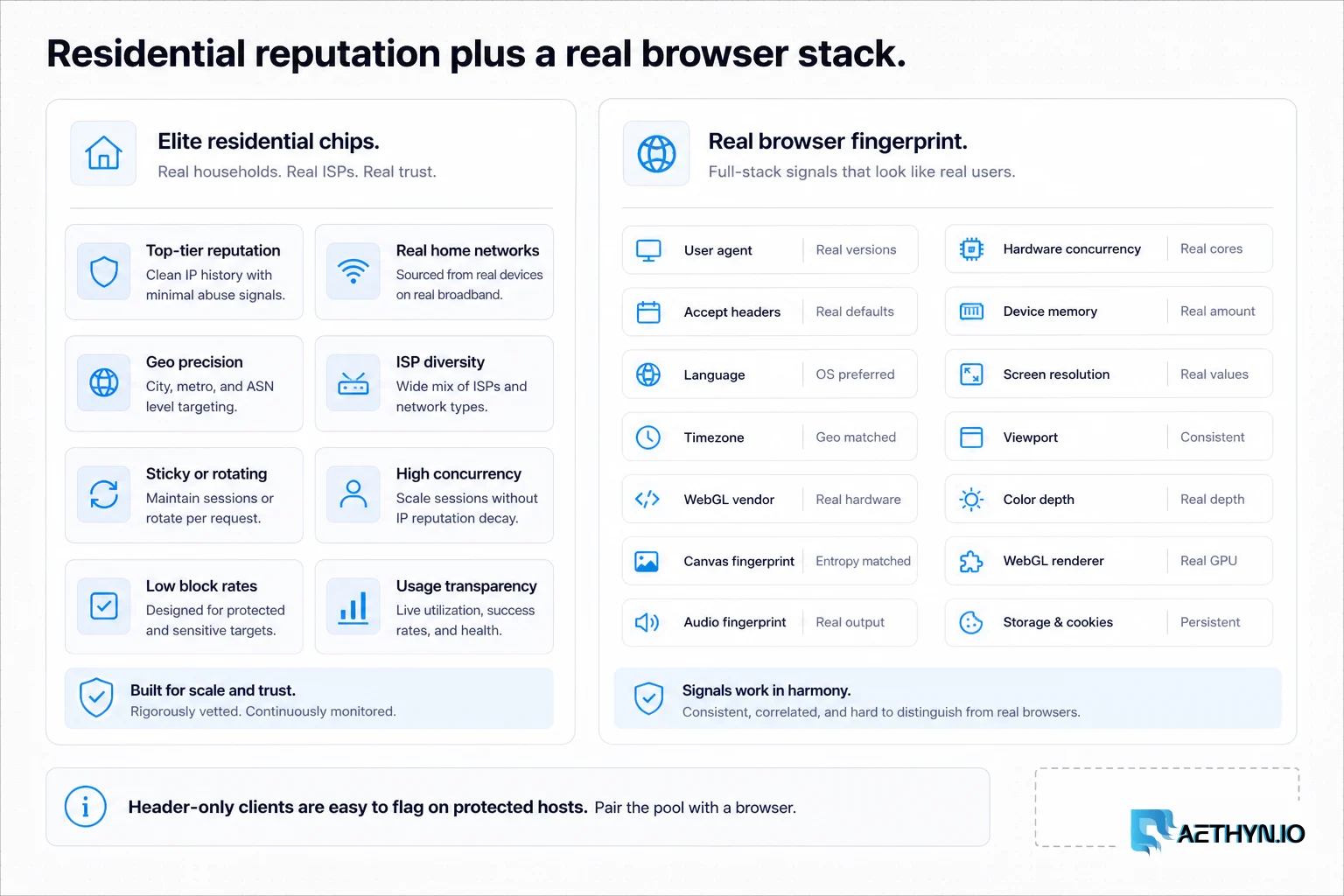
- Elite high-trust residential IPs that rarely trip reputation-based challenges
- Per-request rotation to keep per-IP velocity under challenge thresholds
- Sticky sessions so legitimate multi-step flows don't look erratic
- Country/city targeting to avoid unexpected-location penalties
- Per-byte billing so the headroom to slow down doesn't blow the budget
How to implement this with residential proxies
- 1
Start with high-reputation residential IPs
Because IP reputation is the dominant trigger, this is the highest-leverage change. Move protected targets off datacenter ranges onto high-trust residential IPs and rotate so no single IP builds the velocity that flips the risk score. This alone eliminates most challenges on many sites.
Python (residential baseline)import requests PROXY = "http://aethyn-XXXXX-country-us:PASSWORD@proxy.aethyn.io:5499" proxies = {"http": PROXY, "https": PROXY} # Each request can rotate to a fresh residential IP, keeping per-IP # velocity low — the pattern that most often avoids reputation challenges. r = requests.get("https://example.com", proxies=proxies, timeout=30)Field note: Geo-match the IP to the content. A US site accessed from an unexpected region scores higher risk on some systems. Target the country your traffic should plausibly come from.
- 2
Present a consistent, real browser fingerprint
For protected targets, a header-only client is trivially flagged. Use a real browser (Playwright/Puppeteer) so TLS, HTTP/2, and JS-level fingerprints match a genuine client, and keep the User-Agent, Accept-Language, and platform internally consistent. Mismatched signals (a Chrome UA with a non-Chrome TLS fingerprint) are a strong bot tell.
Python (consistent browser via Playwright)from playwright.sync_api import sync_playwright with sync_playwright() as p: b = p.chromium.launch(headless=True, proxy={ "server": "http://proxy.aethyn.io:5499", "username": "aethyn-XXXXX-country-us", "password": "PASSWORD"}) ctx = b.new_context(locale="en-US", user_agent=("Mozilla/5.0 (Windows NT 10.0; Win64; x64) " "AppleWebKit/537.36 (KHTML, like Gecko) " "Chrome/124.0 Safari/537.36")) page = ctx.new_page() page.goto("https://example.com")Field note: Don't half-spoof. A Chrome User-Agent over a Python TLS stack is more suspicious than honest defaults, because the fingerprint and the header disagree. Consistency beats clever spoofing.
- 3
Pace and vary like a human
Velocity and rhythm matter. Replace fixed sleeps with randomized, jittered delays, cap concurrency per site, and avoid perfectly periodic request timing. For browser flows, let pages settle and interact (scroll, hover) where it's genuinely needed rather than firing instant, identical requests.
Python (jittered pacing)import time, random def polite_get(session, url): time.sleep(random.uniform(1.5, 4.0)) # jittered, not fixed return session.get(url, timeout=30)Field note: Perfectly regular timing (exactly 2.0s apart) is itself a bot signature. Jitter the delays so the inter-request distribution looks human rather than machine-scheduled.
- 4
Detect the challenge and respond correctly
Recognize when you've been challenged — reCAPTCHA, hCaptcha, Cloudflare Turnstile, or PerimeterX markers in the response — and treat it as a stop signal. Back off, rotate to a fresh IP, and slow the overall crawl. Retrying immediately through the same IP only deepens the block.
Python (challenge detection)CHALLENGE_MARKERS = ( "g-recaptcha", "hcaptcha", "challenges.cloudflare.com", "cf-chl", "px-captcha", "_px", ) def is_challenged(resp): if resp.status_code in (403, 429): return True body = resp.text.lower() return any(m in body for m in CHALLENGE_MARKERS) # On True: back off, rotate IP, reduce global concurrency — don't retry in place.Field note: A sudden spike in challenges across many fresh IPs means your global concurrency is too high, not that the IPs are bad. Throttle the whole crawl before burning through your pool.
- 5
Treat solving as a rare fallback, not the plan
Even with good prevention, a few challenges slip through. It's fine to have a fallback path for those edge cases, but if you're solving CAPTCHAs constantly, your signals are wrong — go back and fix reputation, fingerprint, and velocity. Prevention scales; per-challenge solving doesn't.
Field note: Track a challenge rate metric (challenges ÷ requests) per target. If it climbs, your prevention is degrading — adjust before costs and failures pile up rather than leaning harder on a solver.
Best practices that keep scrapers reliable
- Lead with high-trust residential IPs and per-request rotation
- Use a real browser with a consistent fingerprint on protected sites
- Geo-match IPs to content to avoid location penalties
- Jitter pacing and cap per-site concurrency
- Detect challenges and back off + rotate instead of retrying
- Track challenge rate and fix signals before scaling solving
Common mistakes that burn proxy budget
- Paying solver services to grind through walls you keep triggering
- Running protected targets on datacenter IPs
- Half-spoofing (Chrome UA over a non-Chrome TLS fingerprint)
- Fixed, periodic delays that read as machine-scheduled
- Retrying through the same IP after a challenge
- Ignoring rising challenge rates until the crawl collapses