

What goes wrong when this scraper fails
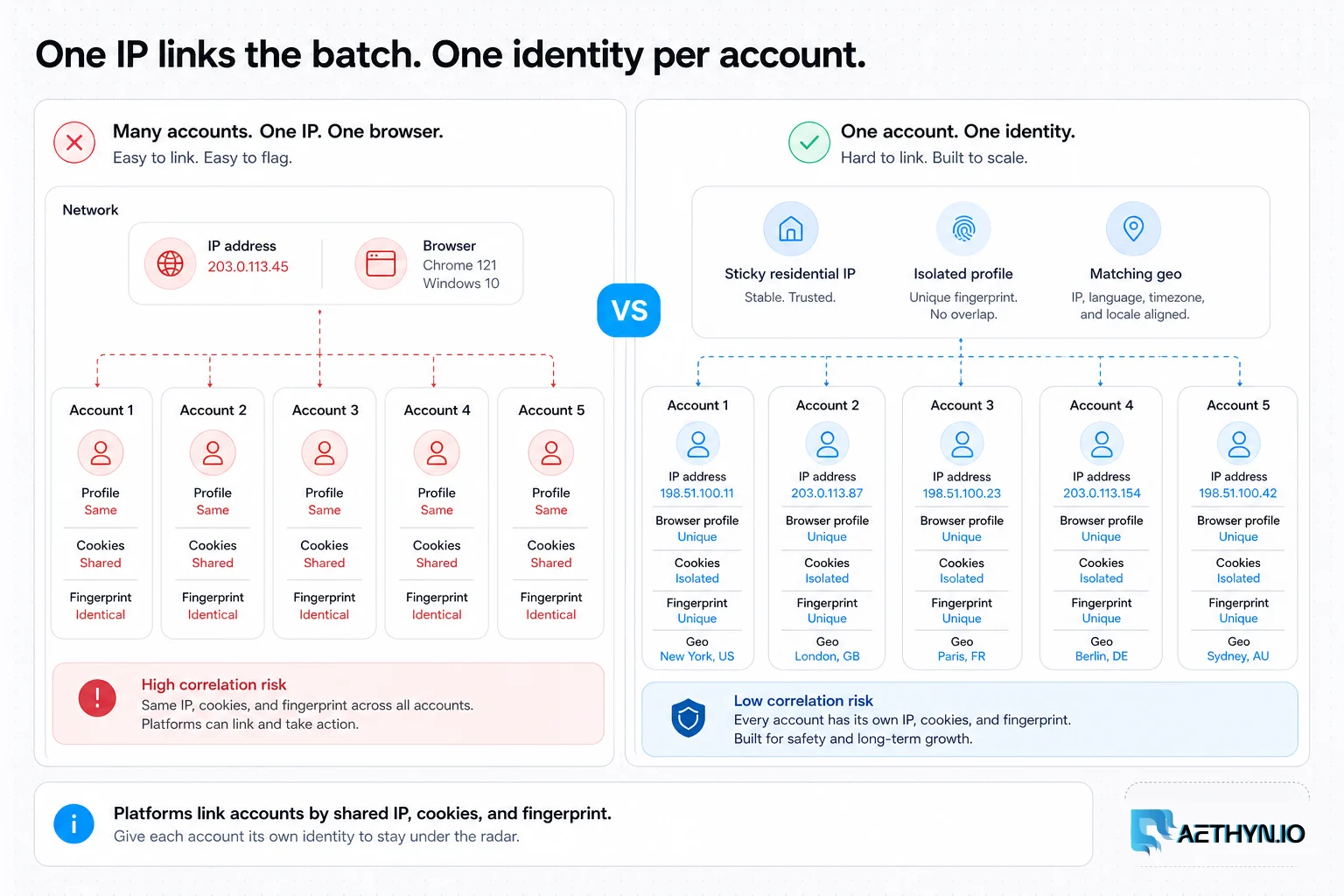
Agencies, marketplaces, and community teams legitimately operate many social accounts, and the failure mode is treating them as one operation: same IP, same browser, simultaneous identical actions. Platforms detect this trivially — they correlate accounts by IP, cookies, and device fingerprint, and a sudden country change or shared device gets accounts flagged or banned in bulk. Doing it safely means giving each account a persistent, isolated identity and behaving like a real person per account.
Why this failure mode happens
Social platforms fight fake-account farms by linking accounts that share signals: the same IP, overlapping cookies/local storage, an identical browser fingerprint, or synchronized behavior. They also treat sudden geography changes as account-takeover signals. So accounts run from a shared IP and browser look like exactly what platforms ban, while erratic IP changes on a single account look like compromise. Safe management requires per-account identity stability and isolation.
Challenges that make this hard to automate
- Accounts linked by shared IP, cookies, or fingerprint
- IP geography that contradicts an account's location/history
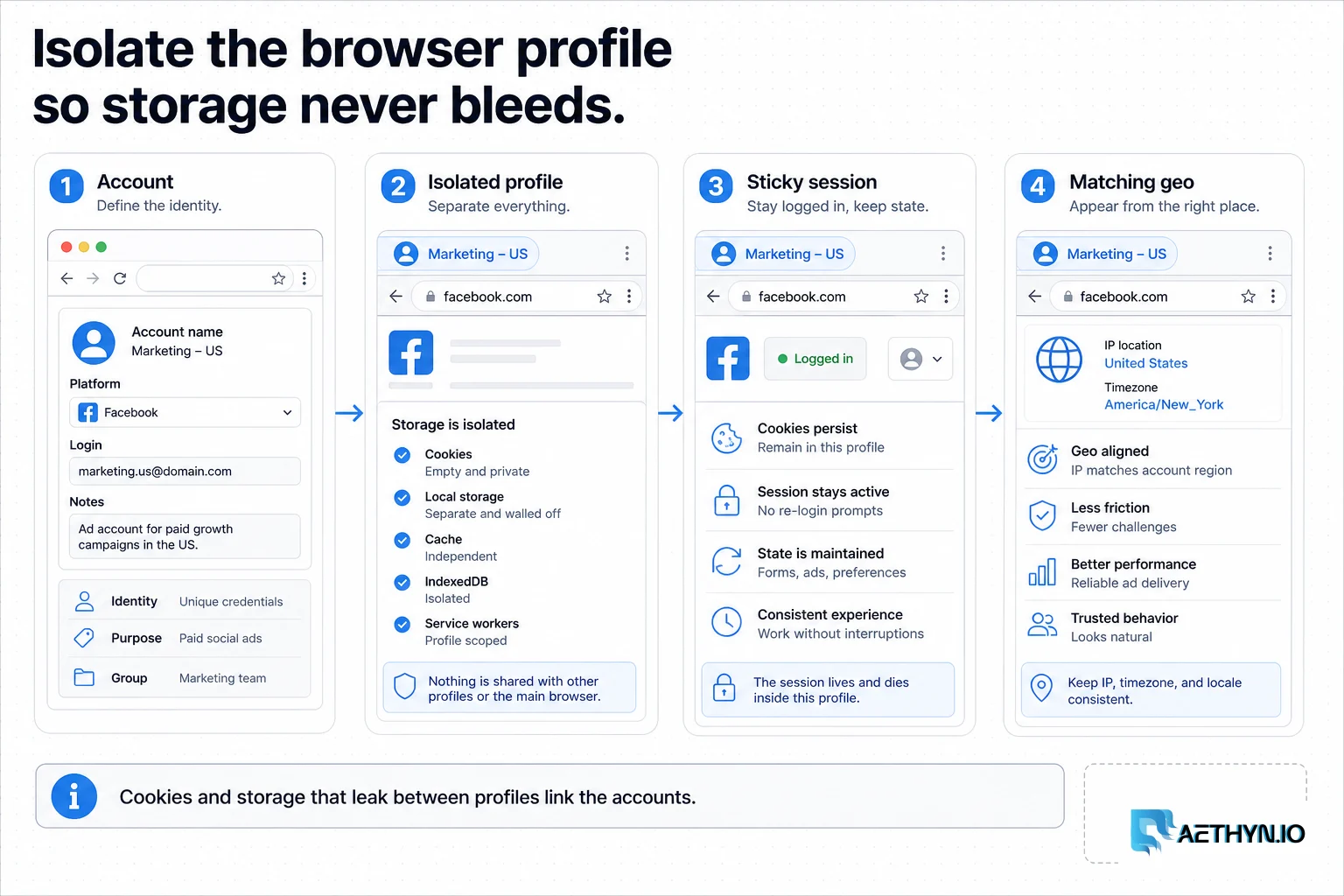
- Cookie/storage bleed across accounts in one browser
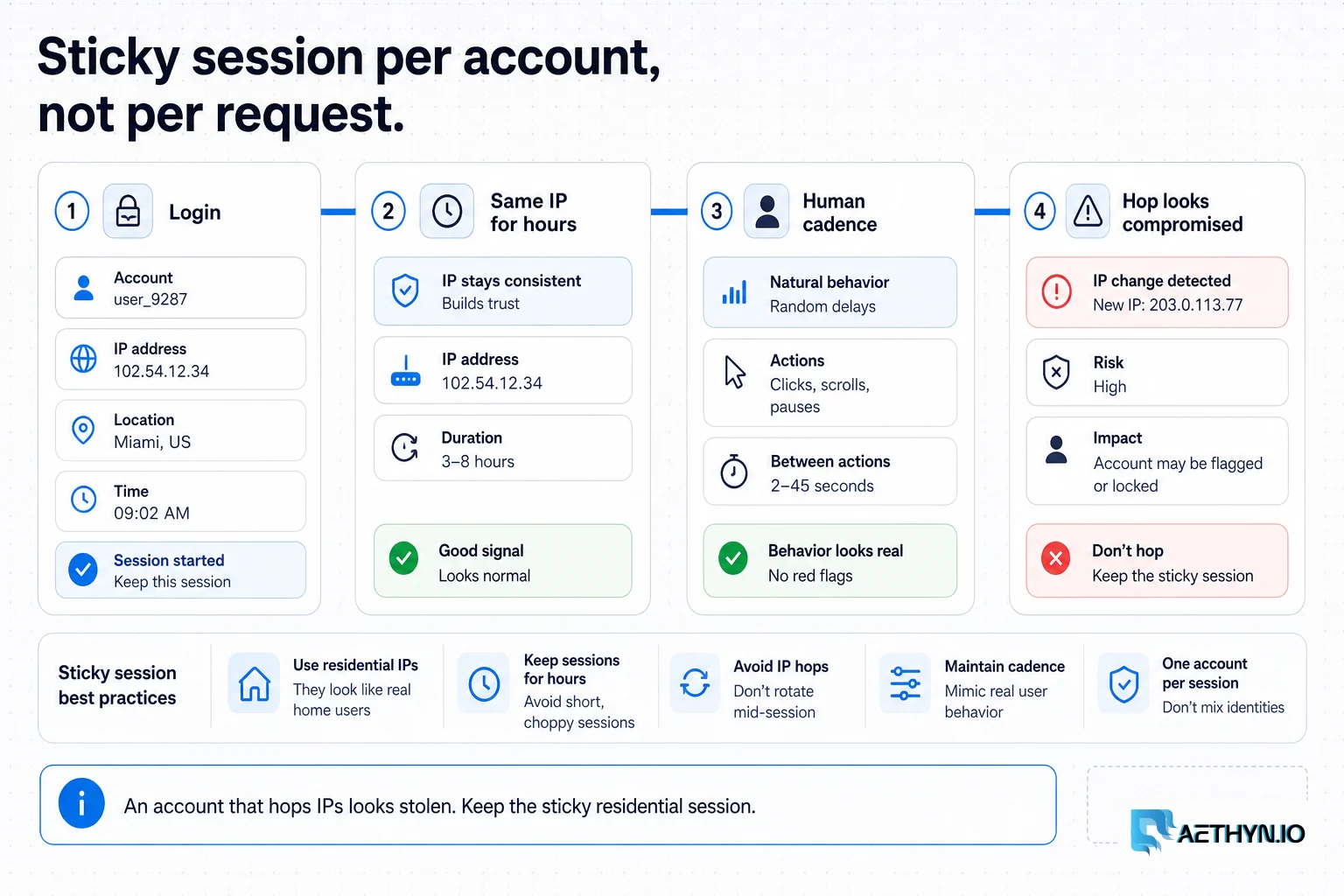
- Sudden IP changes that look like account takeover
- Behavioral patterns (burst, identical timing) that read as automation
Approaches that usually fail
- One IP for all accounts — instant correlation and bulk bans
- Per-request rotation per account — looks like account compromise
- One browser for everything — cookie/fingerprint bleed links accounts
- Datacenter IPs — flagged as non-residential and high-risk
When residential proxies fix this — and when they cannot
A sticky residential session gives each account a stable, real-looking IP for the duration of its work, so it presents like one consistent person rather than a rotating bot. Targeting that IP to the account's stated region keeps geography consistent, and keeping one account on one session (not rotating per request) avoids the takeover signals that erratic IP changes trigger.
How Aethyn residential proxies help here
Safe multi-account management is about per-account identity stability and the right geography — exactly what Aethyn's sticky sessions and targeting provide.
- Sticky sessions (up to 30 min, renewable) so each account keeps one IP
- Elite high-trust residential IPs that present as real consumer connections
- Country/city targeting so each account's geography stays consistent
- A large pool so every account gets a distinct stable identity
- Per-byte billing so running many accounts stays cost-predictable
How to implement this with residential proxies
- 1
Give each account one stable sticky identity
Assign every account a dedicated sticky residential session keyed to a per-account session ID, and reuse the same session ID for that account over time. This keeps the account on a consistent, real-looking IP — the opposite of per-request rotation, which on a logged-in account looks like compromise.
Python (per-account sticky proxy)def proxy_for(account): # Stable session id per account => consistent IP for that account user = (f"aethyn-XXXXX-country-{account['country']}" f"-session-{account['id']}-lifetime-30") return f"http://{user}:PASSWORD@proxy.aethyn.io:5499" # Account A always routes through its own session; Account B through its own.Field note: Persist the session ID with the account record and reuse it. The goal is continuity — the same account appearing from the same stable IP — not a fresh IP each login, which is the single biggest red flag for account-takeover systems.
- 2
Match IP geography to the account
Set the proxy country (and city where it matters) to the account's stated location and history. An account that has always appeared from Berlin suddenly connecting from Brazil is a textbook takeover signal that triggers verification or suspension.
Field note: Keep a region per account and never drift it. If an account genuinely 'travels', change geography gradually and rarely — abrupt cross-continent jumps are what platforms flag.
- 3
Isolate each account in its own browser profile
Run each account in a separate browser profile or container with its own cookies, local storage, and a distinct, consistent fingerprint. Never share a browser context across accounts — shared cookies or an identical fingerprint links them regardless of IP.
Python (isolated context per account)from playwright.sync_api import sync_playwright def session(account): p = sync_playwright().start() b = p.chromium.launch(headless=False, proxy={ "server": "http://proxy.aethyn.io:5499", "username": f"aethyn-XXXXX-country-{account['country']}-session-{account['id']}-lifetime-30", "password": "PASSWORD"}) # Dedicated, persistent profile per account => isolated cookies/storage ctx = b.new_context(locale=account["locale"], user_agent=account["user_agent"], storage_state=account.get("state_path")) return p, b, ctxField note: Persist each account's storage_state (cookies + local storage) to its own file and reload it next session. Re-logging in from scratch every time is itself suspicious; a returning, remembered session looks normal.
- 4
Keep fingerprints consistent per account
Each account should present the same device profile every time — User-Agent, locale, timezone, viewport. Consistency per account matters more than uniqueness: an account whose fingerprint changes every session looks automated, while a stable one looks like a real person's device.
Field note: Align locale and timezone with the account's geography. A US-IP account reporting an Asia/Kolkata timezone and de-DE locale is an obvious mismatch that contributes to linking and risk scores.
- 5
Behave like a human, within limits
Identity isn't enough — pace actions like a person. Avoid bursts and identical timing across accounts, respect platform rate limits, add jittered delays, and don't run all accounts in lockstep. Synchronized behavior across many accounts is itself a farm signal.
Best practices that keep scrapers reliable
- One stable sticky residential session per account, reused over time
- Match and hold IP geography to each account's location
- Isolate cookies, storage, and fingerprint per account
- Persist and reload each account's session state
- Keep each account's fingerprint consistent across sessions
- Pace actions humanly and never run accounts in lockstep
Common mistakes that burn proxy budget
- Running many accounts from one shared IP
- Rotating IPs per request on logged-in accounts
- Sharing a browser/context and bleeding cookies between accounts
- Abrupt geography changes that look like takeover
- Changing an account's fingerprint every session
- Synchronized, bursty behavior across all accounts