

What goes wrong when this scraper fails
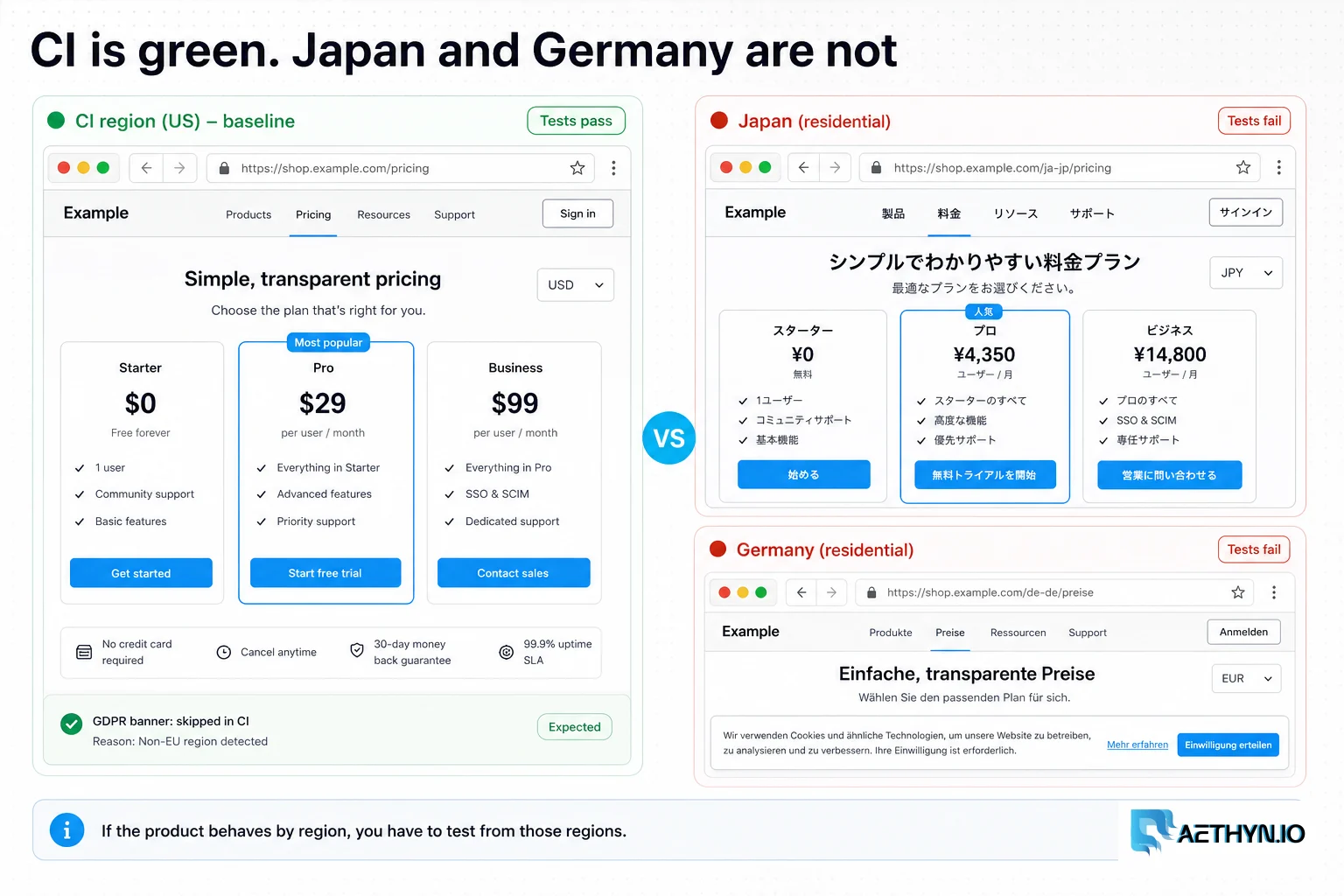
Teams ship geo-aware behavior all the time — localized copy, regional pricing and tax, currency, GDPR/CCPA consent banners, content licensing, and outright geo-blocking. But QA almost always runs from one office network or one CI region, so the geo branches are never exercised. The bugs then surface as confusing tickets from users abroad ('the price is in dollars', 'I can't access the trial'), which nobody can reproduce from headquarters. The logic was never tested from where it actually matters.
Why this failure mode happens
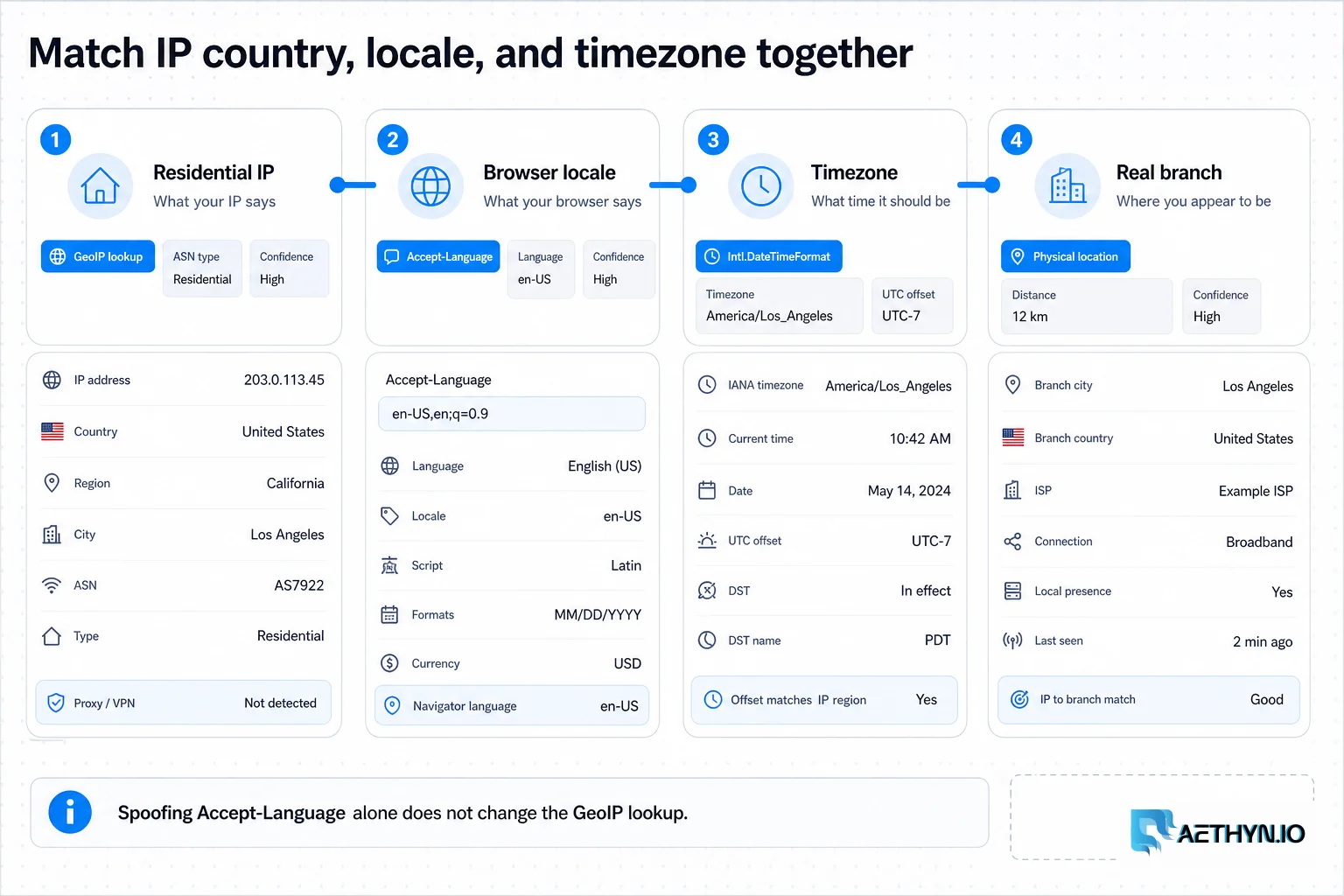
Geo behavior is driven primarily by the visitor's IP address (often via a GeoIP lookup or CDN edge), sometimes refined by locale headers. A CI runner or office network has one fixed location, so it only ever takes one branch. Spoofing Accept-Language doesn't help because it doesn't change the IP the GeoIP layer sees — and datacenter IPs are frequently flagged as non-residential and routed or blocked differently than the real users you're trying to emulate.
Challenges that make this hard to automate
- Exercising every geo branch from a single office or CI location
- Reproducing geo-specific bugs that only remote users can trigger
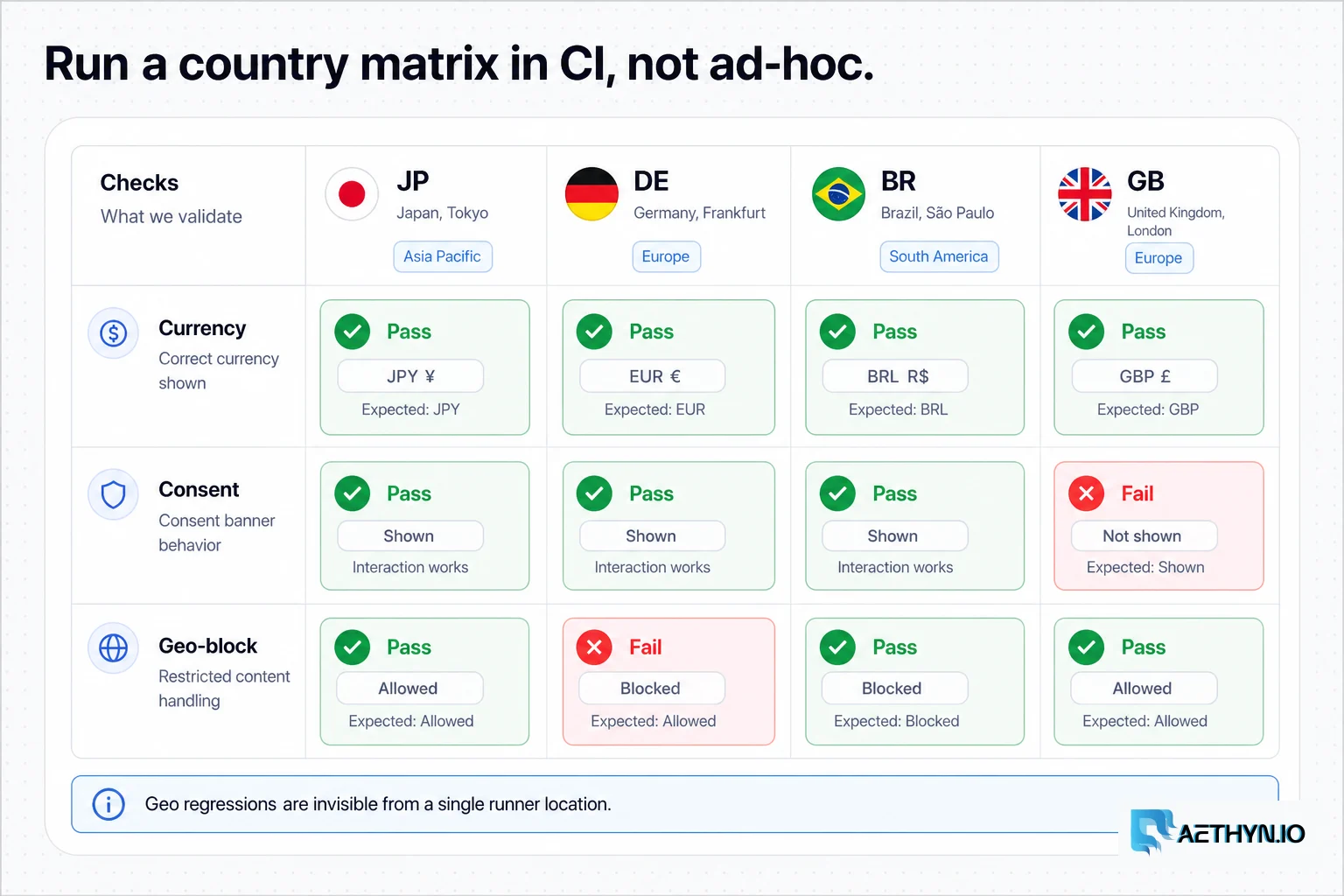
- Confirming geo-blocking, licensing, and consent banners actually fire per region
- Validating localized currency, tax, language, and pricing together
- Keeping a geo test matrix fast and non-flaky in CI
Approaches that usually fail
- VPNs — few locations, shared detectable IPs, and painful to script in CI
- Asking colleagues abroad to check — slow, unrepeatable, and not in CI
- Spoofing only headers/locale — misses all IP-based logic and gives false passes
- Datacenter proxies — treated as non-residential and routed unlike real users
When residential proxies fix this — and when they cannot
Residential proxies let automated and manual tests originate from real consumer IPs in any target country, so GeoIP lookups, CDN edge logic, and geo-blocking resolve exactly as they would for a local user. Because it's just a proxy endpoint, the same suite runs in CI unchanged — turning regional QA from a manual favor into a repeatable, scheduled check.
How Aethyn residential proxies help here
Geo testing needs broad country coverage and a clean way to swap regions inside an existing test suite. Aethyn changes region through the username, so one endpoint drives the whole matrix on the cost-efficient Premium tier.
- 195+ countries to cover every geo branch your product ships
- Country targeting (city/ISP on Elite) for precise regional logic
- Standard proxy auth that drops into Playwright, Selenium, and Cypress suites
- Sticky sessions for multi-step regional flows (signup, checkout, consent)
- Premium pricing that keeps scheduled CI geo-sweeps affordable
How to implement this with residential proxies
- 1
Parameterize tests by country — and assert the real value
Drive the suite from a list of countries, building the proxy username per region. The key is asserting the actual expected output per country (¥ in Japan, € in Germany), not just that some currency element exists — a weak assertion passes even when the geo logic is broken.
Python (pytest + Playwright)import pytest from playwright.sync_api import sync_playwright # Expected, per-country ground truth — this is what makes the test meaningful EXPECTED = {"us": ("$", "en-US"), "de": ("€", "de-DE"), "jp": ("¥", "ja-JP")} @pytest.mark.parametrize("country", list(EXPECTED)) def test_localized_price(country): symbol, locale = EXPECTED[country] with sync_playwright() as p: b = p.chromium.launch(proxy={ "server": "http://proxy.aethyn.io:2099", "username": f"aethyn-XXXXX-country-{country}", "password": "PASSWORD", }) page = b.new_page(locale=locale) page.goto("https://yourapp.example/pricing") assert symbol in page.locator(".price").inner_text() b.close()Field note: Set the browser locale (and timezone) to match the proxy country. Real users in Germany have a German IP and a de-DE browser; testing a German IP with an en-US browser can take a different code path than any real user ever hits.
- 2
Verify geo-blocking and consent banners fire correctly
Test both directions: that restricted regions are actually blocked or redirected, and that allowed regions are not. Assert on the real signal — HTTP status, a redirect's final URL, or the presence of the GDPR/CCPA banner — for each country, including the negative cases.
Python (geo-block assertions)BLOCKED = {"cn", "ru"} # expected to be geo-blocked ALLOWED = {"us", "de", "jp"} @pytest.mark.parametrize("country", BLOCKED | ALLOWED) def test_geo_blocking(country, page_for): page = page_for(country) page.goto("https://yourapp.example/trial") if country in BLOCKED: assert page.locator(".region-unavailable").is_visible() else: assert page.locator(".signup-form").is_visible()Field note: The bug that bites in production is almost always the negative case — a feature reachable from a country it should be blocked in. Test 'allowed' regions as explicitly as 'blocked' ones.
- 3
Reproduce a customer's regional bug
When a user abroad reports something you can't see, stop debugging blind — route a session through their exact country (city on Elite) and follow their steps. A quick header check confirms the geo before you dig in.
cURLcurl -x "http://aethyn-XXXXX-country-br:PASSWORD@proxy.aethyn.io:2099" \ -I "https://yourapp.example/feature" # inspect status + redirects as a BR userField note: Pin a sticky session when reproducing a multi-step flow (signup → verify → checkout). The bug often lives in the interaction between steps, and a consistent IP keeps the repro faithful to the user's experience.
- 4
Wire the geo matrix into CI on a schedule
Store proxy credentials as CI secrets and run the country matrix as a scheduled job, not just on demand. Geo regressions creep in from CDN config changes, GeoIP database updates, and pricing edits — a nightly sweep across regions catches them before users do.
YAML (CI matrix)jobs: geo-tests: strategy: matrix: country: [us, de, jp, br, in] runs-on: ubuntu-latest env: PROXY_USER: aethyn-XXXXX-country-${{ matrix.country }} PROXY_PASS: ${{ secrets.AETHYN_PASSWORD }} steps: - uses: actions/checkout@v4 - run: pytest tests/geo -k ${{ matrix.country }}Field note: Keep the geo suite fast and parallel (one matrix leg per country) so it stays a routine check rather than a slow job people skip. Flaky geo tests get muted, and a muted test protects nothing.
Best practices that keep scrapers reliable
- Keep an explicit country matrix with expected values per region
- Assert the real localized output, not just that an element exists
- Match IP country, browser locale, and timezone together
- Test negative cases (allowed regions) as hard as blocked ones
- Run the geo matrix in CI on a schedule, parallelized per country
- Store proxy credentials as CI secrets and use sticky sessions for multi-step flows
Common mistakes that burn proxy budget
- Spoofing Accept-Language but not the IP, so geo logic is never exercised
- Weak assertions (element exists) that pass even when localization is broken
- Testing a country's IP with a mismatched browser locale/timezone
- Only testing blocked regions and missing the feature leaking into allowed ones
- Running geo checks ad-hoc instead of on a schedule, so regressions slip in
- Committing proxy credentials to source instead of CI secrets