

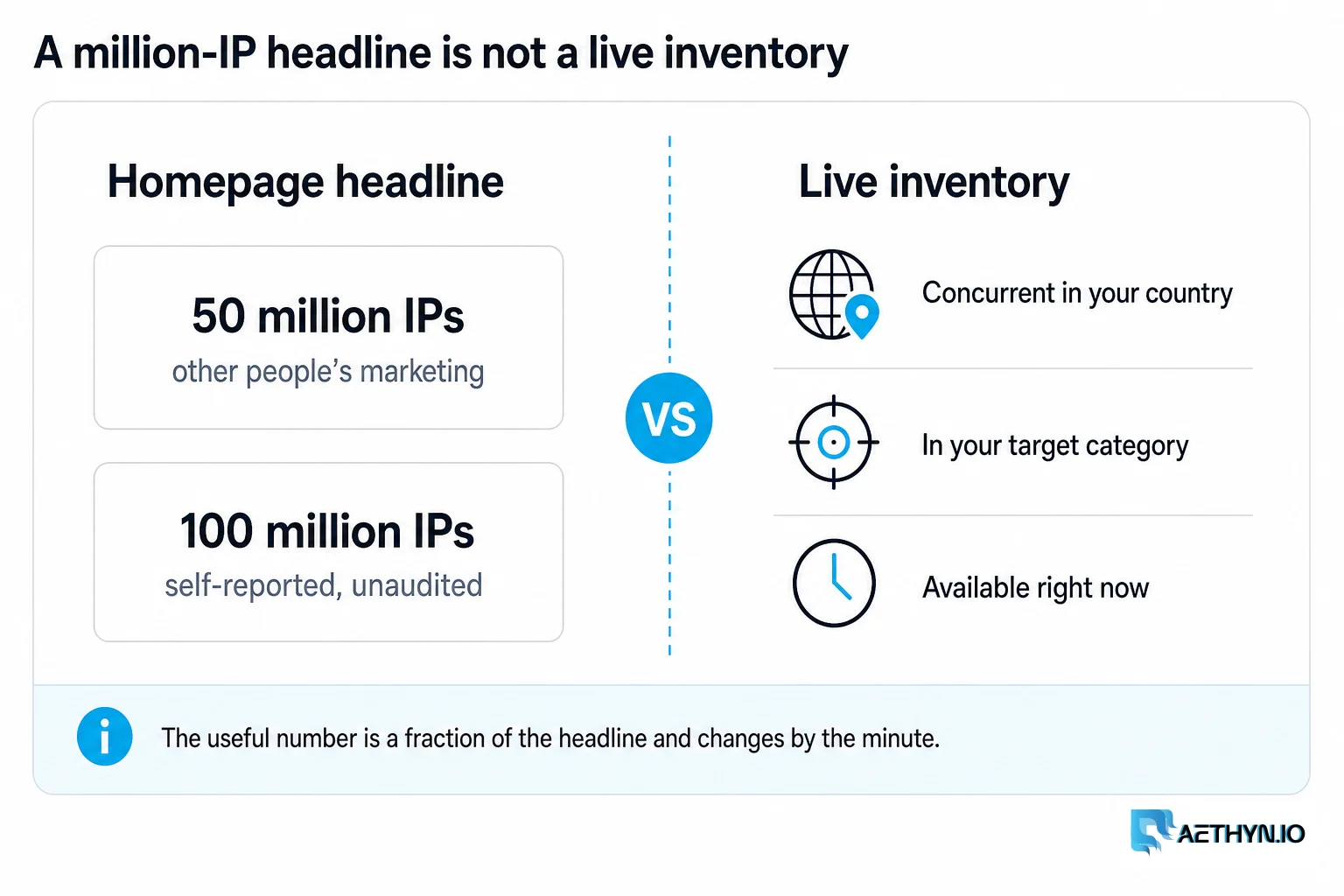
Open any proxy provider's homepage and the first thing you see is a number. 50 million IPs. 100 million. "The largest residential network in the world." It's the industry's favourite headline — and we're not going to give you one.
Not because we're hiding anything — because the number is close to meaningless, and we would rather earn your trust with things you can actually check. This is the long version of why: what the figure really measures, what actually decides whether your scraper succeeds, and how to test any provider — us included — in an afternoon.
What the pool-size number actually measures
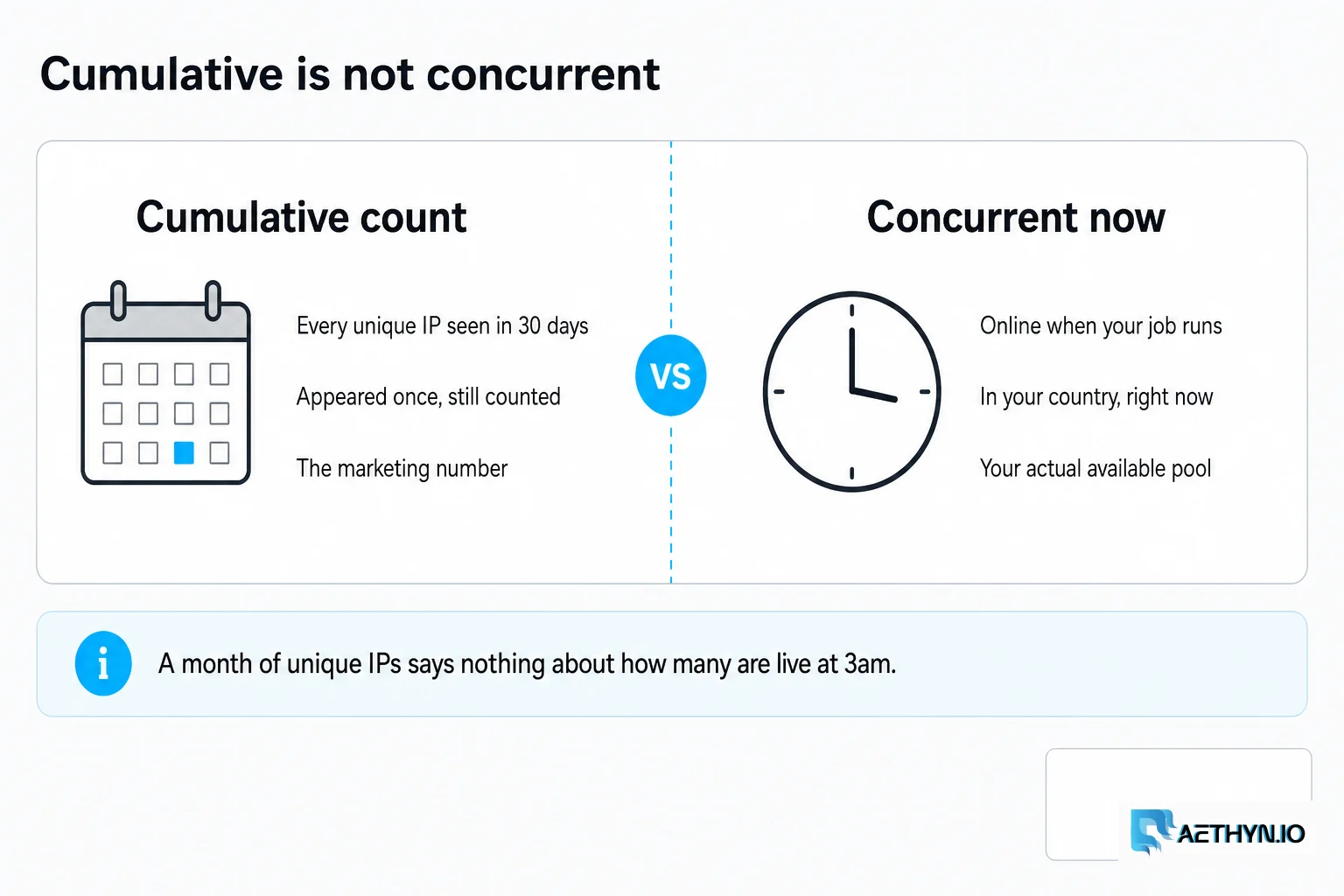
That headline figure is almost always a cumulative count of unique IP addresses seen over a window — usually a rolling 30 days. It is not a live inventory. Providers assemble supply from consumer devices, through disclosed SDKs, rewards apps, or partner networks, and tally every distinct address that appeared at least once during the period.
Three things follow, and none of them make the marketing:
- It's self-reported and unaudited. There is no standard for what counts as an IP, over what window, or whether an address that appeared for ten seconds counts the same as one online all month. The number is a marketing decision, not a measurement — two networks drawing on the very same underlying supply can honestly print very different figures.
- The incentive runs one way. No buyer has ever chosen a provider for having a smaller pool. Every incentive pushes the number up and nothing pulls it down, which is exactly the condition under which a metric stops meaning anything.
- Nobody publishes the figure that matters. The useful number would be concurrent addresses available in your country, in your target's category, right now. That is a fraction of the headline, it changes by the minute, and you will never see it on a pricing page.
Why the number can't predict your success
Even taken at face value, pool size is one of the weakest predictors of whether your requests land.
Cumulative isn't concurrent. A month of unique IPs tells you nothing about how many are online when your job runs. If a country shows a hundred million cumulative but a few thousand concurrent at 3am your time, the few thousand is your reality.
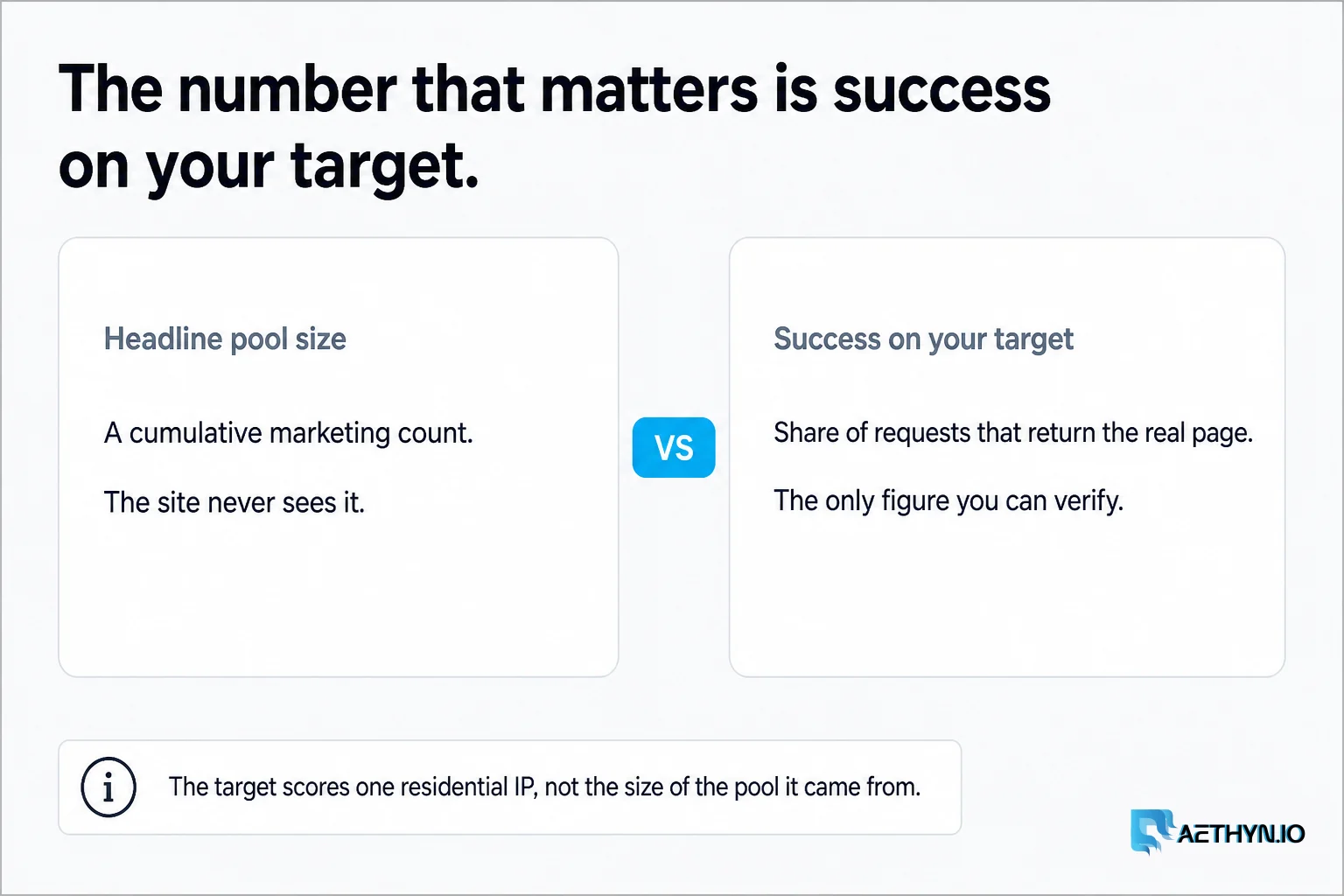
Quantity isn't quality. A huge pool packed with recycled, over-used, or already-flagged addresses performs worse than a smaller, clean one. The moment a target scores the specific IP you were handed, the size of the pool it came from is invisible and irrelevant.
Geography is the real limit. Ten million IPs are worthless if only a handful are live in the city, region, or ISP you need. A network that is enormous globally can be empty exactly where you are working. Concentration where you need it beats a global total you will never touch.
A big number can't fail gracefully. It is a vanity figure with no failure mode — it cannot tell you when it is wrong. A clean, well-routed IP either succeeds or it doesn't, and you can measure that. Only one of those two things shows up in your logs.
What actually decides whether a request lands
Here is the part the pool-size number distracts you from: the target never sees your pool. It sees one IP — the one you are using right now — and it scores that single address. Get inside that scoring and the whole "bigger is better" story falls apart.
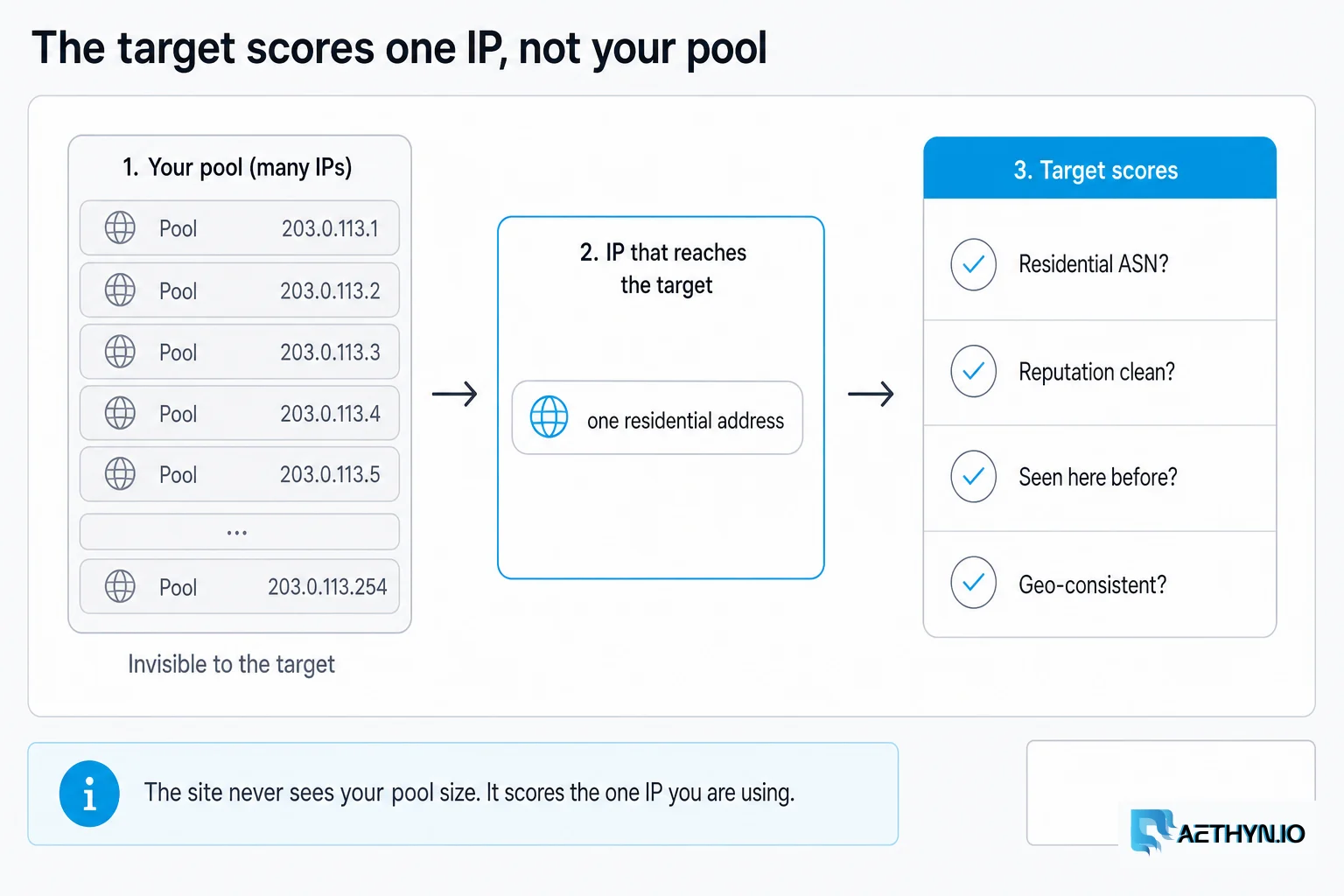
Modern anti-bot systems judge an incoming request on signals like:
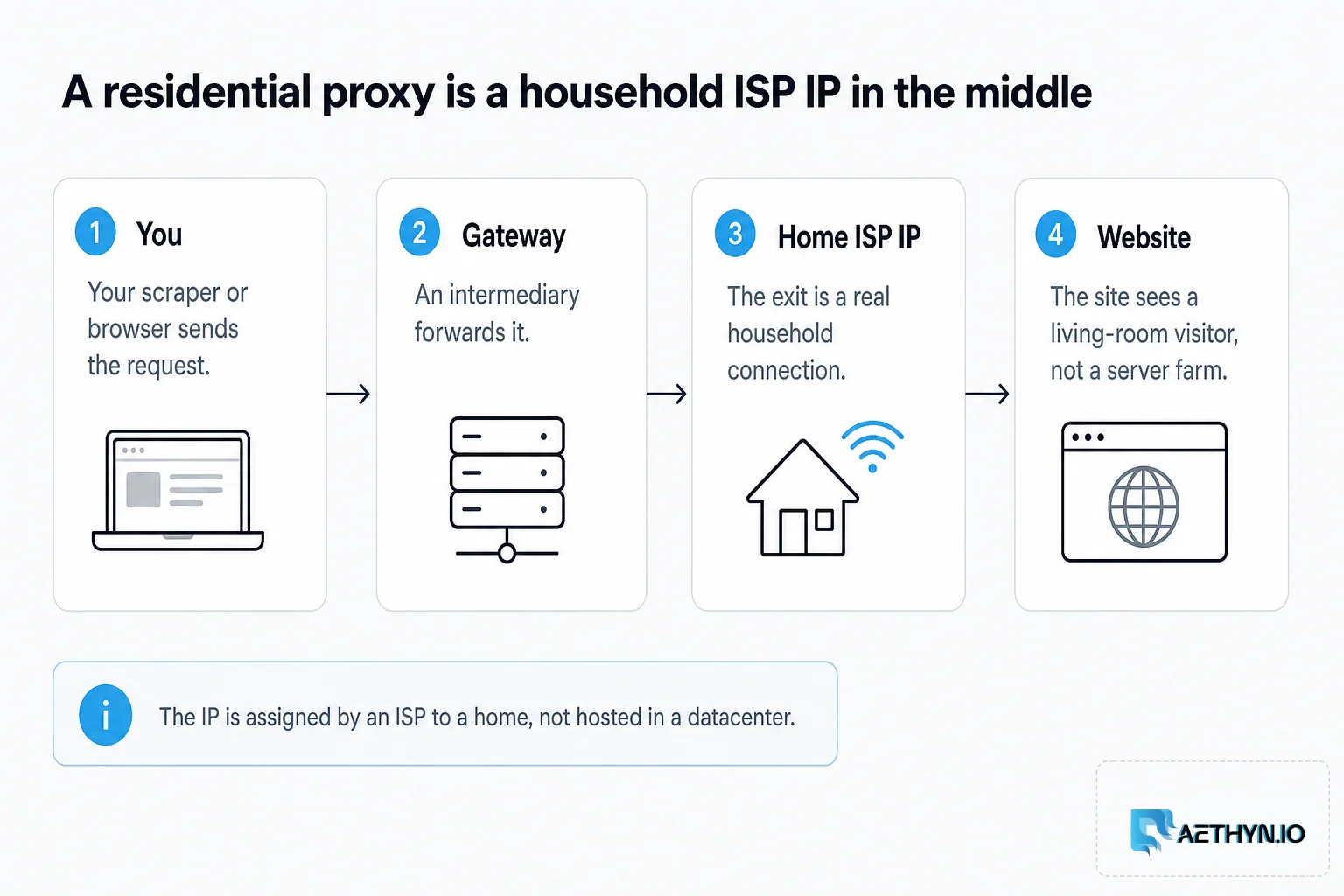
- Is this a residential IP at all? The address's ASN — the network that owns it — instantly separates a real consumer ISP from a datacenter or hosting provider. Datacenter ranges are cheap, fast, and blocked on sight for exactly that reason.
- What is this IP's reputation? Fraud-score and reputation databases track whether an address has recently been tied to abuse, spam, or automation. An IP with a bad score is challenged or blocked before it does anything.
- Has this IP already misbehaved here? Targets keep their own memory. An over-used exit that hammered them yesterday is treated very differently from a quiet residential address.
- Is the story consistent? An IP that geolocates to one country while the request's headers, timezone, and language claim another is a tell. Geo-consistency matters more than geo-availability.
None of these is pool size. All of them are properties of the individual IP and how it is routed to you. A provider optimising for the headline count scrapes up as much supply as it can; a provider optimising for your success curates which addresses you actually get and steers away from the ones that are burning.
What we stand behind instead: IP quality
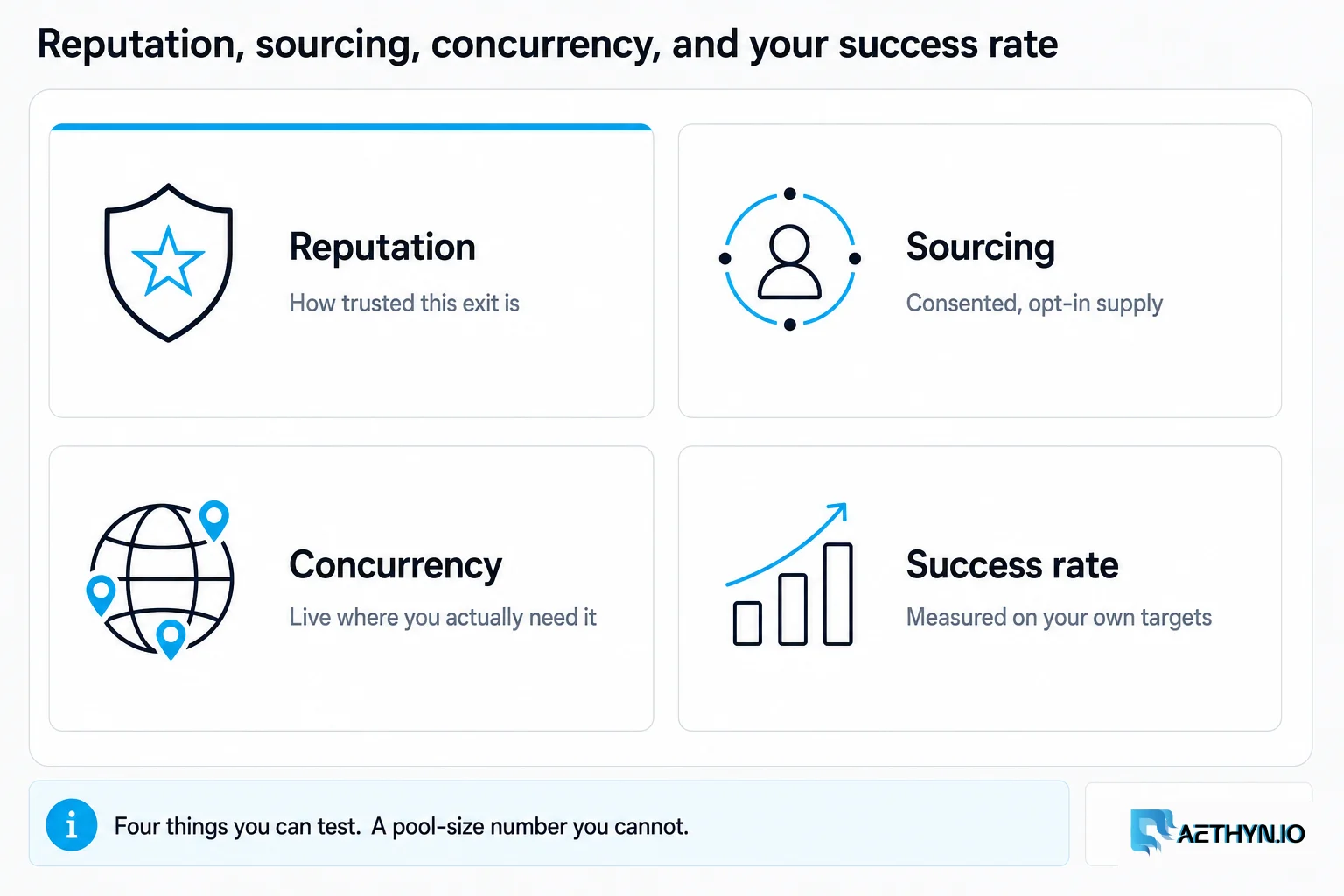
We would rather be measured on the things that actually decide whether your requests succeed. Quality here means four concrete properties — reputation, sourcing, concurrency where you need it, and success rate on your targets — and together they beat any headline count.
- Sourced with consent, not scraped from devices. Our residential IPs come from consented, KYC-verified partners and opt-in peers: real supply, not malware-tainted pools. That is a compliance position and a performance one — consented IPs belong to real users who behave like real users, which is exactly what a target's reputation check is looking for. Ask any provider where their IPs come from; if they can't answer plainly, that is your answer.
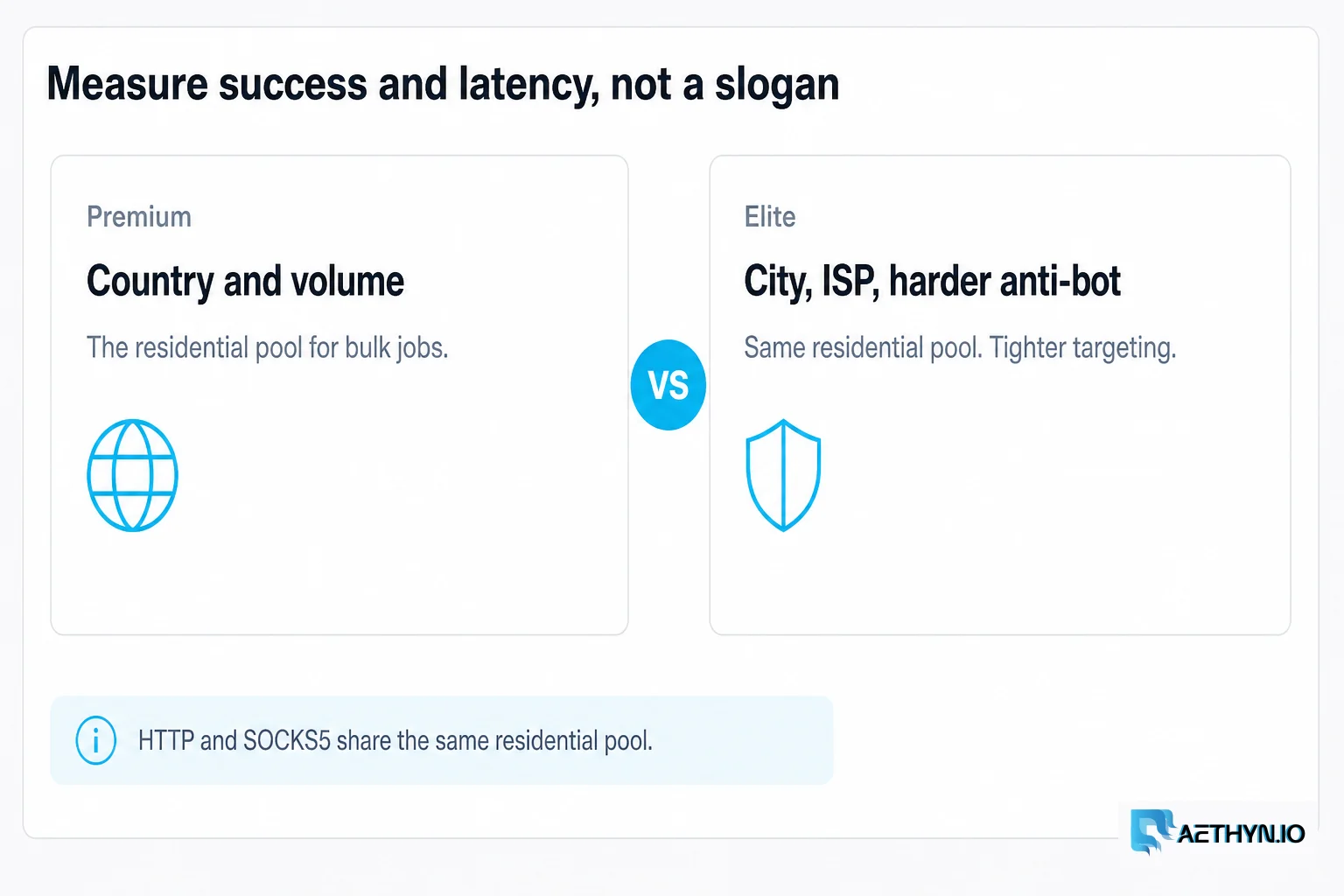
- Tiered supply, so you pick the trust level. Our residential network comes in two tiers — Premium for cost-efficient bulk collection, Elite when a hard target needs our highest-tier exits — so you match the tier to the job instead of paying for one undifferentiated pool.
- Success rate on your targets — proven, not promised. The only benchmark that matters is your own sites, not our slide deck, so we hand you a free trial and let you measure it. If we don't perform on your targets, no pool-size number would have saved us.
- Session control that holds. Sticky when you need one identity across a multi-step job, a fresh IP per request when you don't — behaviour you can verify in a few lines of code, not a claim to trust.
- Transparent per-GB pricing. €2.00/GB Premium and €4.50/GB Elite, billed per byte, so you can forecast a project to the cent — no opaque tiers, no sales call to see a price.
- Support that answers. When a target changes and something breaks, you reach a person who understands scraping, not a ticket queue.
That is the whole pitch: reputation + consented sourcing + real concurrency + measured success rate. It is less quotable than "100 million IPs." It is also the part that shows up in your success logs.
How to test any provider (including us) in an afternoon
You don't have to take anyone's word for this — the whole argument of this post is that you shouldn't. Here is a provider-agnostic way to measure the only things that matter. Run it on us; run it on whoever you use now.
1. Test on your real targets. Not httpbin, not a generic IP-echo endpoint, not the provider's demo — the sites you actually scrape, at the paths you actually hit. Success is target-specific; a network that sails through one site can drown on another.
2. Assert on content, not on status. This is the single most common mistake. A 200 response is not success — modern defenses return a 200 with a soft-block page, a CAPTCHA interstitial, or a stripped-down decoy. Count a request as successful only if the body contains something that appears exclusively on a real page: a price, a known element, a token. Everything else is a failure dressed as a 200.
3. Measure a rate, over volume. One request proves nothing. Send a few hundred across a mix of your targets, count the content-verified successes, and divide. That percentage — your success rate on your sites — is the number the whole industry's marketing exists to distract you from.
4. Check the exits. Pull a handful of the IPs you were served and confirm they read as residential — a consumer ISP's ASN, not a datacenter range — and that they geolocate where you asked. That is the line between a real residential network and a datacenter pool dressed up as one.
5. Watch the meter. Note the gigabytes a real run actually consumes and multiply by the per-GB rate. That is your true cost at scale — and if you can't get a clear per-GB number without a sales call, that itself is a finding.
Whatever wins that test is your provider. The pool size never enters the calculation, because it was never in the target's calculation either.
The economics: you pay per gigabyte, not per IP
Notice what you never actually buy when you buy a proxy plan: individual IPs. You buy bandwidth. Which is why the honest unit of pricing is per gigabyte — not a tier gated by "ports" or "unlimited IPs" that obscure what a real workload will cost.
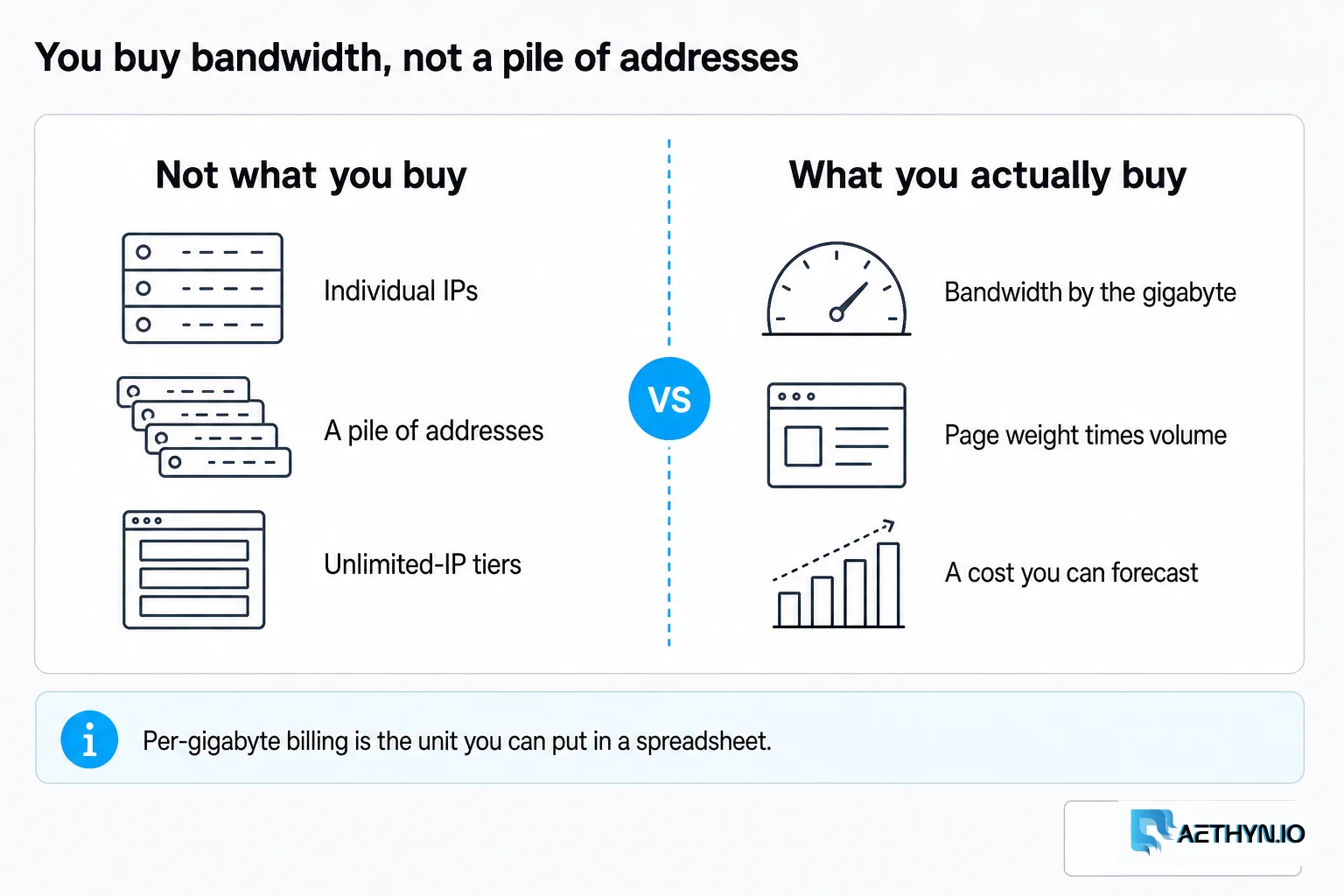
Per-byte pricing you can forecast. Take the average page weight of your targets, multiply by your request volume, and you have your monthly cost before you spend a euro. Opaque tiers and "contact sales" pricing exist precisely because that arithmetic is unfavourable to the seller — the surprise arrives at scale, after you have built on top of them. Transparent per-GB billing is the boring answer, and it is the one you can put in a spreadsheet.
The one question a provider can't dodge
If you take a single thing from this: ask where the IPs come from, and don't accept a non-answer.
Sourcing is where the whole quality story begins. IPs obtained from users who gave informed, opt-in consent — through disclosed SDKs or rewards programs, with the freedom to leave — behave like the real people they belong to, and carry the reputation to match. IPs harvested from compromised or unwitting devices are, bluntly, a botnet: already flagged, ethically indefensible, and a legal liability you inherit the moment you route through them. The dividing line is ethical sourcing, and it is the one claim a provider cannot fake for long — a clean sourcing story is either documented or it is not.
A network that leads with a pool-size number and goes quiet on sourcing has told you which one it optimised for.
The honest version of our pitch
We are not the largest anything, and we are not going to pretend a headline number means what it doesn't. What we will stake our name on is the stuff that shows up in your success logs: consented, high-reputation IPs, session control that holds, geo-targeting that is accurate, transparent per-byte pricing, and support that answers — all of it verifiable, none of it on faith.
So don't take our word for it, and don't take anyone's number for it. Run the test above on your own targets. That is the only benchmark that has ever mattered, and it is the one we are happy to be judged on.
Test us on your own targets — free, no card · see transparent pricing
Common questions about this article
Does a bigger proxy pool mean higher success rates?
Why won't you quote an IP-pool number?
What should I judge a residential network on instead?
How can I tell if a provider's IPs are actually good?
Why do datacenter proxies get blocked when residential ones don't?
How do I estimate my proxy bandwidth cost?
Guides, integrations & docs
Continue reading
2026 Residential Proxy Benchmarks: Elite vs Premium Pools
We put our own network to the test. See the latest performance data on success rates, latency, and throughput across different pool types.
Residential Proxy Statistics 2026: Market Data & Network Trends
A data-driven look at the residential proxy market in 2026 — adoption, success rates, latency, pricing, and traffic patterns drawn from Aethyn network data and industry estimates.
What Are Residential Proxies? Complete Beginner Guide (2026)
Learn everything about residential proxies: how they work, why they are more reliable than datacenter IPs, and how to use them for your business in 2026.
Don't take a number on faith — test us
Point a free trial at your own targets and measure the success rate yourself. No card, transparent per-GB pricing, and real people on support.