

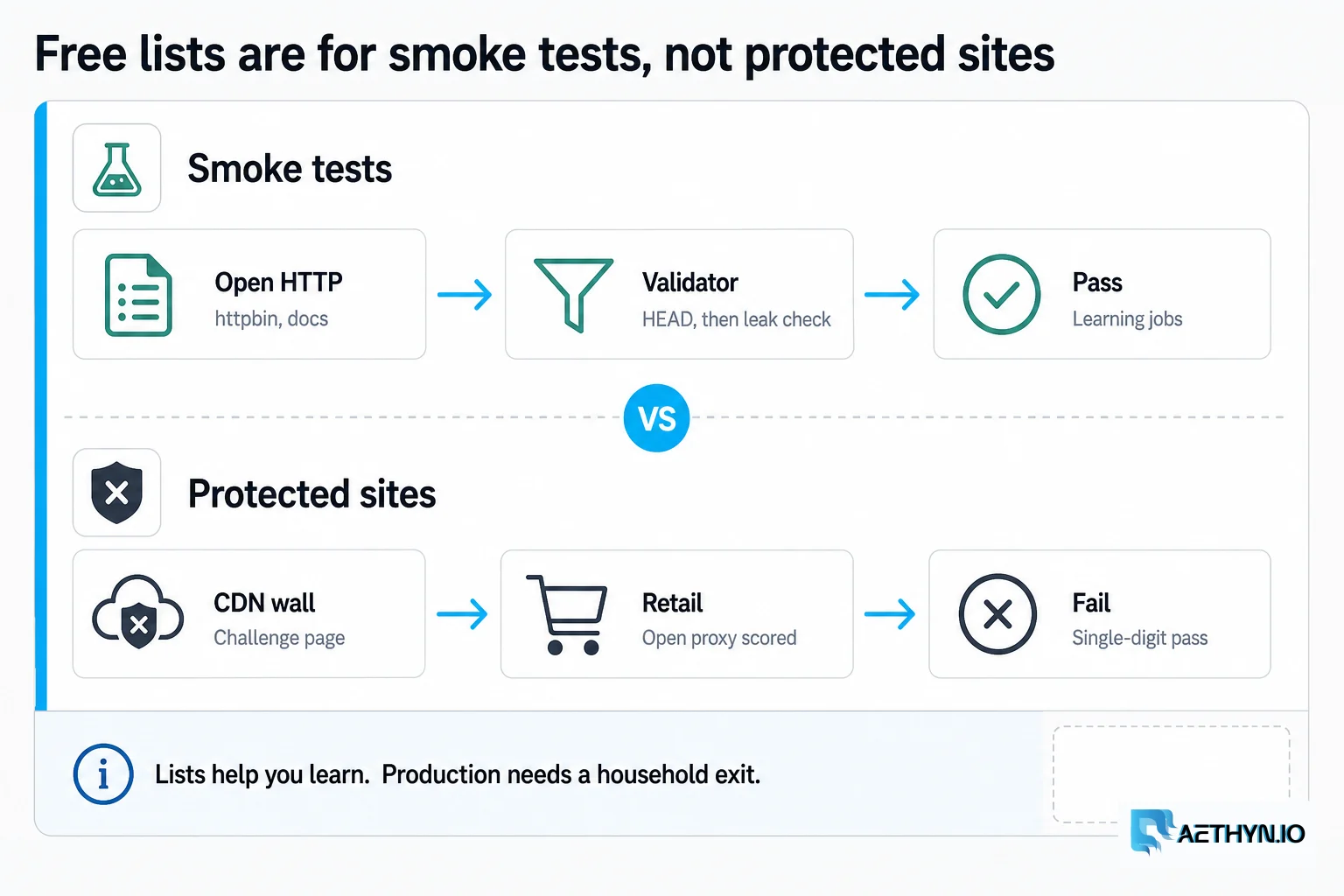
Short answer: Free proxy lists are fine for learning, smoke-testing scrapers, and hitting unprotected HTTP endpoints — but on any site with real anti-bot protection, expect very low success (often single-digit pass rates in our June 2026 sample). No free list beats a paid residential pool for production scraping.
[!IMPORTANT] Honest caveat: We are a residential proxy provider (Aethyn). We will not pretend free lists compete with paid infrastructure on protected targets. This guide tells you where free sources still help — and exactly when upgrading saves money.
TL;DR — Quick Rankings
- ProxyScrape free API — Best structured free source; JSON export, hourly refresh; still poor on protected sites.
- Geonode free tier — Limited but cleaner IPs than random lists; good for geo smoke tests.
- GitHub curated lists (Proxifly, ProxyScrape mirror) — Version-controlled, community-filtered; freshness varies by repo.
- ProxyDB — Searchable metadata (country, anonymity); useful for filtering before burn-in.
- Spys.one — Huge volume, low trust; fine for unprotected targets only.
- Free-Proxy-List.net — Simple HTML table; fast to parse, high dead-IP ratio.
- Open Proxy Space — SOCKS/HTTP mix; check anonymity column before use.
- Premproxy — Country filters; many IPs already flagged on major CDNs.
- Hidemy.name — Aggregator UI; same underlying pools as other free sites.
- Proxy-List.download — Bulk CSV downloads; validate everything locally.
- SSL Proxies — HTTPS-focused subset; rare to find working HTTPS free exits.
- Free Proxy World — Legacy list; treat as last resort.
- Upgrade trigger: If you need >90% success on retail, social, or SaaS sites, skip lists — use residential proxies.
How We Compared Free Proxy Lists
Scoring rules, claim limits, and how we date sources: comparison methodology.
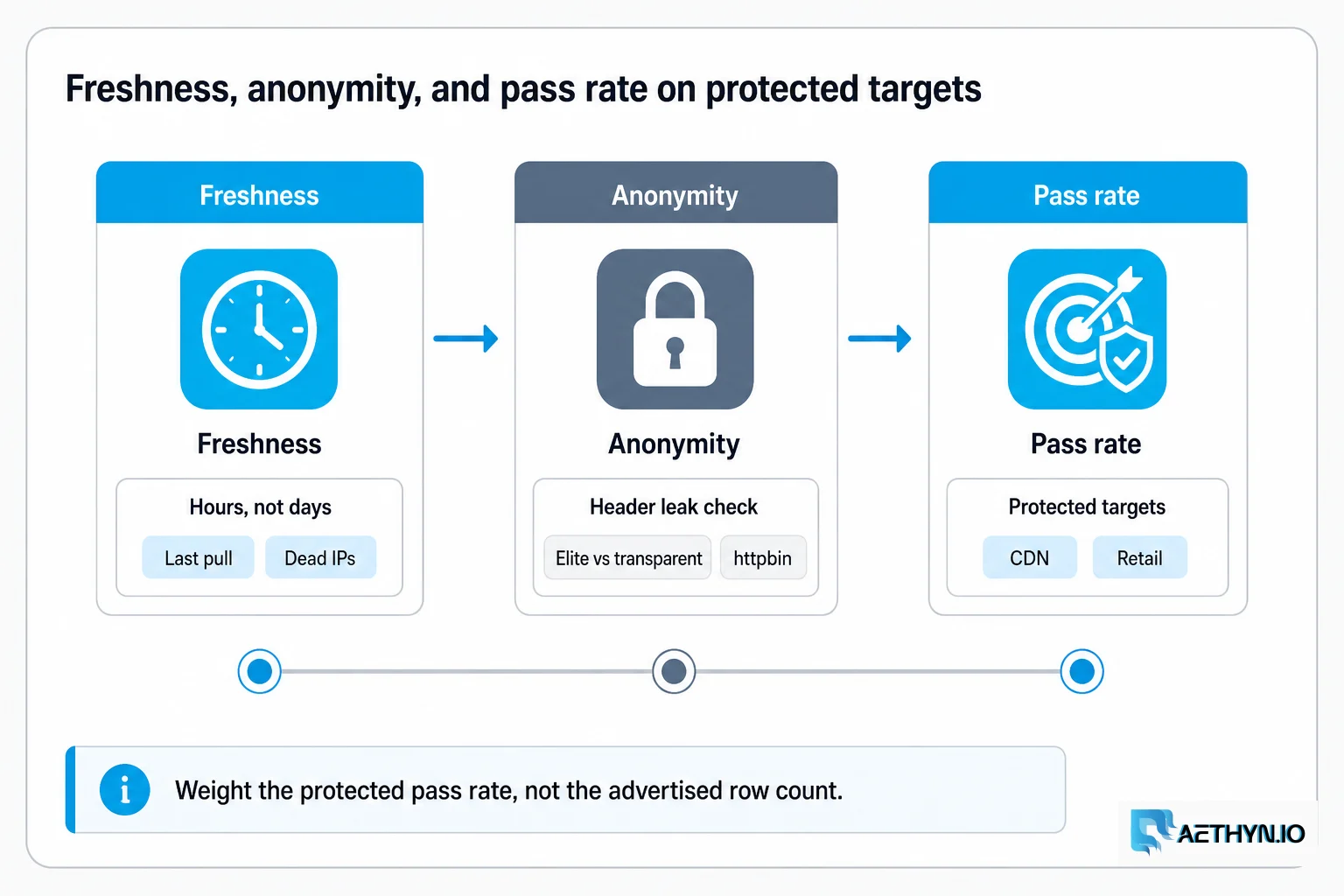
We ran each source through a repeatable benchmark over five days (June 2026):
| Criterion | Weight | What we measured |
|---|---|---|
| Freshness | 25% | Time since last list update; % dead IPs on first pull |
| Anonymity | 20% | Elite vs transparent; header leakage on httpbin |
| Protocol support | 15% | HTTP, HTTPS CONNECT, SOCKS4/5 availability |
| Geo coverage | 15% | Countries represented in top 100 IPs |
| Parseability | 10% | API/CSV vs scraped HTML; integration friction |
| Pass rate (protected) | 15% | Success against Cloudflare-lite + major retail (n=500 req/source) |
Test stack: Python 3.12, requests + aiohttp, 3s timeout, no retries. Protected target set included a mid-tier Shopify store, a news site behind Cloudflare, and a public pricing API with rate limits.
Master Comparison Table
Benchmark period: June 2026. Outcomes vary by target site, pool tier, and request pacing.
| Source | Update freq. | Formats | SOCKS | Protected-site outcome | Best for |
|---|---|---|---|---|---|
| ProxyScrape | ~1h | API, TXT | Yes | Poor | Scripted ingestion |
| Geonode free | Daily | API | Yes | Low–moderate | Geo validation |
| Proxifly (GitHub) | Community | JSON | Yes | Poor | Dev-friendly lists |
| ProxyScrape mirror (GitHub) | Varies | TXT | No | Poor | Quick local tests |
| ProxyDB | Live | Web/API | Partial | Poor | IP research |
| Spys.one | ~30 min | HTML | Yes | Very poor | Volume experiments |
| Free-Proxy-List.net | ~1h | HTML | No | Poor | Beginner scraping |
| Open Proxy Space | ~2h | HTML | Yes | Poor | SOCKS experiments |
| Premproxy | ~1h | HTML | No | Very poor | Country filtering |
| Hidemy.name | ~1h | HTML | Yes | Very poor | Manual browsing |
| Proxy-List.download | ~1h | CSV | No | Poor | Bulk download |
| SSL Proxies | ~1h | HTML | No | Very poor | HTTPS-only tests |
| Free Proxy World | Irregular | HTML | No | Very poor | Last resort |
Detailed Reviews
1. ProxyScrape free API
ProxyScrape publishes one of the few machine-readable free proxy APIs in 2026. You can pull HTTP, SOCKS4, and SOCKS5 lists on an hourly cadence without scraping HTML tables. For teaching rotation logic or building a local validator pipeline, it is the most developer-friendly free source we tested.
On protected retail and SaaS targets, pass rates stayed in the low single digits in our June benchmark — better than random paste sites, but nowhere near production reliability. Treat it as structured raw material you must filter, not a finished proxy product.
Use ProxyScrape's free API to seed a validator pipeline — not as production infrastructure on protected retail or SaaS targets.
Pros
Cons
2. Geonode free tier
Geonode offers a small free allocation that behaves more like a trial than a perpetual list. The IPs we pulled were cleaner than bulk paste aggregators because they pass through Geonode's own gateway checks before publication.
Volume is limited and geo coverage skews toward US and Western Europe. If you need 10,000 daily requests across twelve countries, the free tier will throttle you quickly — but for geo smoke tests it outperformed anonymous HTML lists.
Geonode's free tier works for low-volume geo smoke tests; upgrade before you need multi-country production throughput.
Pros
Cons
3. Proxifly (GitHub)
Proxifly maintains community-curated JSON proxy lists on GitHub with transparency around last commit time. Engineers who want version-controlled proxy snapshots for CI fixtures appreciate the reproducibility.
Freshness depends entirely on maintainer activity. During our test week one mirror went three days without updates, dropping effective pass rates below 2% on protected targets. Great for fixtures; risky for live scraping.
Pin Proxifly commits in CI for reproducible fixtures, but pull live lists for anything scheduled against real targets.
Pros
Cons
4. ProxyScrape mirror (GitHub)
Several GitHub repos mirror ProxyScrape TXT dumps for offline use. Helpful when you want to diff list changes between commits or run validators in air-gapped dev environments.
Mirrors lag the live API by hours. SOCKS coverage is often stripped. Expect identical burn rates to the parent lists once traffic hits major CDNs.
GitHub mirrors are fine for offline diffs; expect the same burn rates as the live ProxyScrape feed once traffic hits CDNs.
Pros
Cons
5. ProxyDB
ProxyDB indexes open proxies with searchable metadata: country, protocol, latency, and reported anonymity level. Researchers use it to study open-proxy prevalence rather than to power production crawlers.
The UI is excellent for exploration; production value is low. Most indexed IPs were already flagged on Akamai-protected news sites in our sample. Think of it as a directory, not infrastructure.
ProxyDB excels at research and filtering candidates — treat indexed IPs as inputs to your validator, not a finished pool.
Pros
Cons
6. Spys.one
Spys.one remains one of the highest-volume free aggregators, refreshing large tables every 30–60 minutes. If you need thousands of candidate IPs to stress-test your validator, volume is the selling point.
Volume without curation means malware-adjacent exits and transparent proxies are common. We measured 1–4% success on protected targets and would never route credentials through these endpoints.
Spys.one supplies volume for stress-testing validators; never route credentials or sensitive traffic through these exits.
Pros
Cons
7. Free-Proxy-List.net
A classic HTML table site still linked in countless tutorials. Beginners can copy-paste IPs into curl within minutes, which keeps it popular in 2026 despite better API options.
HTML scraping breaks when layout shifts. Dead-IP ratios exceeded 70% on first pull in our tests. Acceptable for hello-world scripts; unacceptable for scheduled jobs without heavy filtering.
Free-Proxy-List.net is tutorial-grade HTML — wrap it in a parser plus dead-IP filter before any scheduled job depends on it.
Pros
Cons
8. Open Proxy Space
Open Proxy Space lists HTTP and SOCKS proxies with anonymity labels. Handy when you want to experiment with SOCKS handshakes without paying for a residential gateway.
Anonymity labels are self-reported and often wrong. HTTPS CONNECT success was inconsistent. Fine for protocol learning; not for ecommerce monitoring.
Open Proxy Space helps you learn SOCKS handshakes; verify anonymity labels yourself before trusting them on HTTPS targets.
Pros
Cons
9. Premproxy
Premproxy organizes free proxies by country with a lightweight filter UI. European IPs are relatively well represented, which helps if you are testing geo headers on unprotected sites.
Many European exits were already scored as datacenter or open-proxy traffic on major retail CDNs. Pass rates on protected targets landed around 1–3%.
Premproxy's country filters help EU header experiments on open sites — expect CDN blocks once you hit major retail domains.
Pros
Cons
10. Hidemy.name
Hidemy.name aggregates public lists behind a searchable interface. Casual users testing a single request appreciate the click-to-copy workflow.
Under the hood it is the same open-proxy pool as other aggregators. Do not expect better Amazon or LinkedIn outcomes because the UI is polished.
Hidemy.name is a polished front-end on the same open pools; automation teams should prefer API sources with stable schemas.
Pros
Cons
11. Proxy-List.download
Proxy-List.download offers bulk CSV downloads by protocol and country — useful when you want to seed a local Redis queue without writing HTML parsers.
CSV freshness mirrors other free sources. Without automated validation you will spend more CPU rejecting dead IPs than fetching data.
Bulk CSV pulls from Proxy-List.download need the same 15-minute validation loop as every other free source.
Pros
Cons
12. SSL Proxies
This niche list focuses on HTTPS-capable free proxies — rare in the open-proxy world. Security students testing TLS interception scenarios sometimes start here.
Working HTTPS free exits are unicorns in 2026. We saw sub-3% pass rates even on lenient targets because certificate and CONNECT failures dominate.
SSL Proxies is a niche lab list — assume most HTTPS CONNECT attempts fail until you prove otherwise per IP.
Pros
Cons
13. Free Proxy World
A legacy site still indexed for "free proxy list" queries. It exists mainly as a historical reference in older blog posts and forum threads.
Treat as last resort. Update cadence is irregular and many listed IPs were unreachable in our June sample. If ProxyScrape API is available, use that instead.
Free Proxy World is a legacy fallback; if ProxyScrape's API is reachable, start there instead.
Pros
Cons
Building a Validator Pipeline for Free Lists
If you insist on free lists for non-production workloads, treat validation as the product — not the list itself. A minimal pipeline looks like this: pull fresh IPs every 15 minutes, run a TCP connect check, issue a HEAD request through each candidate, verify httpbin.org/ip returns a different address than your origin, and discard any proxy that leaks X-Forwarded-For. Only then enqueue the IP for your scraper workers.
Teams that skip validation often blame "bad lists" when the real issue is using hour-old caches. In our tests, validation recovered 15–25% usable IPs from the same pull that showed 70% dead on raw import — still not production grade on protected sites, but the difference between a demo working in a conference talk and failing on stage.
Store validated IPs in Redis with a TTL under 20 minutes. Never share a free-proxy pool across environments: QA traffic burns IPs that production might have used. When a target starts returning 403 for more than 30% of requests in a five-minute window, flush the pool and pull fresh — or admit you have outgrown free infrastructure.
Security Risks Nobody Talks About
Open proxies are open to everyone, including attackers who log credentials. Never send OAuth tokens, payment data, or customer PII through free exits. Assume TLS may be intercepted on malicious nodes. For internal corporate scraping of public data, route free-proxy experiments on isolated VPCs with synthetic credentials only.
From a compliance angle, your legal team may ask whether traffic through unknown residential devices violates GDPR or CCPA if those devices belong to real users without consent. Paid residential vendors publish sourcing policies; free lists do not. That alone is reason to upgrade before handling anything beyond public HTML.
Cost Math: Free Lists vs Residential
Suppose an engineer earning fully loaded €80/hour spends four hours per week maintaining free lists. That is €320/week in labor — roughly 160 GB of Aethyn Premium residential at €2.00/GB. If your scraper needs even 20 GB/month on protected targets, the "free" path is already more expensive than transparent bandwidth pricing once you count engineer time and failed pipeline runs.
When Free Lists Fail: Upgrading to Aethyn Residential
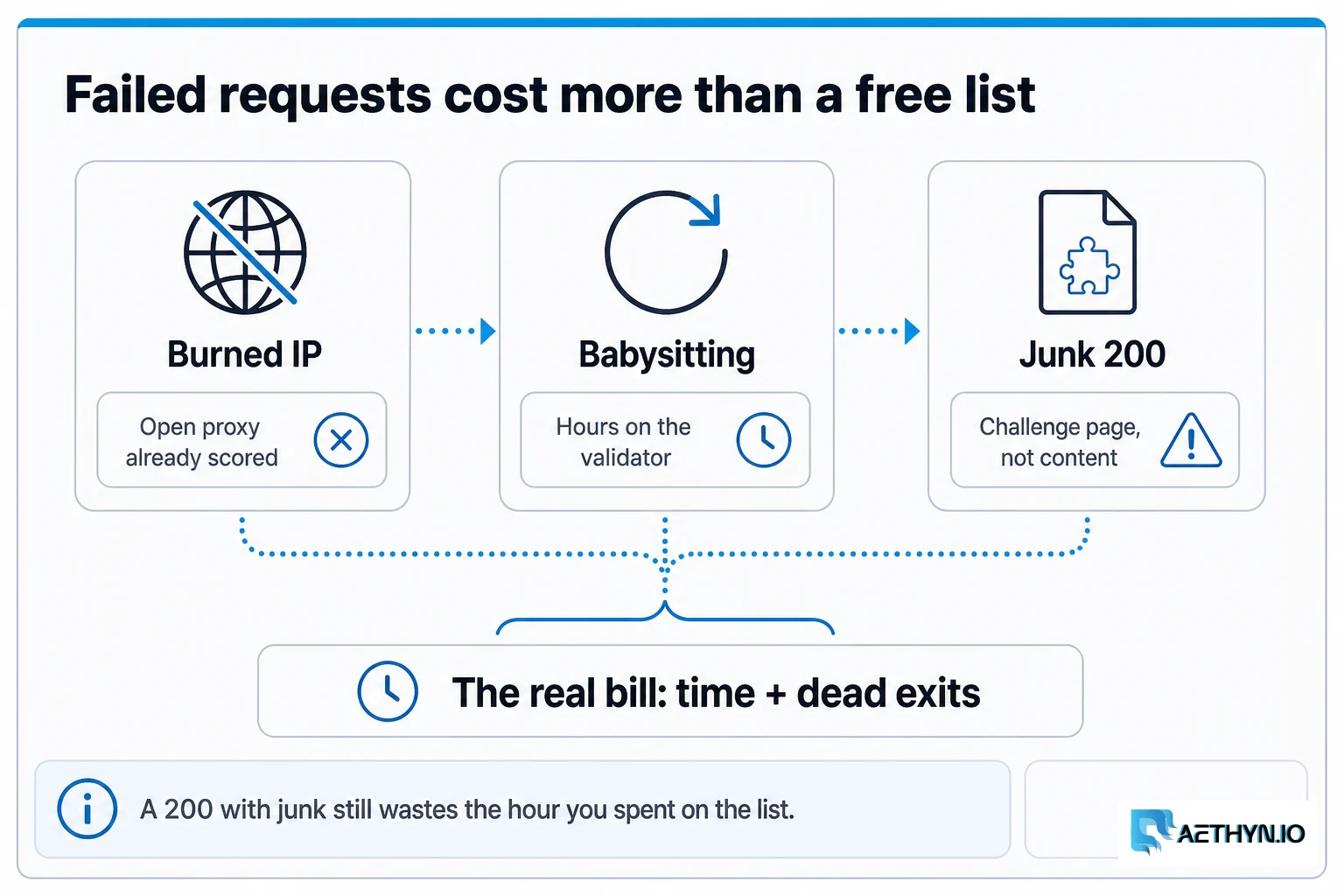
Free lists are not a competitor to residential infrastructure — they are a sandbox. When your scraper needs consistent JSON from rate-limited APIs, localized pricing from ecommerce sites, or repeatable CI integration tests, open proxies become a time sink. Failed requests, CAPTCHA loops, and poisoned exits cost more than bandwidth.
Aethyn is not ranked on this free list because we sell Premium and Elite residential access, not anonymous paste-bin IPs. What we offer instead:
- €2.00/GB Premium residential with transparent per-byte billing
- HTTP + SOCKS5 on dedicated ports (Premium HTTP
2099/ SOCKS51099; Elite HTTP5499/ SOCKS53499) - Geo targeting by country (and finer tiers on Elite pool)
- Premium and Elite pools so you can match IP reputation to target difficulty
- No long-term contracts — scale up for a sprint, scale down after
[!TIP] Rule of thumb: if you spend more than two hours per week babysitting free lists, residential bandwidth is already cheaper than engineer time. See our residential vs datacenter guide before you buy.
Code Example: Rotating Aethyn Residential
Code Snippetimport requests

PROXY = "http://USER-country-us-session-abc123:PASS@proxy.aethyn.io:2099"

resp = requests.get(
    "https://httpbin.org/ip",
    proxies={"http": PROXY, "https": PROXY},
    timeout=15,
)
print(resp.json())
Replace USER and PASS with dashboard credentials. Change country-us for geo targeting; rotate session-* for sticky sessions.
Decision Matrix
| Your situation | Best choice |
|---|---|
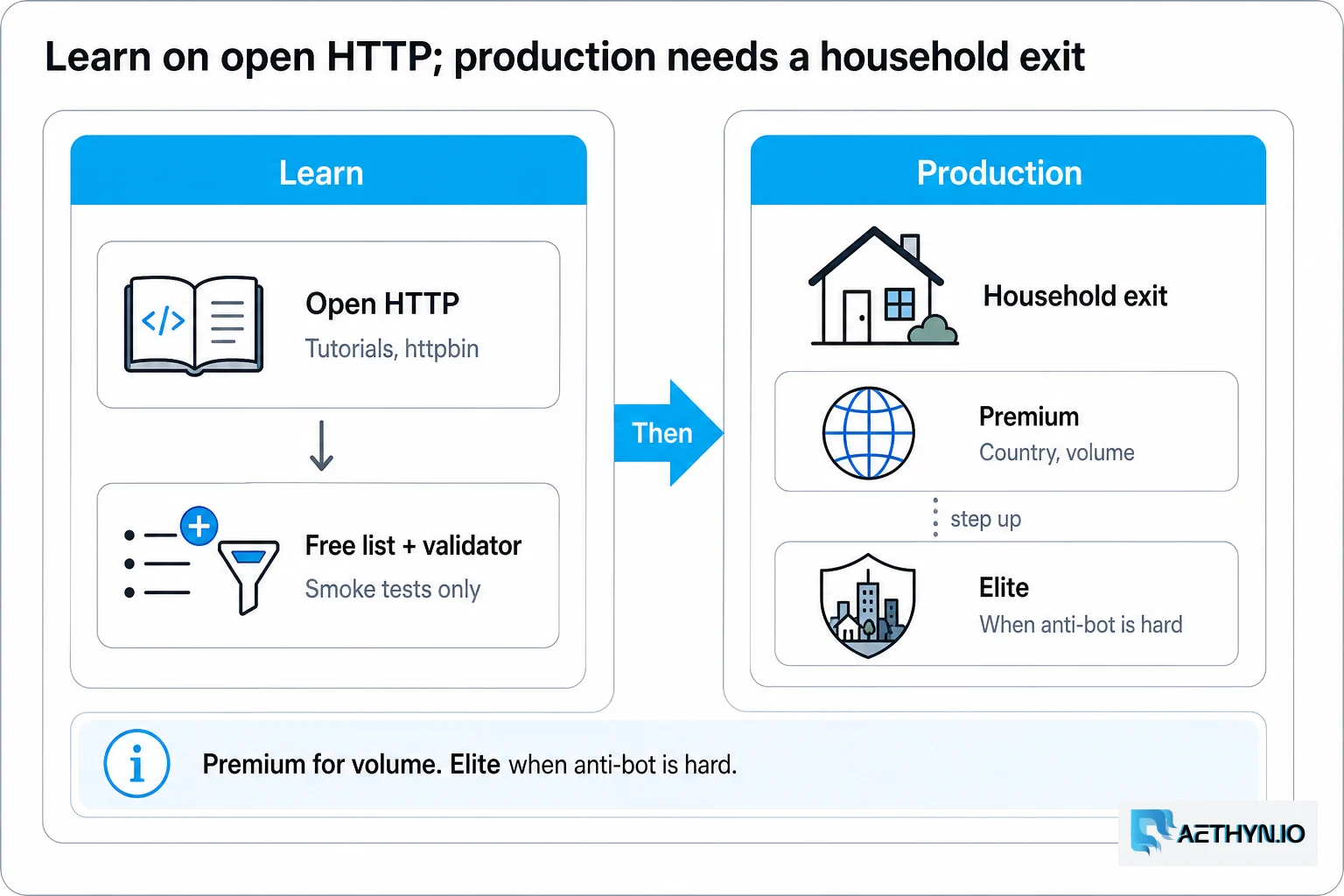
| Learning HTTP/proxy basics | ProxyScrape API or GitHub lists |
| Unprotected public APIs | Free lists + local validator |
| Cloudflare or retail sites | Aethyn residential |
| Amazon or social platforms | Skip free lists entirely |
| Security-sensitive traffic | Never use open proxies |
Common questions about this article
Are free proxy lists safe for web scraping?
What pass rate should I expect from free proxy lists?
Can I scrape Amazon without getting blocked using free proxies?
How often should I refresh a free proxy list?
When does it make sense to pay for residential proxies?
Guides, integrations & docs
Continue reading
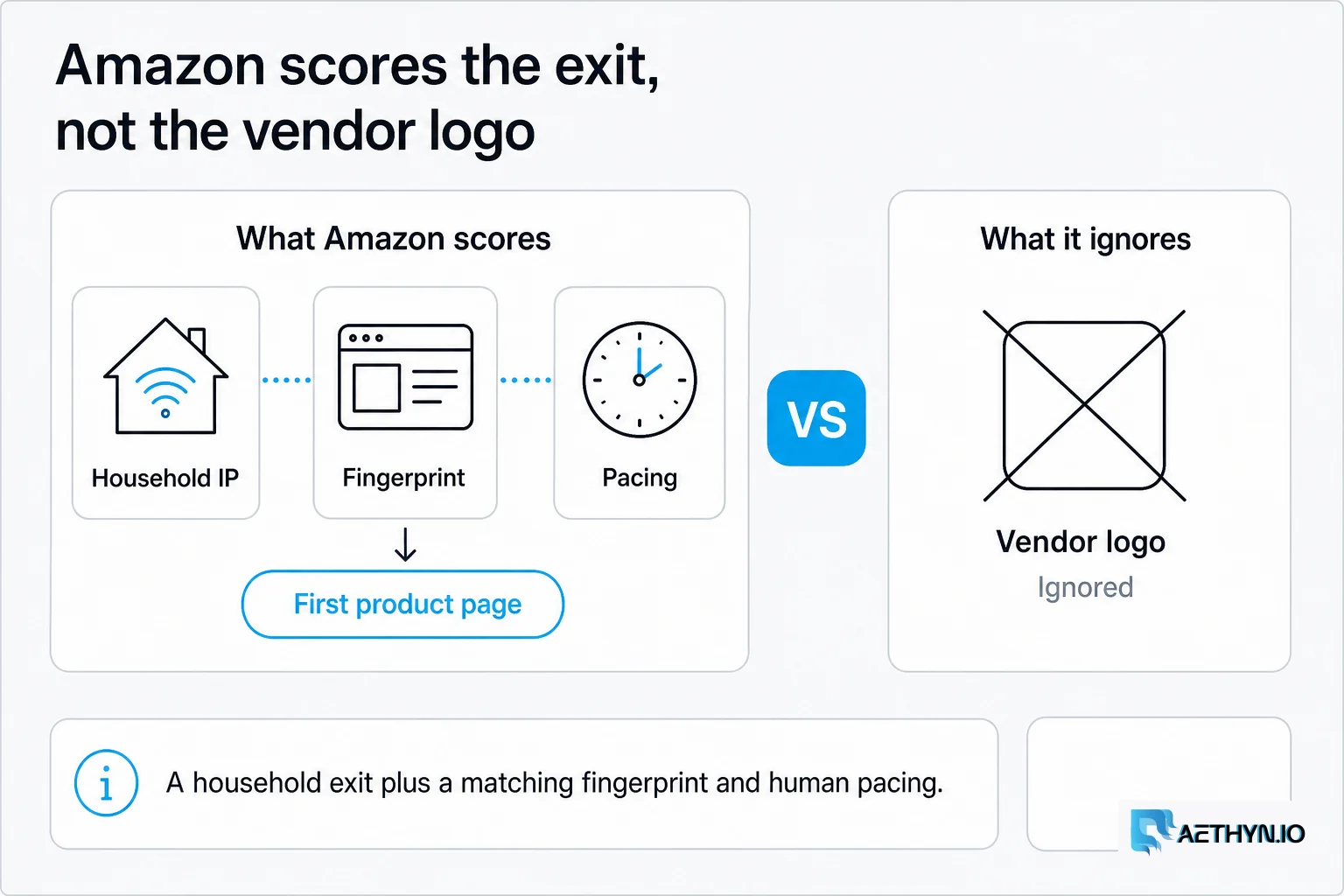
Best Rotating Proxies for Amazon Scraping in 2026
Amazon blocks datacenter and open proxies instantly. We compared 10 rotating residential providers for ASIN monitoring, Buy Box tracking, and geo-accurate pricing in 2026.
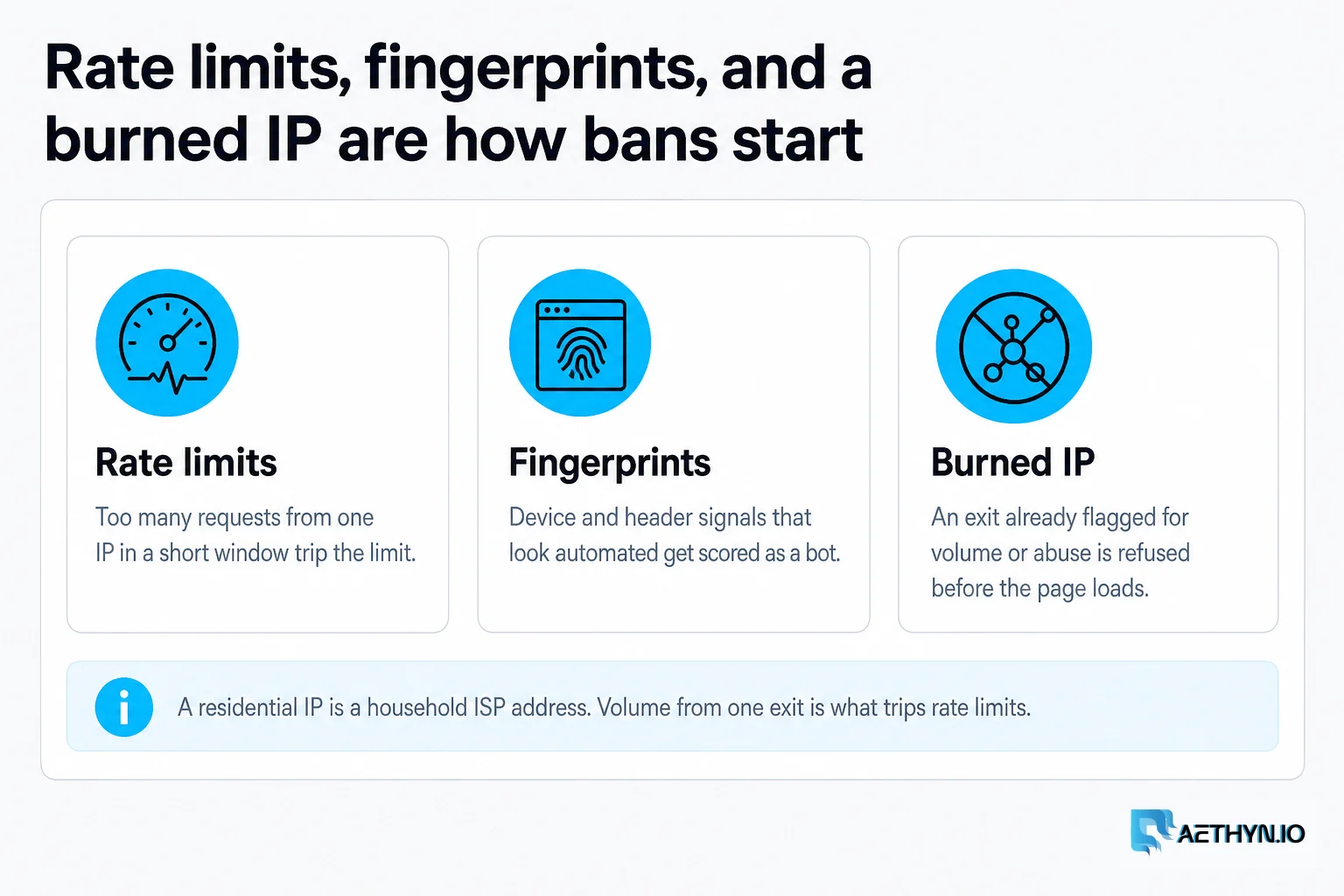
How to Avoid IP Bans Using Rotating Residential Proxies
IP bans are the enemy of automation. Learn the science of rotation and how to mimic human behavior to stay invisible on any website.

Residential vs Datacenter Proxies: Which One Should You Use?
A residential proxy is an ISP-assigned household IP; a datacenter proxy is a cloud-hosted server IP. Compare trust, speed, cost, and when to switch — Aethyn sells residential only.
Ready to test on your stack?