

What goes wrong when this scraper fails
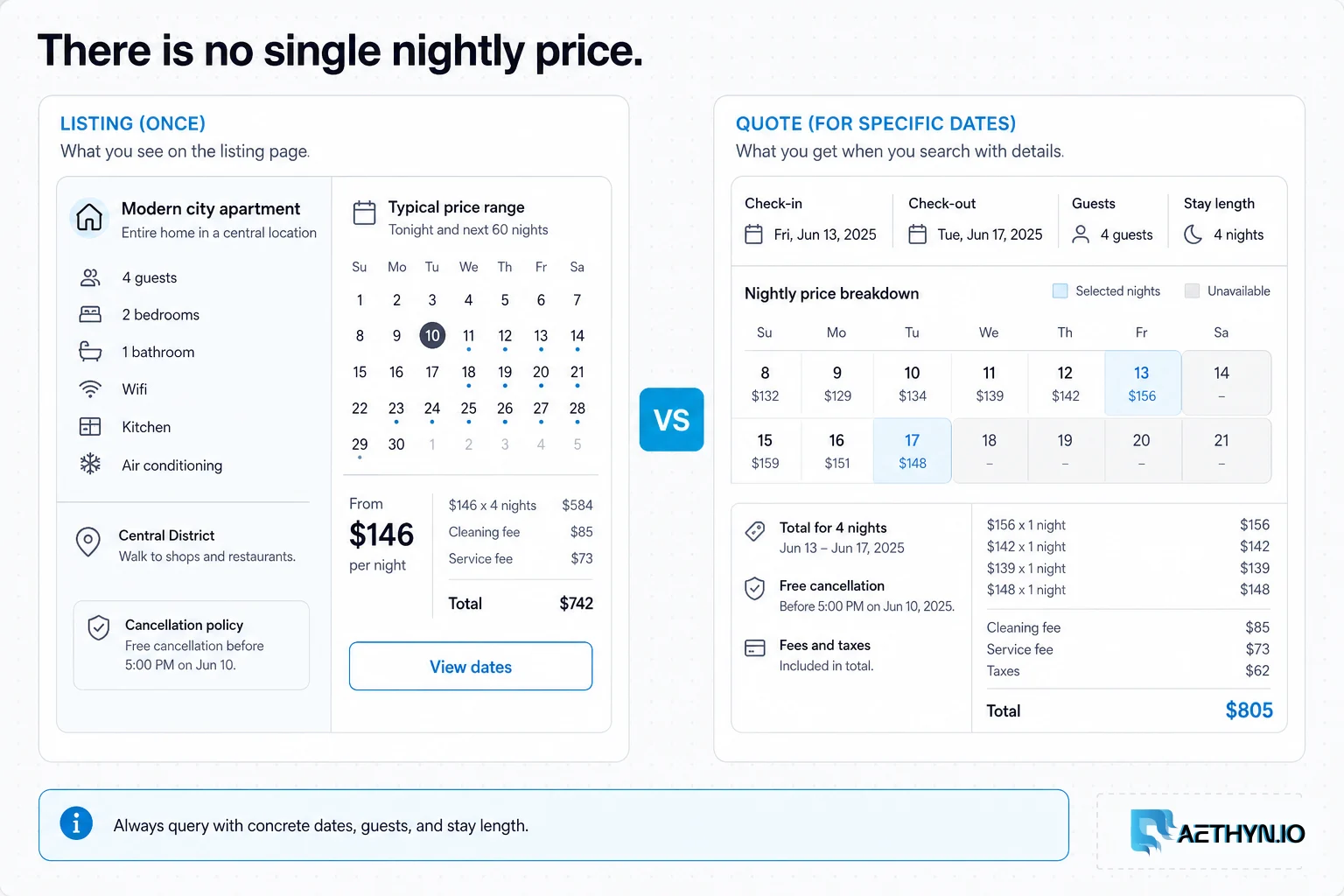
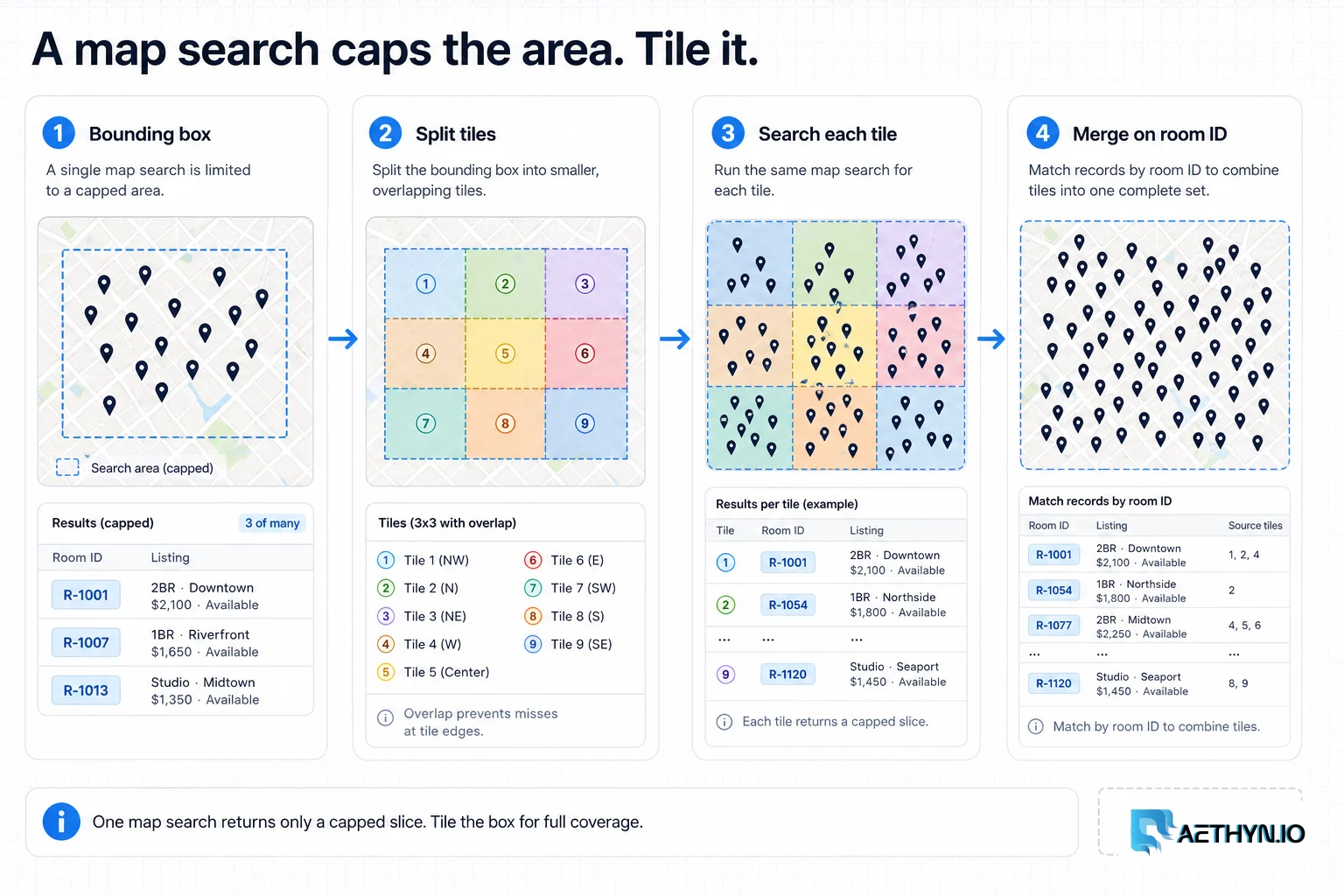
Short-term rental analysts, property managers, and market-research teams want Airbnb supply, pricing, and occupancy for a city or neighborhood. Two things trip up naive scrapers. First, Airbnb prices dynamically: the same listing shows different nightly rates depending on the dates, guest count, and length of stay you search, so a 'price' collected without dates is meaningless. Second, a map search returns only a capped set of results for the viewport, so a single query for 'Lisbon' silently misses most of the supply. On top of that, Airbnb is a heavily-defended SPA, so datacenter IPs get blocked fast.
Why this failure mode happens
Airbnb is a React single-page app that loads data from an internal GraphQL API (the same one the site uses), and it computes price server-side from your search parameters — dates, guests, stay length — plus host pricing rules. The map UI deliberately caps how many results it returns per viewport to keep responses small, so full coverage requires many narrower searches. And like any high-value travel marketplace, it runs strong bot detection that flags datacenter IPs and abnormal velocity.
Challenges that make this hard to automate
- Dynamic pricing that changes with dates, guests, and length of stay
- A per-search result cap that hides most of an area's supply
- A React/GraphQL architecture where data isn't in the static HTML
- Aggressive bot detection on a high-value travel target
- Host and review data that carry privacy obligations
Approaches that usually fail
- Datacenter proxies — blocked quickly on a defended travel site
- Scraping one map search per city — captures only the capped top slice
- Collecting price without dates — returns a number no guest would be quoted
- Manual checks — accurate but hopeless across a whole market's supply
When residential proxies fix this — and when they cannot
Residential IPs in the target market read as real travelers, get past the bot detection that blocks datacenter ranges, and return the localized currency and availability a local searcher sees. A large rotating pool lets you run the many tiled searches needed for full-area coverage — and the repeated date-range pricing lookups — without any single IP tripping velocity limits.
How Aethyn residential proxies help here
Airbnb is a high-security, geo-sensitive target that needs both reputation and the IP volume to run many searches. Aethyn provides both through the username.
- Elite high-trust residential IPs to get past Airbnb's bot detection
- Country/city targeting so currency and availability match the market
- A large rotating pool for tiled map searches and date-range pricing lookups
- Sticky sessions to keep a multi-request listing flow coherent
- Per-byte metering so recurring market sweeps stay cost-predictable
How to implement this with residential proxies
- 1
Always search with concrete dates and occupancy
Because price depends on the stay, fix the parameters before collecting: check-in, check-out, and guests. Decide your sampling policy (e.g. a 2-night midweek stay 30 days out) and apply it consistently so prices are comparable across listings and over time.
cURLcurl -x "http://aethyn-XXXXX-country-pt-city-lisbon:PASSWORD@proxy.aethyn.io:5499" \ "https://www.airbnb.com/s/Lisbon/homes?checkin=2026-08-10&checkout=2026-08-12&adults=2"Field note: Lock a fixed 'pricing scenario' per study (same lead time, nights, and guests). Mixing date ranges across runs makes a price 'change' that's really just a different stay length — the most common error in rental price tracking.
- 2
Tile the map to beat the result cap
A single area search returns only a few hundred listings regardless of true supply. To get full coverage, split the area's bounding box into a grid of smaller boxes and search each, then deduplicate. Subdivide any tile that still returns a full (capped) page, since that means it's hiding more.
Python (tiling)def tiles(sw, ne, n): # sw/ne = (lat, lng) corners; split into n x n sub-boxes (s, w), (no, e) = sw, ne dlat, dlng = (no - s) / n, (e - w) / n for i in range(n): for j in range(n): yield ((s + i*dlat, w + j*dlng), (s + (i+1)*dlat, w + (j+1)*dlng)) def search_area(sw, ne, fetch, cap=270): seen = {} for t_sw, t_ne in tiles(sw, ne, 3): results = fetch(t_sw, t_ne) # one residential request per tile for r in results: seen[r["room_id"]] = r # if a tile is capped, recurse into it for full coverage return list(seen.values())Field note: Deduplicate tiles on room ID — adjacent boxes overlap at the edges and the same listing appears in several. Without dedup your 'supply count' is inflated by double-counting boundary listings.
- 3
Get structured data from the GraphQL API or a rendered page
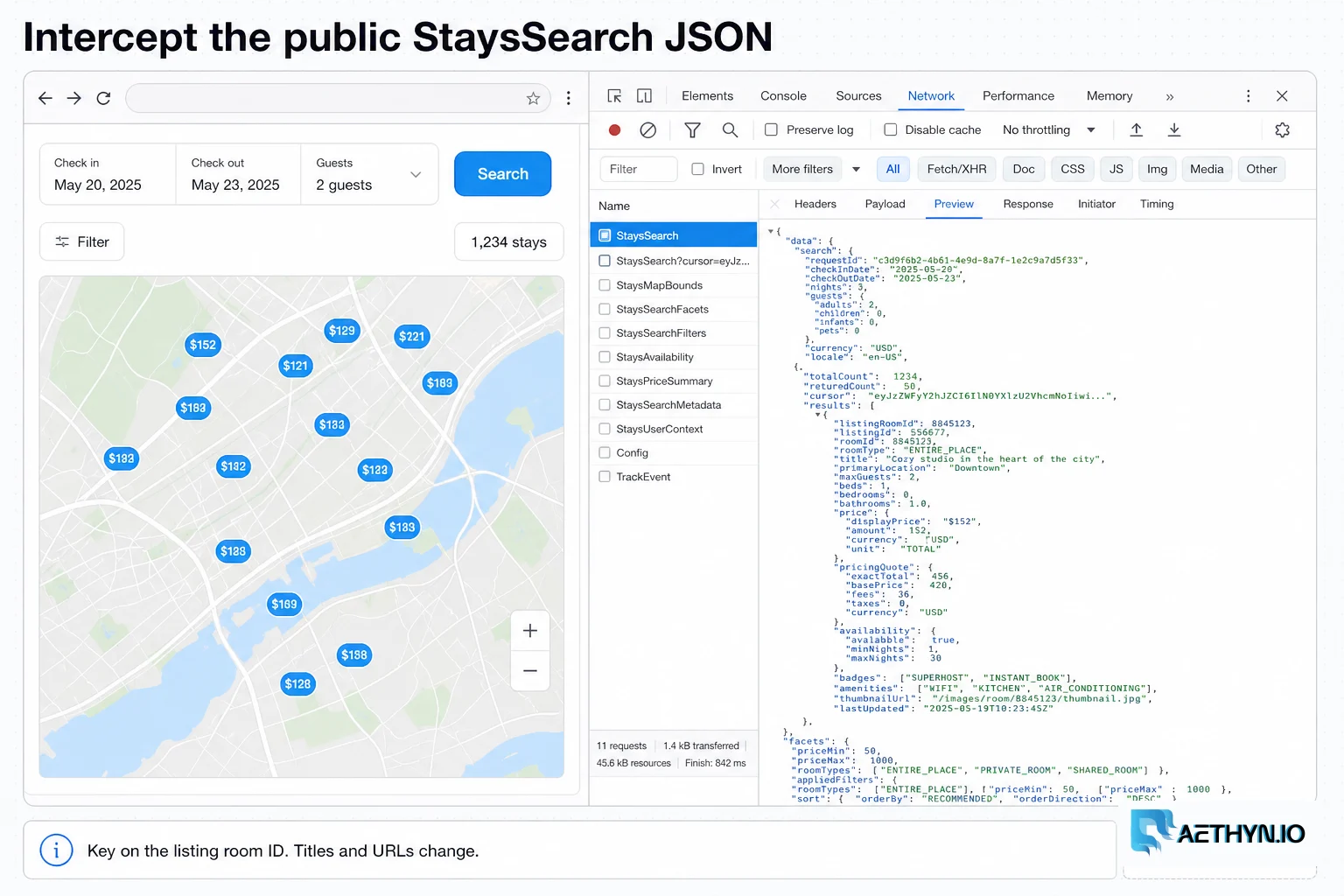
Airbnb's search and listing data come from its internal GraphQL API, which the page calls with a public API key embedded in the HTML. You can either drive a headless browser through the proxy and read the rendered results, or capture that key and call the API directly. Reading intercepted JSON is cleaner and survives UI changes better than DOM scraping.
Python (Playwright + intercept)from playwright.sync_api import sync_playwright captured = [] def on_response(resp): if "/api/v3/" in resp.url and "StaysSearch" in resp.url: try: captured.append(resp.json()) except Exception: pass with sync_playwright() as p: b = p.chromium.launch(proxy={ "server": "http://proxy.aethyn.io:5499", "username": "aethyn-XXXXX-country-pt-city-lisbon", "password": "PASSWORD", }) page = b.new_page(locale="pt-PT") page.on("response", on_response) page.goto("https://www.airbnb.com/s/Lisbon/homes?checkin=2026-08-10&checkout=2026-08-12&adults=2", wait_until="networkidle") b.close()Field note: Intercepting the StaysSearch response gives you the same structured listing objects the UI renders from — room id, price breakdown, rating, coordinates — without scraping a single CSS class. It's the most durable way to read Airbnb.
- 4
Collect listing facts, minimize host/review data
Store listing attributes (room id, type, capacity, amenities, price for your scenario, rating, review count, coordinates). Treat host names, photos, and individual reviews as personal data: collect only what your use case justifies, and prefer aggregates (rating, count) over review text.
Field note: Capacity and room type are essential for normalization — comparing a studio's nightly rate to a 4-bedroom's is meaningless. Always segment price analysis by capacity and room type.
- 5
Schedule market sweeps and track over time
Run tiled searches on a cadence through rotating residential IPs, store (room_id, scenario, price, availability, timestamp), and derive supply, median price, and occupancy proxies per area. Re-price popular listings more often and back off on any challenge.
Best practices that keep scrapers reliable
- Fix a consistent date/guest scenario before collecting prices
- Tile the bounding box and recurse into capped tiles for full coverage
- Dedupe on room ID across overlapping tiles
- Intercept the GraphQL/StaysSearch JSON instead of scraping the DOM
- Segment price analysis by capacity and room type
- Minimize host/review personal data and respect privacy law
Common mistakes that burn proxy budget
- Collecting a 'price' with no dates, so it matches no real quote
- Running one search per city and missing most of the supply
- Counting boundary listings twice by not deduping on room ID
- Comparing nightly rates across different capacities
- Hoarding host names and review text with no lawful basis
- Hammering a defended travel site from datacenter IPs