

What goes wrong when this scraper fails
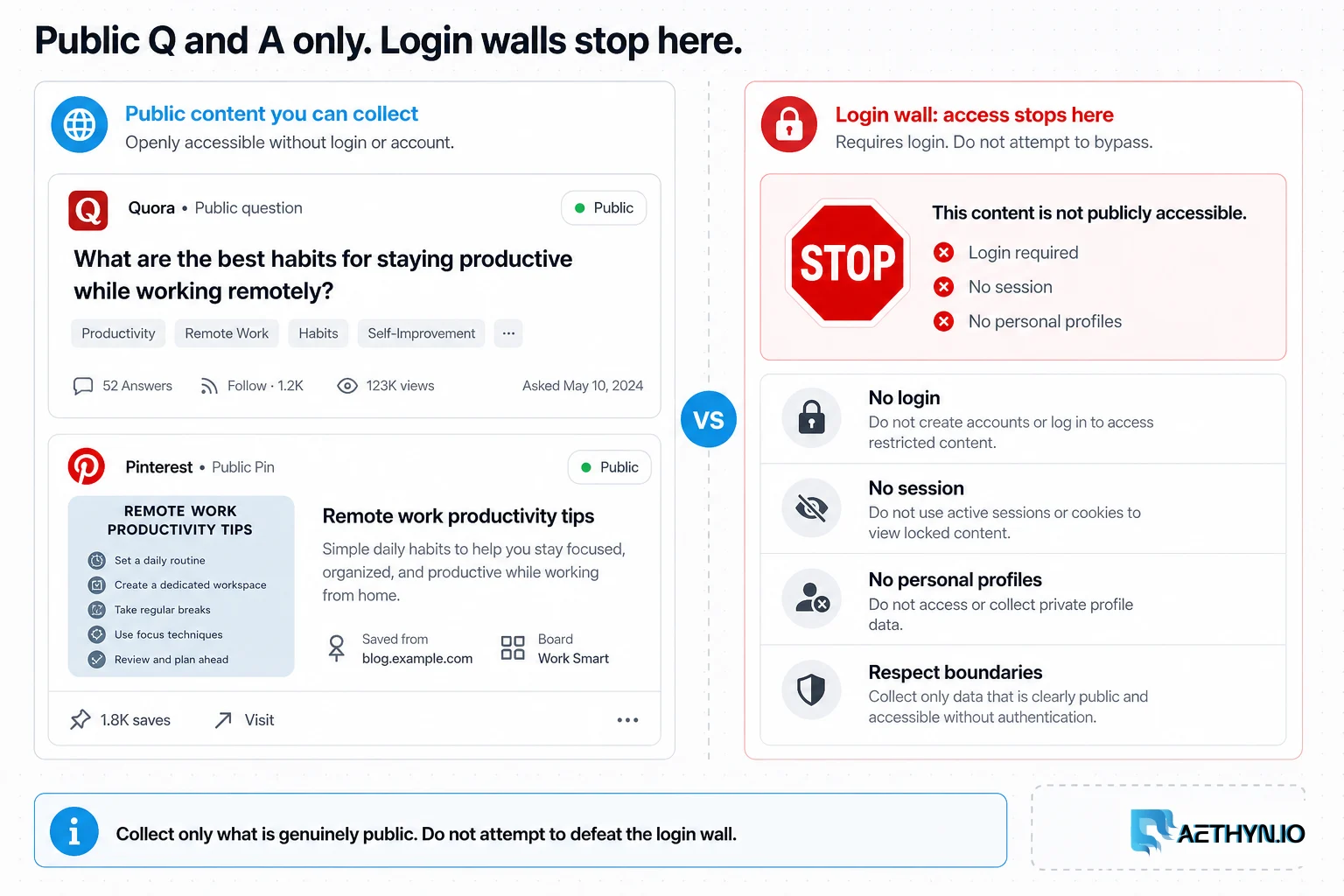
Quora and Pinterest are two of the richest sources of public user-generated signal on the open web - Quora for how real people phrase questions and reason through answers, Pinterest for which visual and product trends are gaining momentum. But both are built to serve humans in a browser, not machines at scale. Quora sits behind Cloudflare and pushes logged-out visitors toward a login wall while rate-limiting on velocity; Pinterest renders nothing useful in initial HTML and instead lazy-loads pins through internal JSON endpoints guarded by bot detection. Collecting this data responsibly means reading only the public surface, at a civilized pace, without authenticating.
Why this failure mode happens
Both companies have strong commercial incentives to keep their content on-platform: Quora monetizes engaged logged-in sessions and Pinterest sells shopping and ad placement against its feed. Aggressive anti-automation - Cloudflare managed challenges, TLS/JA3 fingerprinting, per-IP velocity limits, and device fingerprinting on the internal APIs - is how they protect that. On top of that, both feeds are personalized by geography and inferred interest, so the same URL returns different content depending on the exit IP's location and session state, which is precisely the surface that trips naive scrapers into inconsistent, partially-blocked datasets.
Challenges that make this hard to automate
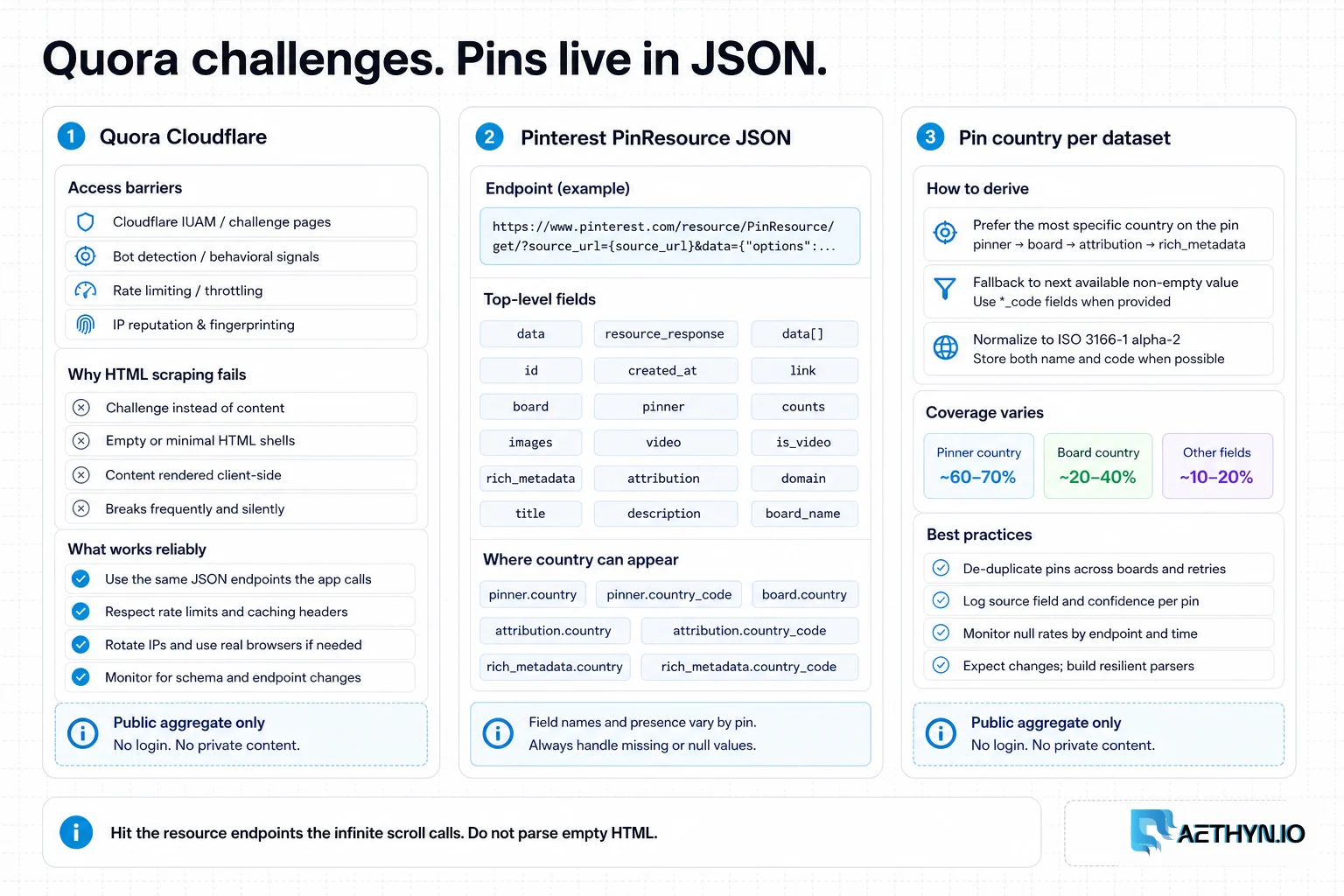
- Quora fronts nearly everything with Cloudflare, so a datacenter IP or thin fingerprint draws a managed challenge or a 403 before you ever see an answer.
- Pinterest returns almost no content in server-rendered HTML - the pins arrive asynchronously via internal JSON resource endpoints that expect specific headers and a valid CSRF token.
- Both platforms rate-limit on request velocity per IP, so a fast single-IP crawl degrades to challenges within a few hundred requests.
- Feeds are geo- and interest-personalized, meaning results drift by exit location and prior session state, hurting reproducibility across a dataset.
- Distinguishing a genuinely empty public page from a soft block (login wall, Cloudflare interstitial, empty JSON) requires content-aware validation, not just HTTP status checks.
Approaches that usually fail
- Running a single-server scraper from a cloud datacenter IP - which Cloudflare flags almost immediately on Quora and which Pinterest's bot detection rate-limits fast.
- Driving a full headless browser for every page to render infinite scroll - correct but brutally slow and expensive at dataset scale, and still fingerprintable.
- Buying scattered datacenter proxies and rotating blindly, without matching geography or sending complete headers, so the block rate stays high and data drifts by location.
- Leaning on unofficial third-party 'Quora API' or Pinterest export tools that break every few weeks when the internal endpoints change and offer no control over exit geography.
When residential proxies fix this — and when they cannot
Residential rotating proxies put each request behind a real consumer IP with genuine reputation, which is what Cloudflare and Pinterest's detection weigh most heavily - a clean residential exit clears challenges that any datacenter IP fails. Per-request rotation spreads a crawl across thousands of IPs so no single address builds the velocity that triggers throttling, while country-pinning lets you hold the personalized feed constant for a reproducible dataset. For the short bursts where Pinterest hands you a CSRF token that must be reused across a few paginated calls, a sticky session keeps those calls on one exit so the token stays valid.
How Aethyn residential proxies help here
Aethyn's residential network is built for exactly this shape of job: high-reputation exits, per-request rotation by default, and country- or city-level targeting through a single username format. You point your existing requests or Playwright code at proxy.aethyn.io and encode the geography and session behavior in the username - no SDK, no rewrites. The Premium tier (port 2099) gives you the residential pool and rotation control that Quora's Cloudflare and Pinterest's bot detection respect.
- Large residential pool with per-request rotation on port 2099, so no single IP accumulates the velocity that triggers Quora throttling or Pinterest rate limits.
- Country and city targeting in the username (-country-us, -city-chicago) to hold Quora's and Pinterest's geo-personalized feeds constant across a dataset.
- Sticky sessions up to 30 minutes (-session-TOKEN-lifetime-N) for the short bursts where a Pinterest CSRF token or paginated resource cursor must stay on one exit.
- High-reputation residential exits that clear Cloudflare managed challenges on Quora far more reliably than datacenter IPs.
- Simple username/password proxy auth that drops into requests, cURL, and Playwright unchanged - encode rotation and geo entirely in the credential string.
- Predictable, transparent egress so you can pace crawls at a civilized rate and respect each site's robots.txt and Terms of Service.
How to implement this with residential proxies
- 1
Route every request through a rotating residential exit
Start by putting all traffic behind Aethyn's residential pool on the Premium port 2099. Use per-request rotation as the default - omit any session token so consecutive requests never stack on the same IP, which is what keeps Quora's velocity-based throttling and Pinterest's rate limiter from ever seeing a burst. Pin the country so the personalized feed stays constant for your dataset.
pythonimport requests # Premium tier -> port 2099. Per-request rotation: no session token. PROXY = "http://aethyn-XXXXX-country-us:PASSWORD@proxy.aethyn.io:2099" proxies = {"http": PROXY, "https": PROXY} resp = requests.get( "https://www.quora.com/robots.txt", proxies=proxies, timeout=20, ) print(resp.status_code) print(resp.text[:500]) # read and honor the crawl directives before anything elseField note: Fetch and actually parse robots.txt first, per host. Both Quora and Pinterest list disallowed paths - staying out of them is the difference between responsible public collection and abuse, and it keeps you off the paths most aggressively defended.
- 2
Send a complete, realistic header set
A bare User-Agent with no Accept-Language or Accept header is a classic bot tell, and on Cloudflare-fronted Quora it is often enough on its own to draw a challenge. Send a full, coherent header set that matches a real browser, and keep Accept-Language consistent with the country you are exiting from so the fingerprint and geo agree.
pythonHEADERS = { "User-Agent": ( "Mozilla/5.0 (Windows NT 10.0; Win64; x64) " "AppleWebKit/537.36 (KHTML, like Gecko) " "Chrome/125.0.0.0 Safari/537.36" ), "Accept": "text/html,application/xhtml+xml,application/xml;q=0.9,image/avif,image/webp,*/*;q=0.8", "Accept-Language": "en-US,en;q=0.9", "Accept-Encoding": "gzip, deflate, br", "Upgrade-Insecure-Requests": "1", "Sec-Fetch-Dest": "document", "Sec-Fetch-Mode": "navigate", "Sec-Fetch-Site": "none", } r = requests.get( "https://www.quora.com/topic/Machine-Learning", headers=HEADERS, proxies=proxies, timeout=20, ) print(r.status_code, len(r.text))Field note: Keep Accept-Language aligned with your exit country. A US residential IP sending Accept-Language: ru-RU is an incoherent fingerprint, and incoherence is exactly what fingerprint-based detection scores against you - matching one signal while breaking another is worse than matching none.
- 3
Detect Cloudflare challenges and soft blocks before parsing
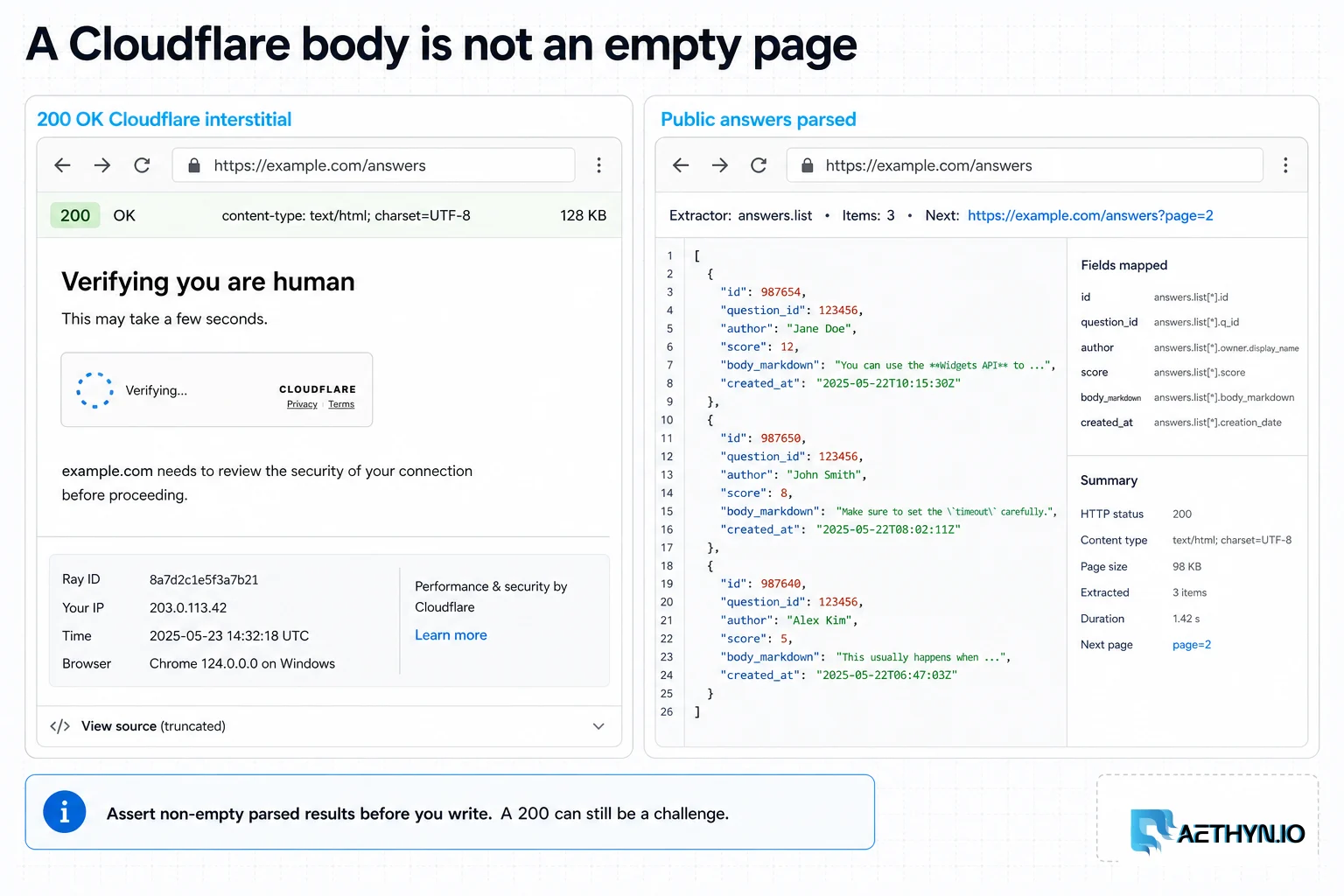
On Quora a 200 OK can still be a Cloudflare interstitial or a login-wall stub with no real answers, and on Pinterest an empty resource payload looks identical to a valid one at the HTTP layer. Build a content-aware guard that classifies the response before you trust it, so you retry on a fresh IP instead of silently storing garbage.
pythondef classify(resp): body = resp.text.lower() header_names = {k.lower() for k in resp.headers} if resp.status_code in (403, 429): return "blocked" if "cf-mitigated" in header_names or \ "just a moment" in body or "cdn-cgi/challenge" in body: return "challenge" if "log in to continue" in body or "login_wall" in body: return "login_wall" return "ok" state = classify(r) if state != "ok": # rotate (a new per-request IP happens automatically) and back off print("soft block:", state) else: pass # safe to parseField note: Treat challenge, login_wall, and empty-result as retry-with-backoff, never as data. A 200 with zero parsed answers is almost never a real empty page - store it and your training set quietly fills with blank rows you will not notice until the model underperforms.
- 4
Pull Pinterest pins from the internal JSON resource endpoints
Pinterest's HTML is a shell; the pins load through internal JSON resource routes that the infinite scroll calls as you scroll. Hitting those endpoints directly is far cheaper than rendering a browser, but they require an x-csrftoken (read from the csrftoken cookie) and the x-requested-with header, and they page via a bookmark cursor. Because the CSRF token and cursor must stay coherent across a paginated burst, use a short sticky session so those calls share one exit.
pythonimport json # Sticky session for a paginated burst: token + cursor stay on one IP. STICKY = "http://aethyn-XXXXX-country-us-session-pinboard1-lifetime-10:PASSWORD@proxy.aethyn.io:2099" sproxies = {"http": STICKY, "https": STICKY} s = requests.Session() s.proxies = sproxies s.headers.update(HEADERS) # Prime cookies (gets a csrftoken) against a public search URL. s.get("https://www.pinterest.com/search/pins/?q=minimalist%20kitchen", timeout=20) csrf = s.cookies.get("csrftoken", "") api_headers = { "x-csrftoken": csrf, "x-requested-with": "XMLHttpRequest", "x-app-version": "latest", "accept": "application/json, text/javascript, */*; q=0.01", } options = {"query": "minimalist kitchen", "scope": "pins", "bookmarks": [""]} params = { "source_url": "/search/pins/?q=minimalist%20kitchen", "data": json.dumps({"options": options, "context": {}}), } resp = s.get( "https://www.pinterest.com/resource/BaseSearchResource/get/", headers=api_headers, params=params, timeout=25, ) payload = resp.json() results = payload.get("resource_response", {}).get("data", {}).get("results", []) print("pins:", len(results)) bookmark = payload.get("resource", {}).get("options", {}).get("bookmarks", [""])[0]Field note: Reuse the returned bookmark as the next page's cursor, and keep the whole pagination loop inside one sticky session (lifetime up to 30 min). Rotating IP mid-pagination invalidates the CSRF token and the cursor context, and Pinterest returns an empty results array that your classifier will correctly reject.
- 5
Render infinite scroll with Playwright only where you must
Some Quora topic and question pages, and a few Pinterest surfaces, only expose their public content after client-side rendering. Reserve a headless browser for those cases - it is 5 to 10x slower and heavier than a direct request, so use it as a fallback, not the default. Route the browser through the same residential exit so its traffic shares the IP reputation and geography of your HTTP crawl.
pythonfrom playwright.sync_api import sync_playwright PROXY_SERVER = "http://proxy.aethyn.io:2099" PROXY_USER = "aethyn-XXXXX-country-gb" # per-request rotation, GB feed PROXY_PASS = "PASSWORD" with sync_playwright() as p: browser = p.chromium.launch( headless=True, proxy={"server": PROXY_SERVER, "username": PROXY_USER, "password": PROXY_PASS}, ) page = browser.new_page(locale="en-GB") page.goto("https://www.quora.com/topic/Data-Science", wait_until="networkidle", timeout=45000) # Scroll to trigger lazy-loaded public content, bounded so we stay civilized. for _ in range(5): page.mouse.wheel(0, 4000) page.wait_for_timeout(1200) # Collect only public question text; never touch profile or contact data. questions = page.eval_on_selector_all( "a[href*='/']", "els => els.map(e => e.innerText).filter(t => t.endsWith('?'))", ) print(len(questions), "public questions") browser.close()Field note: Set the browser locale to match your exit country (en-GB for a GB IP). A mismatched locale versus IP geolocation is a fingerprint contradiction that Cloudflare scores, and it also skews the personalized feed you are trying to hold constant across the dataset.
- 6
Pace the crawl, back off on blocks, and validate before writing
Sustained collection is about rhythm, not raw speed. Cap concurrency, add jitter between requests, and apply exponential backoff whenever your classifier reports a challenge or 429 - a polite crawl at a few requests per second across a rotating pool outlasts a fast one that gets an IP range flagged. Only write records that pass a non-empty, schema-valid check.
pythonimport time, random def fetch_with_backoff(url, max_tries=4): delay = 2.0 for attempt in range(max_tries): r = requests.get(url, headers=HEADERS, proxies=proxies, timeout=20) state = classify(r) if state == "ok": return r time.sleep(delay + random.uniform(0, 1.5)) # jitter delay *= 2 # exponential backoff; next request is a fresh IP return None def save_answer(rec): # Defensive validation: reject soft blocks and personal data. if not rec.get("question") or not rec.get("answer_text"): return False assert "author_email" not in rec and "author_profile" not in rec # ... write public, non-personal record to your store ... return True r = fetch_with_backoff("https://www.quora.com/topic/Machine-Learning") if r: print("got", len(r.text), "bytes of public content")Field note: Log the block-rate per country and per hour. A sudden climb usually means you are pushing velocity on one geo too hard - throttle that lane rather than the whole crawl, and you keep the reputation of your exits intact for the long-running dataset build.
Best practices that keep scrapers reliable
- Collect only public, non-personal content - public questions, answers, pins, boards, and topic/trend data. Never harvest personal profile fields, contact details, or anything behind authentication, and respect each site's robots.txt and Terms of Service; consult counsel for your jurisdiction.
- Rotate per request by default and only reach for a sticky session when a CSRF token or pagination cursor must stay on one exit for a short burst.
- Pin the exit country per dataset so the geo-personalized feeds on Quora and Pinterest stay reproducible across runs.
- Send a complete, coherent header set - User-Agent, Accept, Accept-Language, Sec-Fetch-* - with Accept-Language matching the exit geography.
- Prefer Pinterest's internal JSON resource endpoints over rendered HTML, and reserve Playwright for the pages that genuinely require client-side rendering.
- Classify every response for Cloudflare challenges, login walls, and empty payloads before parsing, and back off exponentially on blocks with jitter.
- Pace crawls to a civilized rate and monitor block-rate per country and hour so you throttle a hot lane instead of burning the whole pool's reputation.
Common mistakes that burn proxy budget
- Crawling from datacenter IPs - Cloudflare flags them on Quora almost instantly and Pinterest rate-limits them fast; residential reputation is the signal that matters most.
- Storing 200 OK responses without content validation, so Cloudflare interstitials, login-wall stubs, and empty JSON silently poison the dataset.
- Sending a bare User-Agent with no Accept-Language or Sec-Fetch headers, which is a textbook bot fingerprint on both sites.
- Rotating the IP mid-pagination on Pinterest, which invalidates the CSRF token and cursor and returns empty results.
- Rendering every page with a headless browser instead of hitting Pinterest's JSON endpoints directly - 5 to 10x slower and more fingerprintable for no benefit.
- Attempting to defeat Quora's login wall or scraping personal profile data, which crosses the line from public collection into ToS violation and personal-data harvesting.