

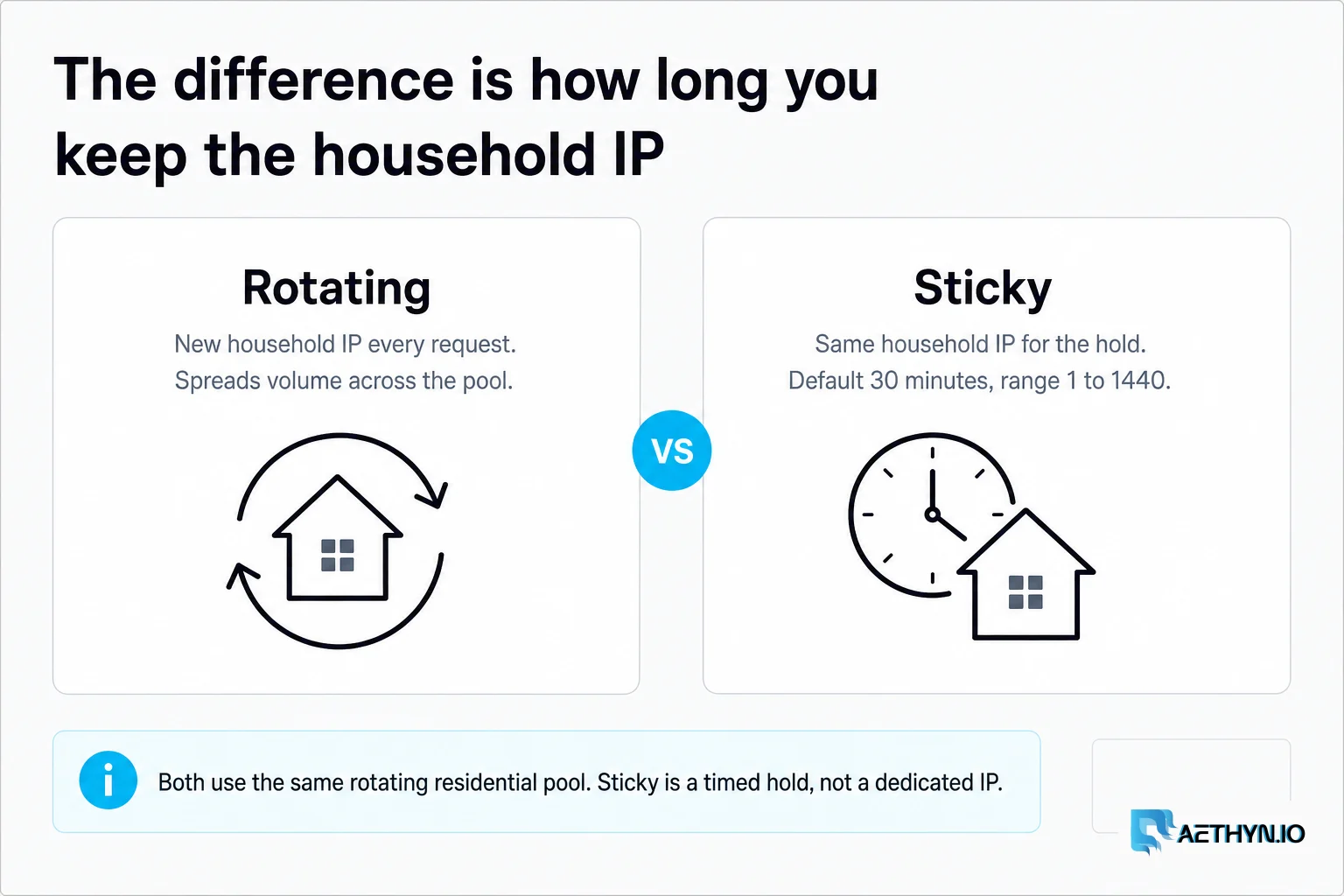
A rotating residential proxy is a proxy that assigns a different household IP to each request. A sticky session holds one of those household IPs for a timed window. Search results still pair rotating with "static" or "ISP" proxies — a dedicated address you keep for months. That is not the product Aethyn sells. City and ISP on this network are Elite username targeting suffixes. Sticky is a hold of 1–1440 minutes (default 30) on a rotating-pool household IP. The difference that actually matters is how long you keep the household IP.
Rotating residential proxies
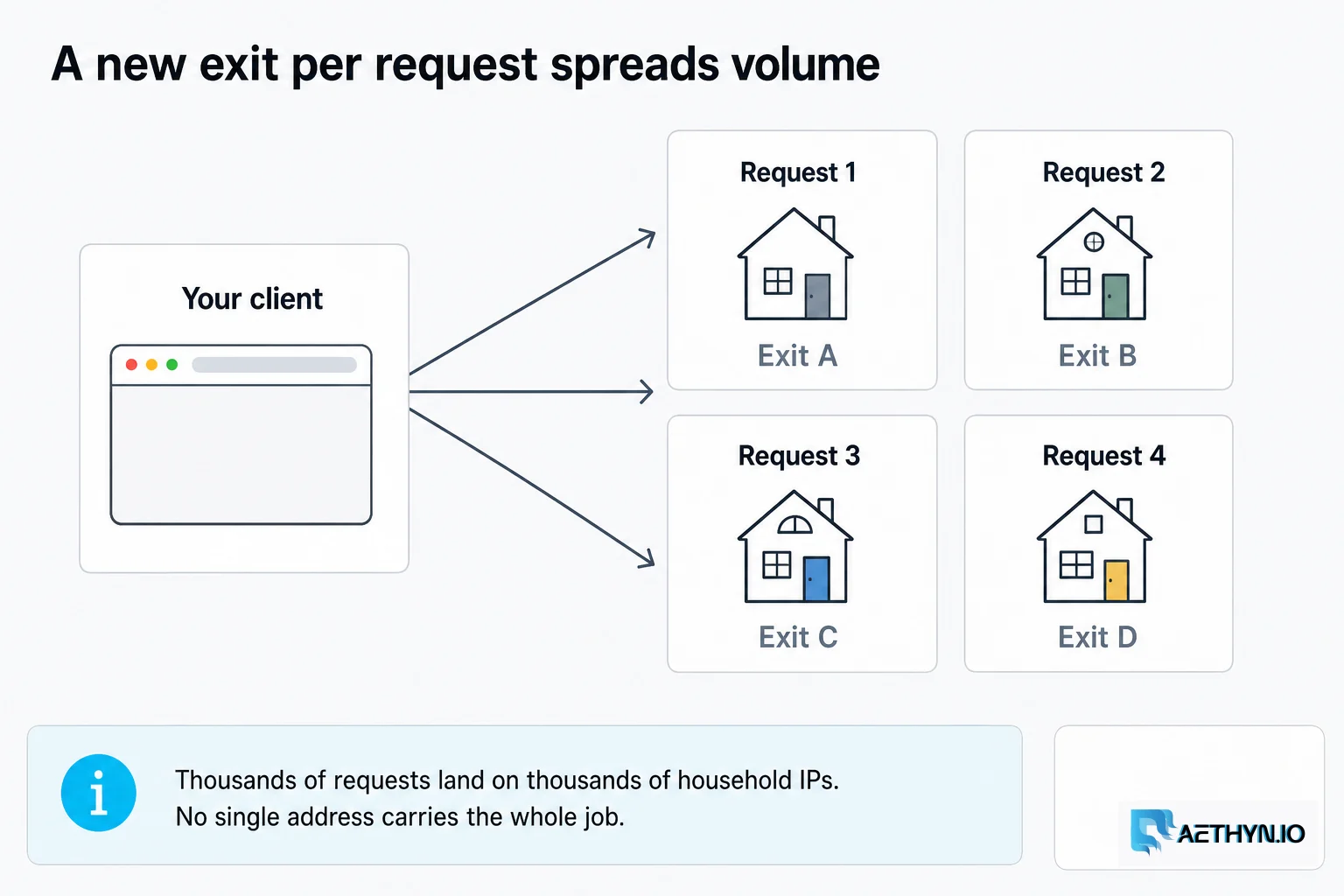
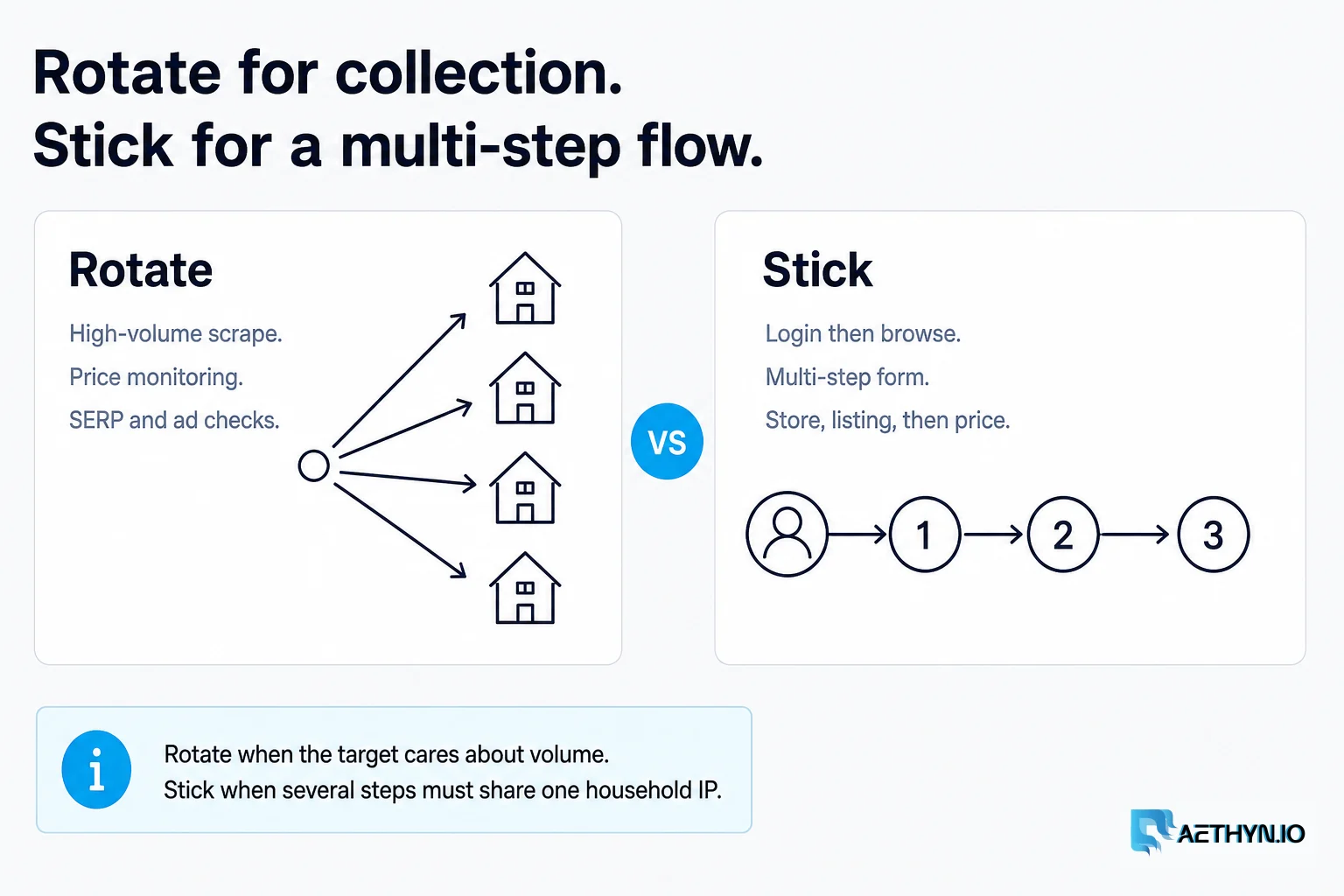
A rotating residential proxy assigns a new household IP for every request from a large pool. Thousands of requests land on thousands of different exits, so no single address carries the whole job. If one IP gets challenged, the next request is already on a fresh one. That is why rotation is the default for high-volume collection: web scraping, price monitoring, SERP tracking, ad verification, and any crawl where the target cares about request volume rather than a persistent identity.
The trade-off is persistence. Each request can look like a different person, which breaks login-based or session-based flows. A multi-step form that starts on one exit and finishes on another produces exactly the plausible-but-wrong row you were trying to avoid. For those jobs you do not buy a different product — you hold the rotating-pool IP for the lifetime of the flow.
Strengths
- Spreads volume. Thousands of requests land on thousands of different IPs, so no single address trips a rate limit.
- Resilient to challenges. If one IP gets flagged, the next request is already on a fresh one.
- The right default for raw data collection.
Weaknesses
- No persistent identity. Each request can look like a different person, which breaks login-based or session-based flows.
- Less predictable for tasks that need the same IP twice.
Best for
High-volume web scraping, price monitoring, SERP tracking, ad verification, and general data collection.
Static (ISP) residential proxies
What people mean by a static residential — often called an ISP proxy — is a dedicated address that stays the same for days or months, sometimes an ISP-ASN IP hosted in a datacenter. Vendors sell that as a SKU. Aethyn does not.
City and ISP here are not a leased identity. They are Elite username suffixes that pick where and through whom an exit comes from, still drawn from the rotating residential pool. If you need a stable identity for a task — login then browse, a multi-step form, set the store then read the price — that is a sticky session, not a static product. The next section is the one that actually applies.
The middle ground: sticky sessions
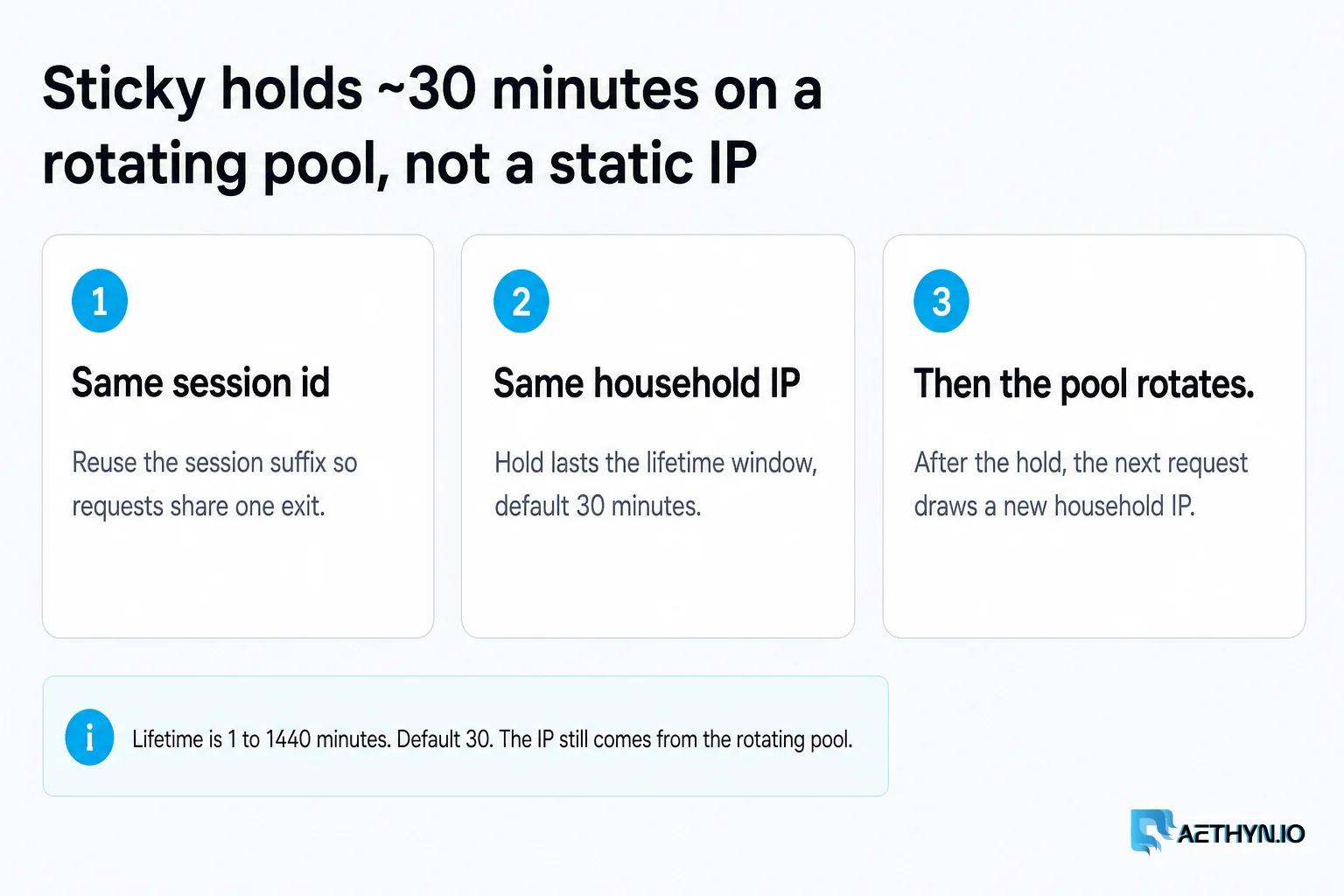
A sticky session is a timed hold on the rotating pool. You reuse the same session id, and every request rides the same household exit for the lifetime window. Lifetime is in minutes: 1–1440, default 30. Size it to the flow rather than to the job. If store selection takes four minutes, a 30-minute window is plenty. If you are paging a catalog for an hour, either extend the lifetime or accept that the identity will roll and make the parser notice. After the hold, the next request draws a new household IP from the same pool.
That covers most "stay on one IP just long enough to finish a task" cases without pretending you bought a dedicated address. Sticky is not static. It is the same rotating residential pool with a hold.
[!IMPORTANT] Match the tool to the trust model. If the target only cares about request volume, rotate. If a multi-step flow needs one identity, stick. Most teams run both — rotating for collection, sticky for the flow.
Quick decision table
| Need | Use |
|---|---|
| Scrape millions of pages | Rotating |
| Avoid rate limits at scale | Rotating |
| Finish a multi-step form on one IP | Sticky session |
| Hold a login through a short flow | Sticky session |
| Lowest cost per GB | Rotating |
| City or ISP targeting | Elite suffixes, still the rotating pool |
Where Aethyn fits
Aethyn's residential proxy network is rotating by default. Sticky sessions hold a pool IP for the lifetime window. Premium is country and volume. Elite adds city and ISP as username suffixes — targeting, not a dedicated IP.
Common questions about this article
What is the difference between rotating and static residential proxies?
Are static residential proxies better than rotating ones?
Can I get sticky sessions with rotating proxies?
Guides, integrations & docs
Continue reading

Residential vs Datacenter Proxies: Which One Should You Use?
A residential proxy is an ISP-assigned household IP; a datacenter proxy is a cloud-hosted server IP. Compare trust, speed, cost, and when to switch — Aethyn sells residential only.
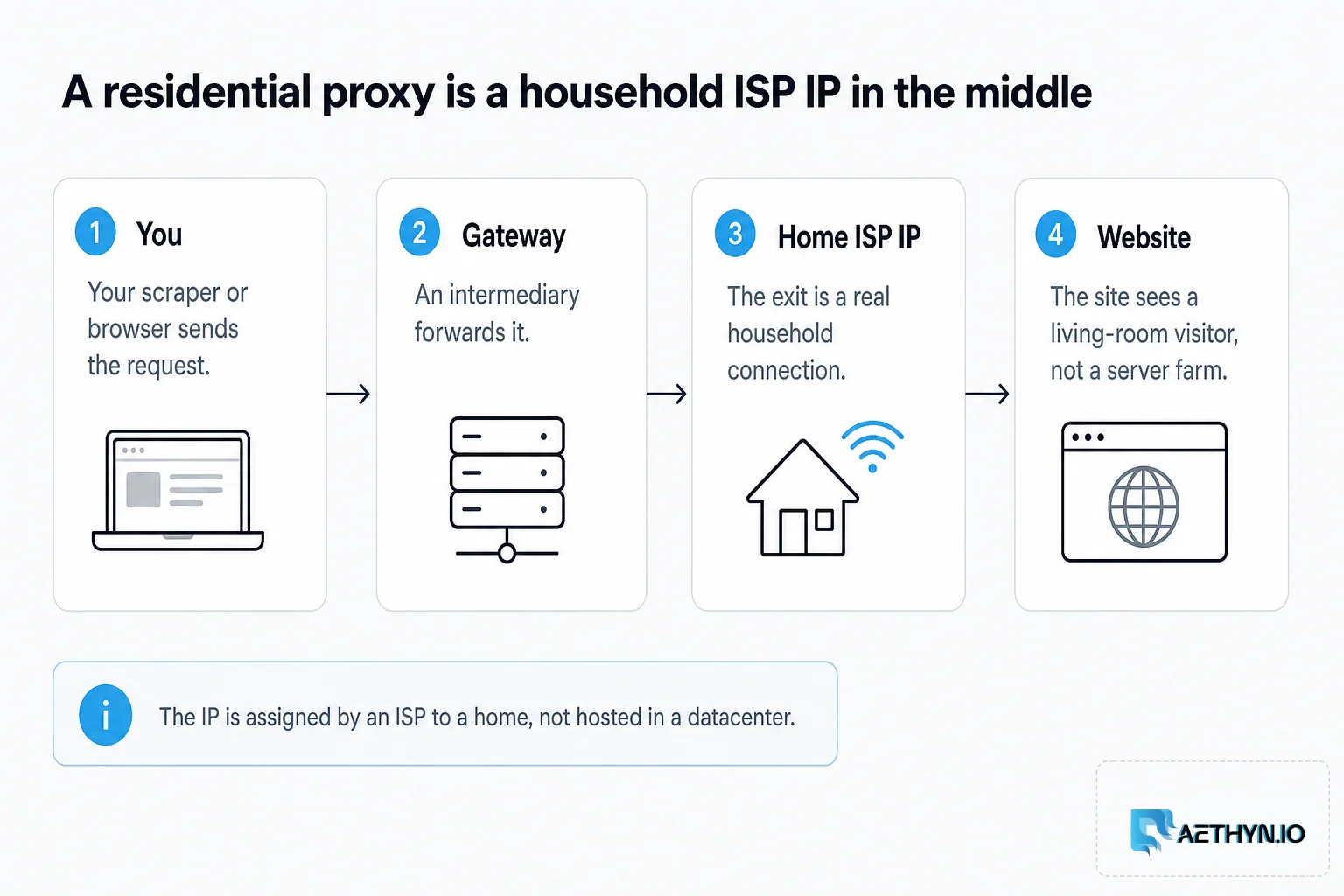
What Are Residential Proxies? Complete Beginner Guide (2026)
Learn everything about residential proxies: how they work, why they are more reliable than datacenter IPs, and how to use them for your business in 2026.
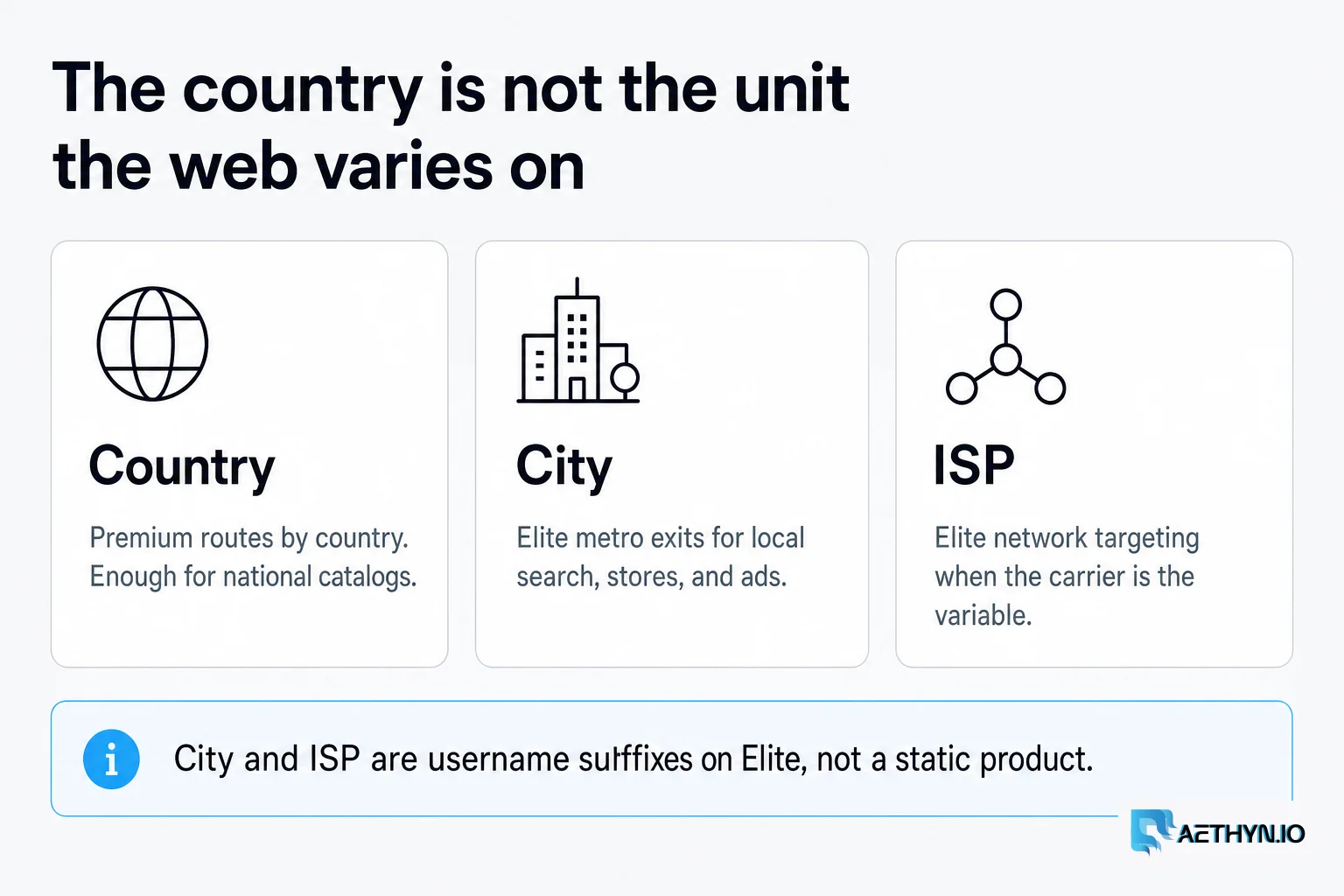
Country-Level Targeting Isn't Enough: City and ISP Proxies Explained
Country targeting fails silently. The page renders, the price parses, the row lands in your warehouse — describing a market nobody sells into. Here's when you need city or ISP granularity, when you don't, and how to prove the exit landed where you asked.
Premium or Elite residential proxies
Join developers scaling scraping and automation with Aethyn Premium and Elite pools from €2.00/GB.