

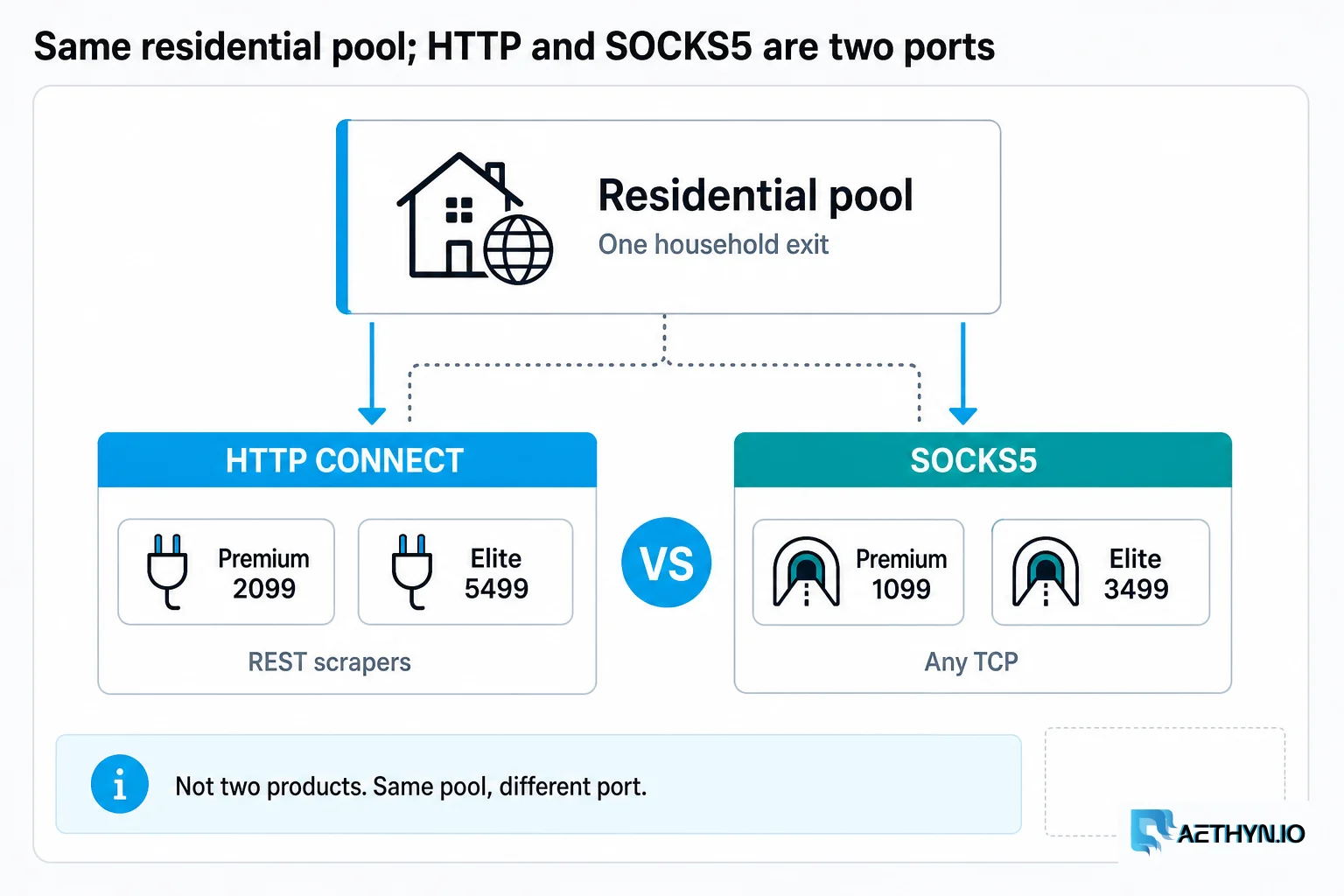
Short answer: The best SOCKS5 provider depends on whether you need raw protocol flexibility (gaming, UDP-adjacent tooling, non-HTTP clients) or residential reputation for scraping. In 2026, Aethyn, Bright Data, and Oxylabs lead for production scraping; Webshare and ProxyScrape fit lighter budgets.
[!IMPORTANT]
Honest caveat: Aethyn sells SOCKS5 alongside HTTP on the same host (proxy.aethyn.io) with dedicated ports per protocol. We rank ourselves in the top tier for scraping use cases, not for every SOCKS5 niche (e.g., casual VPN replacement).
TL;DR — Quick Rankings
- Aethyn — HTTP + SOCKS5 on dedicated ports (Premium 2099/1099); €2.00/GB residential.
- Bright Data — Enterprise SOCKS5 across product lines.
- Oxylabs — Reliable SOCKS5 with SLAs.
- IPRoyal — Budget SOCKS5 residential.
- Smartproxy — Mid-market SOCKS5 with easy dashboard.
- Webshare — API-friendly SOCKS5 for dev and CI.
- ProxyScrape paid — Affordable multi-protocol vendor.
- SOAX — ISP-granular SOCKS5 targeting.
- Rayobyte — US-centric SOCKS5 residential.
- PacketStream — P2P SOCKS5 at low per-GB rates.
- Protocol primer: SOCKS5 vs HTTP proxies.
- Compare: Aethyn vs IPRoyal.
How We Compared SOCKS5 Providers
Scoring rules, claim limits, and how we date sources: comparison methodology.
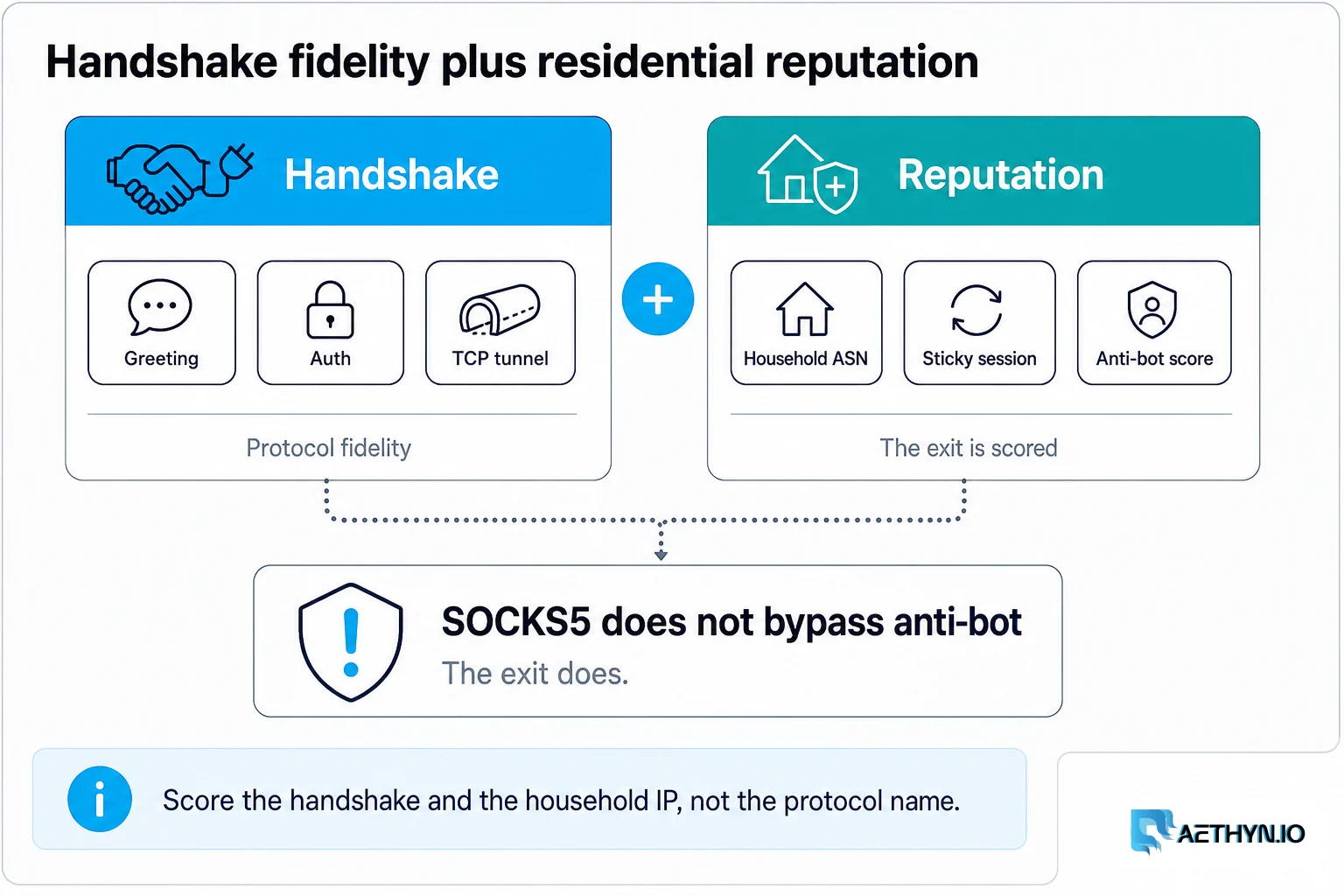
We scored handshake fidelity and residential reputation together. SOCKS5 does not bypass anti-bot — the exit does.
| Criterion | Weight | Measurement |
|---|---|---|
| Protocol fidelity | 25% | Clean SOCKS5 handshake; UDP policy documentation |
| Residential reputation | 25% | Pass rate on protected HTTPS targets via SOCKS |
| Auth ergonomics | 15% | Username/password vs IP allowlist |
| Geo targeting | 15% | Country and city via credentials |
| Dashboard + API | 10% | Credential rotation, usage stats |
| Pricing clarity | 10% | Published per-GB or per-IP rates |
Master Comparison Table
Benchmark period: June 2026. Outcomes vary by target site, pool tier, and request pacing.
| Provider | SOCKS5 + HTTP | Residential | Geo in username | Sticky session | Price signal |
|---|---|---|---|---|---|
| Aethyn | HTTP 2099 · SOCKS5 1099 (Elite 5499/3499) | Yes | Yes | Yes | €2.00/GB |
| Bright Data | Yes | Yes | Yes | Yes | Enterprise |
| Oxylabs | Yes | Yes | Yes | Yes | Premium |
| IPRoyal | Yes | Yes | Yes | Yes | Budget |
| Smartproxy | Yes | Yes | Yes | Yes | Mid |
| Webshare | Yes | Mixed | Limited | Yes | Low entry |
| ProxyScrape | Yes | Mixed | Some | Yes | Low |
| SOAX | Yes | Yes | ISP-level | Yes | Geo-based |
| Rayobyte | Yes | Yes | US focus | Yes | Mid |
| PacketStream | Yes | P2P res. | Country | Varies | Low GB |
Why Aethyn (residential-only)
| Dimension | Aethyn | Typical competitor |
|---|---|---|
| Product | Premium + Elite residential only | Mixed DC, residential, or API bundles |
| Pricing | €2.00/GB per-byte | Per-IP, per-request, or opaque tiers |
| Targeting | Country; city/ISP on Elite | Varies by vendor and plan |
| Best for | Blocked retail, social, and CDN-protected targets | Broad catalogs — verify your use case |
Detailed Provider Reviews
Our #1 pick in this guide
1. Aethyn
Aethyn exposes SOCKS5 and HTTP on the same host (proxy.aethyn.io) with dedicated ports — Premium HTTP 2099 / SOCKS5 1099, Elite HTTP 5499 / SOCKS5 3499. Switch protocols by changing the port; reuse the same username and password. For scrapers using curl --socks5, Playwright, or PuTTY tunnels, that keeps credential sprawl low without pretending both protocols share one port.
Geo targeting via username parameters works across both protocols. Premium pool covers most scraping; Elite pool when targets fingerprint residential reputation aggressively.
Run HTTP (e.g. proxy.aethyn.io:2099) and SOCKS5 (e.g. proxy.aethyn.io:1099) from the same credential when your stack mixes curl, Playwright, and legacy TCP clients — pick the Elite ports when you are on Elite.
Pros
Cons
2. Bright Data
Bright Data supports SOCKS5 across residential, datacenter, and mobile products with extensive documentation for enterprise pipelines. If you already pay for their ecosystem, SOCKS5 is a checkbox, not a migration.
Configuration surface is large — zones, permissions, and billing classes multiply quickly. Engineers wanting one hostname and per-GB billing may find it heavy.
Bright Data wins when pool breadth, datasets, and enterprise SLAs matter more than per-GB simplicity.
Pros
Cons
3. Oxylabs
Oxylabs delivers reliable SOCKS5 termination with strong uptime SLAs for Fortune 500 scraping teams. Session control maps cleanly to sticky ecommerce workflows.
Pricing targets enterprise budgets. Verify SOCKS5 auth format matches your orchestration layer before committing.
Oxylabs suits teams that need account management and compliance paperwork alongside residential capacity.
Pros
Cons
4. IPRoyal
IPRoyal includes SOCKS5 on residential and datacenter plans at approachable price points — popular with indie developers running Discord bots or niche scrapers.
Reputation variance means you should benchmark your specific targets rather than trusting generic marketing pass rates.
IPRoyal keeps entry costs low — plan for more session churn and active monitoring on Amazon-class targets.
Pros
Cons
5. Smartproxy
Smartproxy offers SOCKS5 with intuitive rotation controls in the dashboard. Good middle ground when your team outgrew free lists but is not ready for Bright Data contracts.
Very high concurrency on a single SOCKS credential can still trigger bans — throttle at the client.
Smartproxy is a solid mid-market default when you want dashboard polish without Bright Data's contract overhead.
Pros
Cons
6. Webshare
Webshare issues SOCKS5 endpoints alongside HTTP for both datacenter and residential tiers. Developers praise the API for spinning up endpoints in CI.
Datacenter SOCKS5 fails on strict sites; residential is fine for moderate targets. Know which pool you are on.
Webshare is ideal for prototyping parsers — swap to residential before Buy Box or social automation goes live.
Pros
Cons
7. ProxyScrape (paid)
ProxyScrape paid tiers add SOCKS5 with higher freshness guarantees than their free API lists. Useful when you want a single vendor for both cheap DC and residential SOCKS.
Quality sits below premium residential specialists for hard targets. Read our ProxyScrape comparison.
ProxyScrape paid tiers beat free lists on freshness but still trail elite residential on hard retail targets.
Pros
Cons
8. SOAX
SOAX SOCKS5 exits support fine-grained geo and ISP selection — valuable for simulating regional ISP routes during fraud testing or localized scraping.
Narrow filters reduce pool size per request; expect higher effective GB usage when targeting rare ISPs.
SOAX shines when city- or ISP-level exits must match a real shopper — narrow filters shrink the pool and raise effective GB cost.
Pros
Cons
9. Rayobyte
Rayobyte provides SOCKS5 on residential plans with a US-weighted footprint. Teams already on Rayobyte for SEO tools often reuse the same SOCKS credentials.
International SOCKS5 geo is more limited than global providers — map your country list before buying.
Rayobyte remains a familiar US-centric option; verify international geo before you standardize on one credential set.
Pros
Cons
10. PacketStream
PacketStream uses a peer-to-peer residential model with SOCKS5 access at per-GB rates that undercut many enterprise vendors. Hobbyists like the pay-as-you-go feel.
P2P sourcing means reputation is inconsistent hour to hour. Fine for experiments; scrutinize for compliance-sensitive workloads.
PacketStream's P2P SOCKS5 is pay-as-you-go experimentation; audit sourcing policies before compliance-sensitive workloads.
Pros
Cons
Configuring SOCKS5 in Popular Stacks
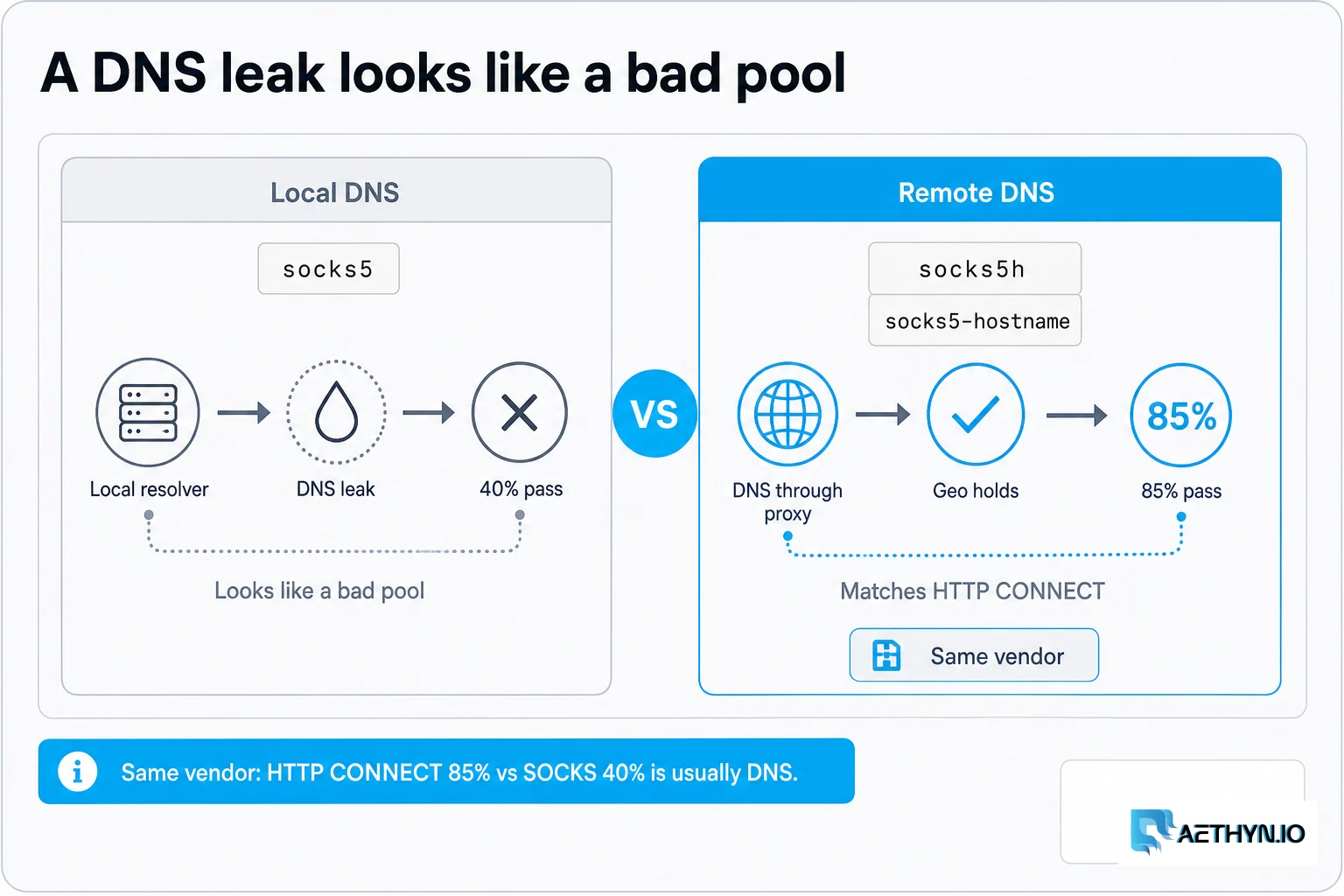
curl: curl --socks5-hostname user:pass@proxy.aethyn.io:1099 https://example.com — Premium SOCKS5 is port 1099 (Elite SOCKS5 3499). Use --socks5-hostname so DNS resolves through the proxy (critical for geo accuracy).
Python requests: use socks5:// scheme with PySocks installed, or stay on HTTP proxy mode (port 2099 / 5499) if you do not need SOCKS semantics.
Playwright: set proxy: { server: 'socks5://proxy.aethyn.io:1099', username: '...', password: '...' } in launch options (Elite: 3499); verify WebSocket targets if you scrape SPAs.
Scrapy: middleware supports socks5h:// for remote DNS; misconfiguring local DNS leaks your real resolver to fingerprinting systems.
Go: golang.org/x/net/proxy dialer with SOCKS5 auth — common in high-QPS microservices.
Misconfiguration often matters more than provider choice. Engineers who see 40% failure on SOCKS5 but 85% on HTTP CONNECT at the same vendor usually have a DNS leak, not a bad pool.
UDP, Gaming, and Non-Scraping SOCKS5 Uses
SOCKS5 can relay UDP in theory; most residential vendors document TCP-only or restricted UDP for anti-abuse reasons. Gamers and VoIP users have different requirements than scrapers — verify UDP policy before buying scraping-oriented residential for gaming.
For scraping, UDP is rarely relevant. Focus on TCP connect latency, session stickiness, and IP reputation. A "fast" SOCKS5 datacenter exit that completes handshakes in 20ms is still useless on Instagram if the ASN is flagged.
Reputation Tiers: When Elite Beats Premium
On permissive blogs and directory sites, Premium residential at €2.00/GB is sufficient. When targets deploy PerimeterX, DataDome, or aggressive Cloudflare bot scores, Elite pools with stricter sourcing filters justify the step-up. SOCKS5 does not bypass those systems — reputation does.
Why SOCKS5 Still Matters in 2026
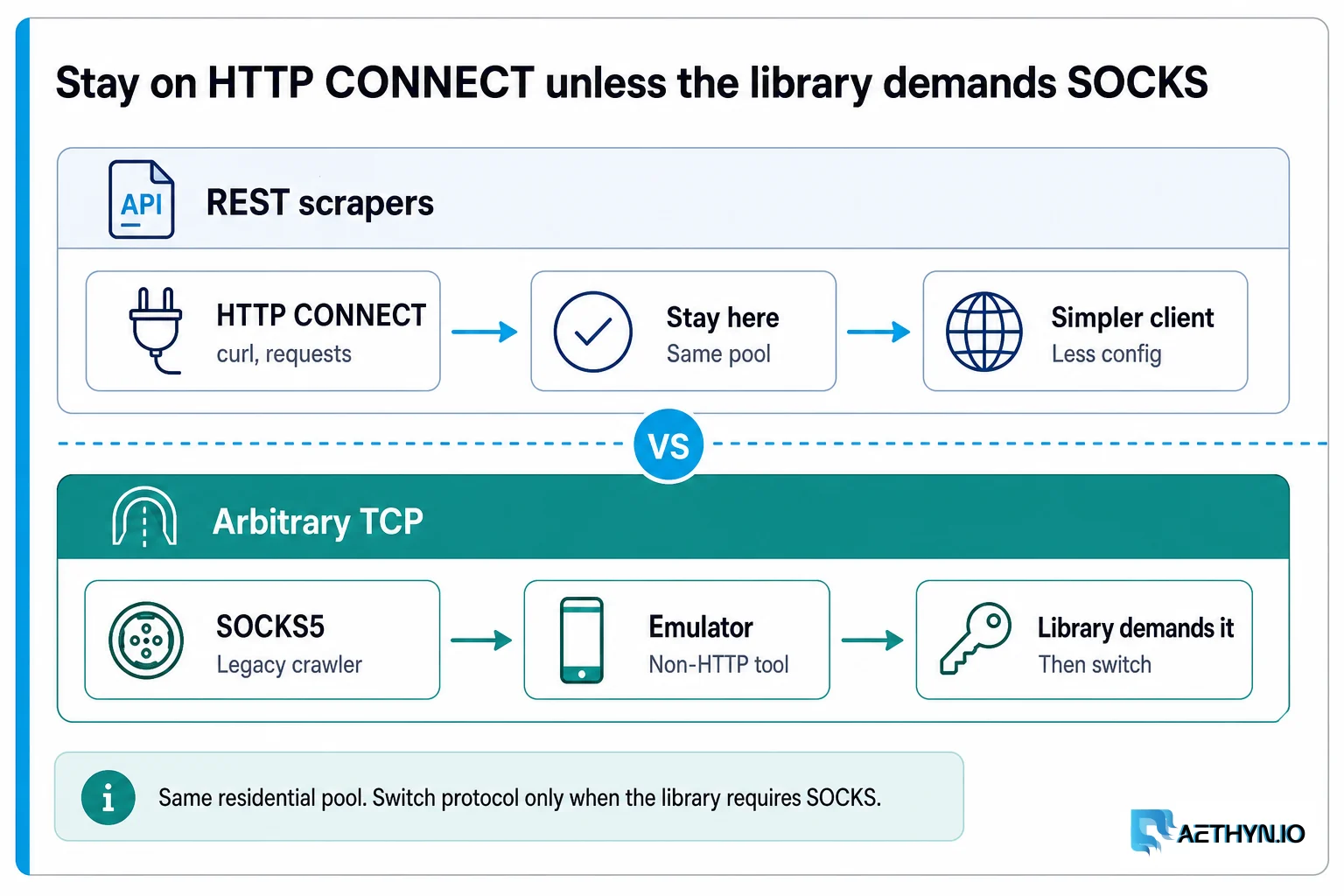
HTTP proxies suffice for most REST scraping, but SOCKS5 wins when tools speak arbitrary TCP — legacy crawlers, some mobile emulators, and multi-protocol automation stacks. The mistake is choosing SOCKS5 for protocol reasons while ignoring IP reputation.
[!TIP]
If your stack already uses HTTP CONNECT, stay on HTTP mode at Aethyn — same pool, less client configuration. Switch to SOCKS5 when your library demands it.
Troubleshooting SOCKS5 Failures
Symptom: connection reset immediately — verify firewall allows outbound SOCKS5 ports 1099/3499 (or HTTP 2099/5499), confirm username/password, check whether your ISP blocks outbound proxy ports.
Symptom: wrong country in response — enable remote DNS (socks5h not socks5); local DNS resolution leaks geo intent.
Symptom: works in curl, fails in Playwright — Playwright may ignore system proxy env vars; set proxy in launch context explicitly.
Symptom: intermittent 407 auth errors — session string too long or special characters unescaped; regenerate credentials from dashboard.
SOCKS5 vs VPN for Scraping
Consumer VPNs tunnel all device traffic through one exit — bad for CI runners that also call internal APIs. SOCKS5 application-level proxies scope only scraper traffic. For engineering teams, scoped proxies beat full-tunnel VPNs because blast radius stays contained when an IP burns.
Enterprise Procurement Checklist
Security teams ask: Where are credentials stored? Is traffic logged? What is ethical sourcing policy? SOCKS5 does not change those answers — vendor reputation does. Prefer providers with published compliance docs when scraping customer-adjacent data.
Performance Testing Methodology
When benchmarking SOCKS5 vendors, run identical workloads: 500 sequential HTTPS fetches through each gateway, measure p50/p95 latency, record 403/407 rates, and tag results by country parameter. Publish results internally — marketing pass-rate claims without your target domains are meaningless. Rotate tests weekly because pool composition shifts.
Future-Proofing: HTTP/3 and QUIC
Some anti-bot systems experiment with QUIC fingerprinting in 2026. SOCKS5 tunnels TCP; QUIC may bypass traditional SOCKS paths. Monitor whether your targets serve HTTP/3-only — you may need browser-based fetching regardless of proxy protocol. Protocol choice is necessary but not sufficient for long-term scraping stacks.
SOCKS5 Authentication Patterns
Username/password auth is standard for residential SOCKS5. IP allowlisting suits datacenter SOCKS but breaks mobile workers on dynamic IPs. Whitelist-based auth conflicts with cloud autoscaling — prefer credential auth for Kubernetes scraper fleets. Document whether your vendor charges per concurrent tunnel; some budget hosts cap simultaneous SOCKS connections.
Decision Matrix
| Scenario | Recommendation |
|---|---|
| Production scraping behind Cloudflare | Aethyn Elite or Bright Data residential SOCKS5 |
| Budget hobby project | IPRoyal or Webshare residential |
| ISP-specific routing tests | SOAX |
| P2P experiment | PacketStream with compliance review |
| HTTP-only Scrapy | Aethyn HTTP mode — skip SOCKS complexity |
Extended Guidance
The SOCKS5 market in 2026 is crowded with vendors selling the same protocol label at wildly different reputation tiers. Your selection criteria should be residential sourcing transparency, session stickiness, and whether HTTP and SOCKS share one credential on dedicated ports — not whether the marketing page says "SOCKS5" in bold.
Run a two-week proof of concept against your top three targets before annual contracts. Log handshake failures separately from HTTP 403 failures; they indicate different remediation paths (client config vs IP reputation).
When in doubt, start with HTTP CONNECT on Aethyn or your chosen vendor, then enable SOCKS5 only if a library forces it. Fewer moving parts mean faster incident response when a target changes TLS requirements overnight.
Inventory every service in your stack that opens outbound TCP — not just scrapers. Internal tools accidentally configured with production SOCKS credentials can burn sessions and pollute metrics. Centralize proxy config in a single module imported by all workers.
PacketStream and other P2P models may violate target site terms or corporate policy even when technically functional. Legal should sign off before P2P SOCKS5 touches customer projects — engineering pass rates are not the only approval gate.
Bright Data and Oxylabs SOCKS5 excel when your procurement team already holds master agreements with those vendors. Incremental SOCKS enablement is faster than onboarding a new vendor solely for protocol support — but do not overpay for unused platform modules.
Load-testing SOCKS5 gateways differs from HTTP: open concurrent TCP tunnels gradually. Some residential vendors rate-limit simultaneous handshakes separately from bandwidth — a surprise during Black Friday scale tests if you only load-tested HTTP GET volume.
Document SOCKS5 connection limits in runbooks alongside retry policies. Engineers on call should know whether to fail open (direct egress) or fail closed (pause jobs) — fail open leaks real IP and is almost never acceptable for production scraping.
Common questions about this article
What is the difference between SOCKS5 and HTTP proxies?
Does Aethyn support SOCKS5?
Are SOCKS5 proxies better for web scraping?
Can I use free SOCKS5 lists for production?
Which SOCKS5 provider is best for beginners?
Guides, integrations & docs
Continue reading
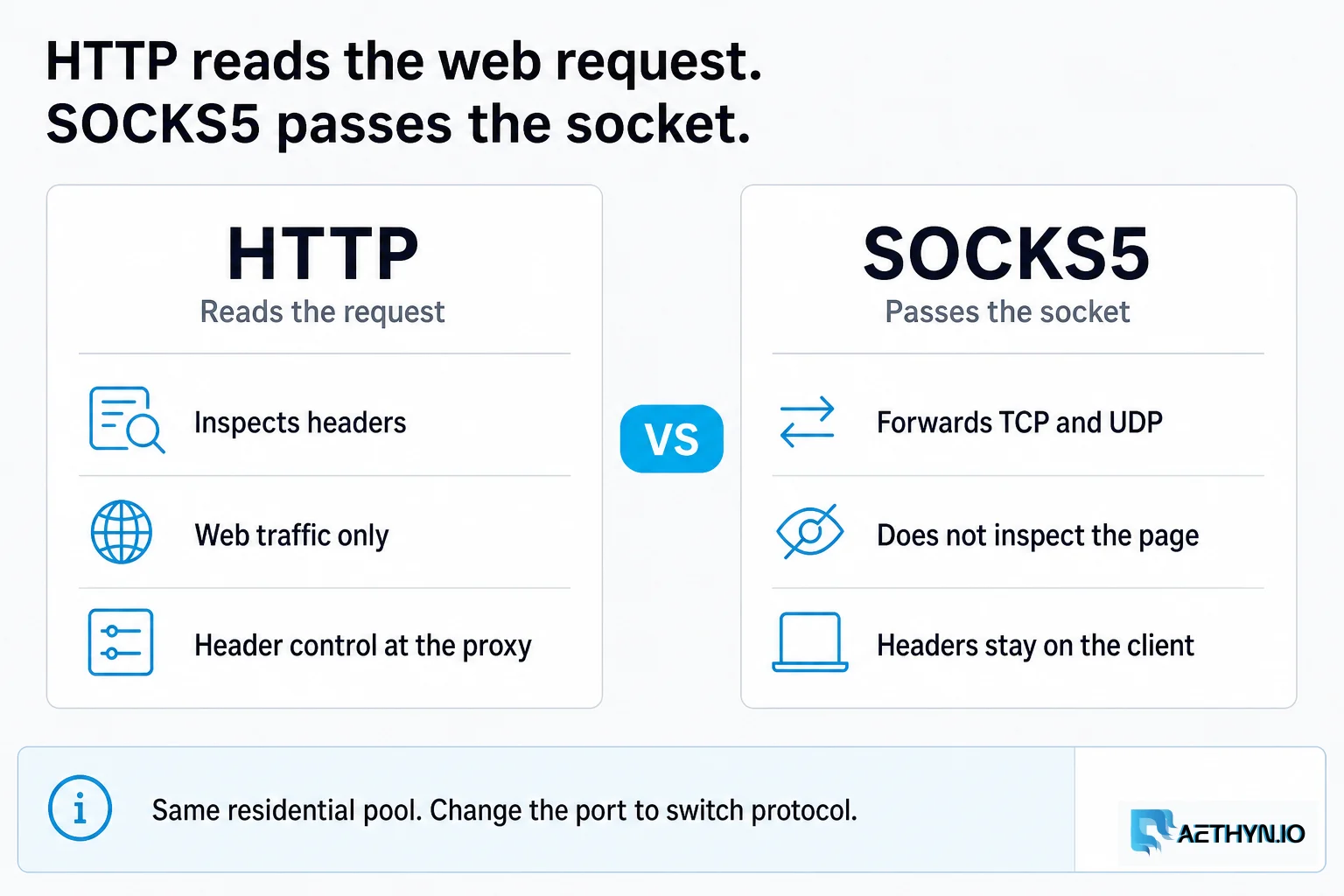
SOCKS5 vs HTTP Proxies: Which is Better for Web Scraping?
Understand the fundamental differences between SOCKS5 and HTTP protocols and which one provides better performance for your automation.
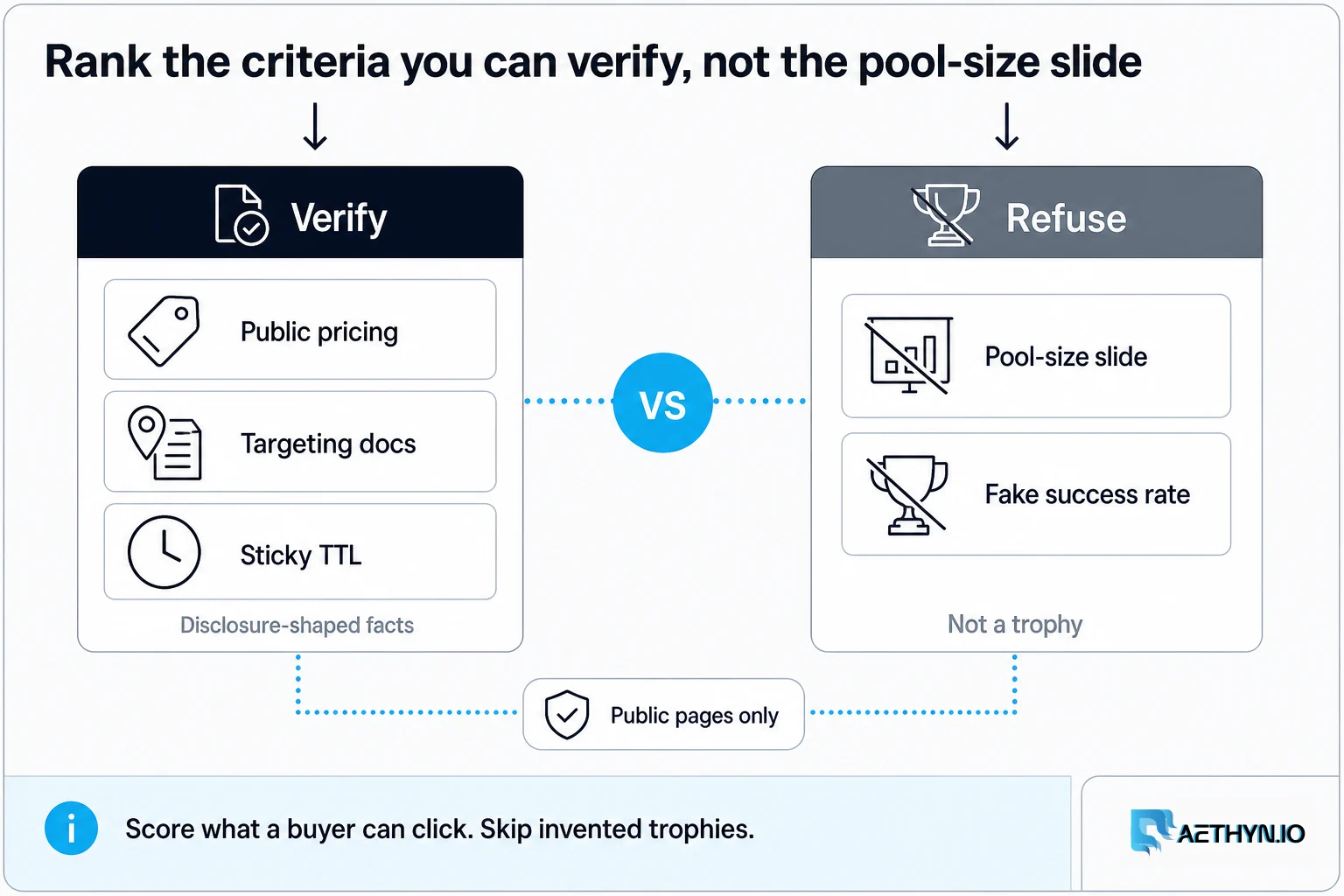
Best Residential Proxies for Web Scraping in 2026 (Tested Criteria, Published Sources)
Nine residential proxy vendors ranked for web-scraping buyers on pricing transparency, documented targeting, session control, and self-serve access — every competitor fact linked and dated.
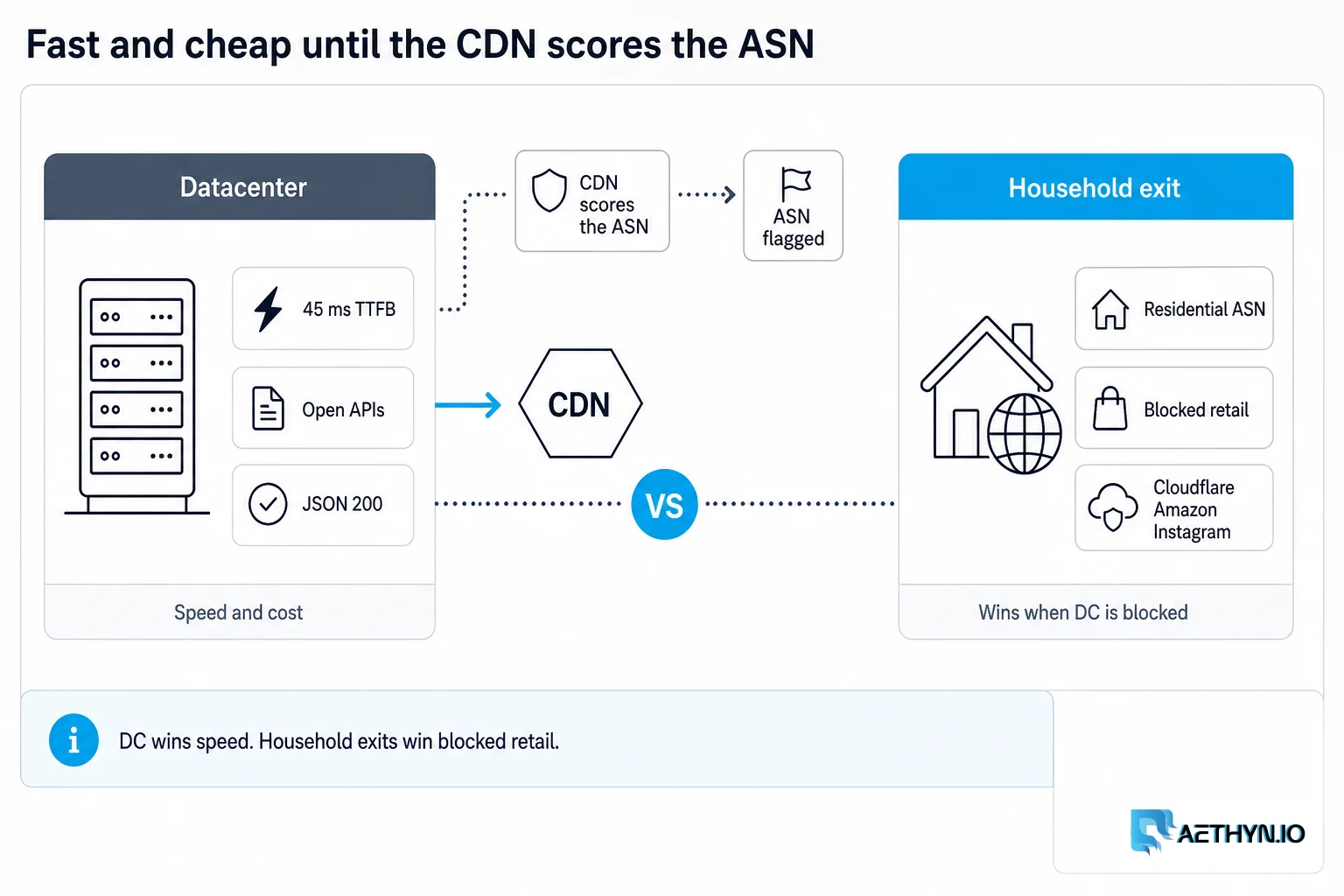
Best Datacenter Proxy Providers (2026) — When to Switch to Residential
Datacenter proxies are still the fastest, cheapest option for open APIs and unprotected sites. We compared Webshare, Bright Data, Byteful, Oxylabs, and others — plus when to upgrade to Aethyn residential.
Ready to test on your stack?