

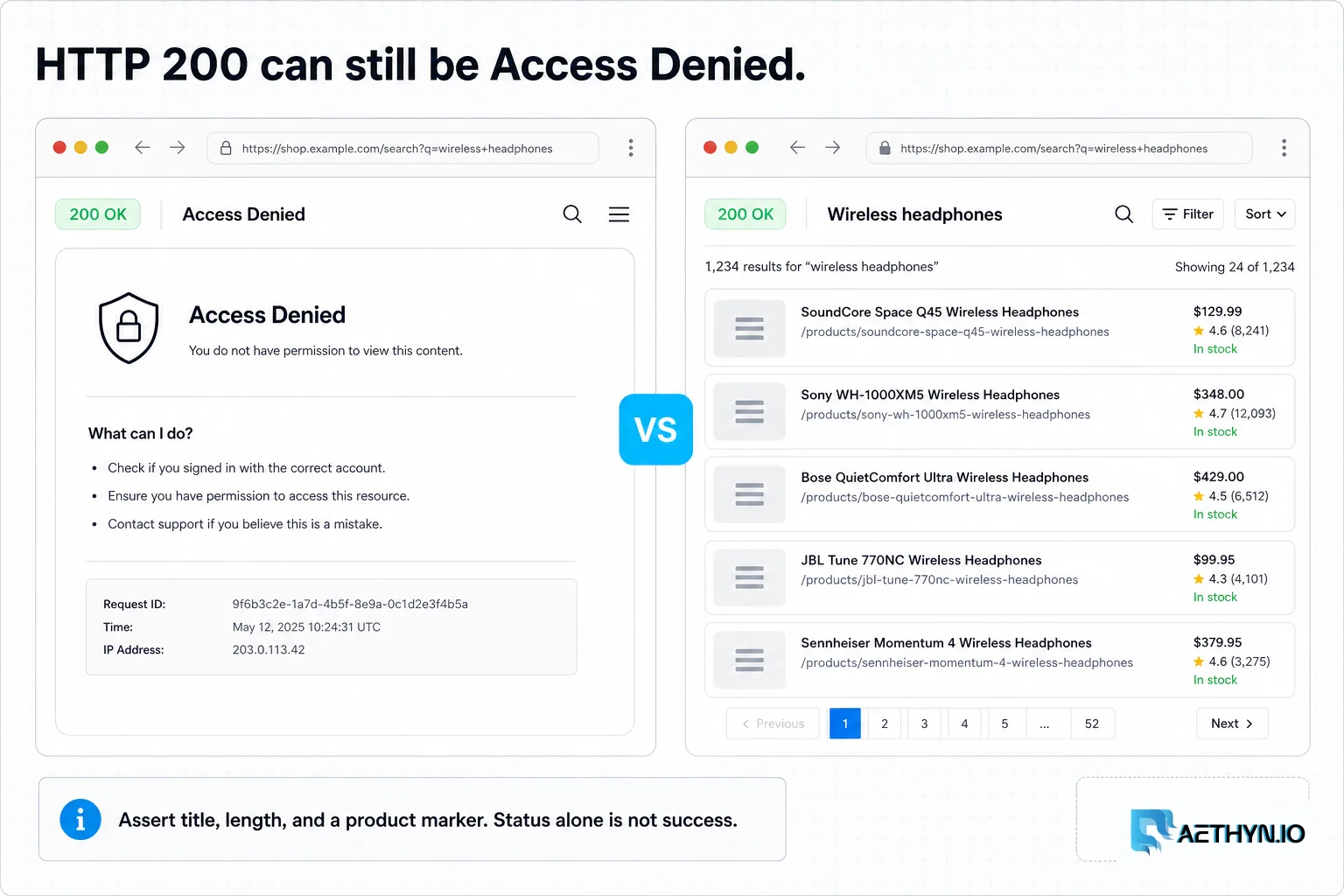
Signal observed → what it means for your scraper
Match the signal you captured, then decide whether a residential proxy can change that layer before you rotate.
| Signal observed | What it indicates | Which layer | Does a proxy change it |
|---|---|---|---|
| 200 + Access Denied title | Short HTML; title or TITLE tag says Access Denied; optional entity-encoded Reference | Edge soft deny — status intentionally healthy while content is a block shell | Fail the row in your validator; decode HTML entities before grepping Reference; then identify the vendor via the hub matrix. |
| 200 + page unavailable / AkamaiNetStorage | Server: AkamaiNetStorage; title like page unavailable; /akamai-block/ asset paths | Akamai-hosted unavailable/block template served as a normal document | Treat as block. Do not store. Follow /solutions/fix-akamai-access-denied-scraping for Reference-shaped siblings. |
| 200 + thin body / missing price node | Length far below baseline; expected selectors absent | Substitute shell, consent wall, or challenge document without a hard status | Baseline length and must-have tokens per URL class; alert on drift. |
| 200 identical across plain/UA/residential | All three curls return the same block shell | Client fingerprint or always-on soft template — not an IP-only gate | Stop rotating exits; upgrade client stack or accept the path is JS-gated. |
| 200 flips after curl_cffi / browser | requests gets deny shell; browser-grade TLS gets real HTML on same IP | Fingerprint decision with a soft status | IP rotation would not have fixed it — change the client, keep sticky residential only after content asserts pass. |
| Grep misses Reference # | ('Reference #' in text) is False on a real Akamai shell | Entity encoding (Reference#18…) in the raw bytes | html.unescape() before pattern match. |
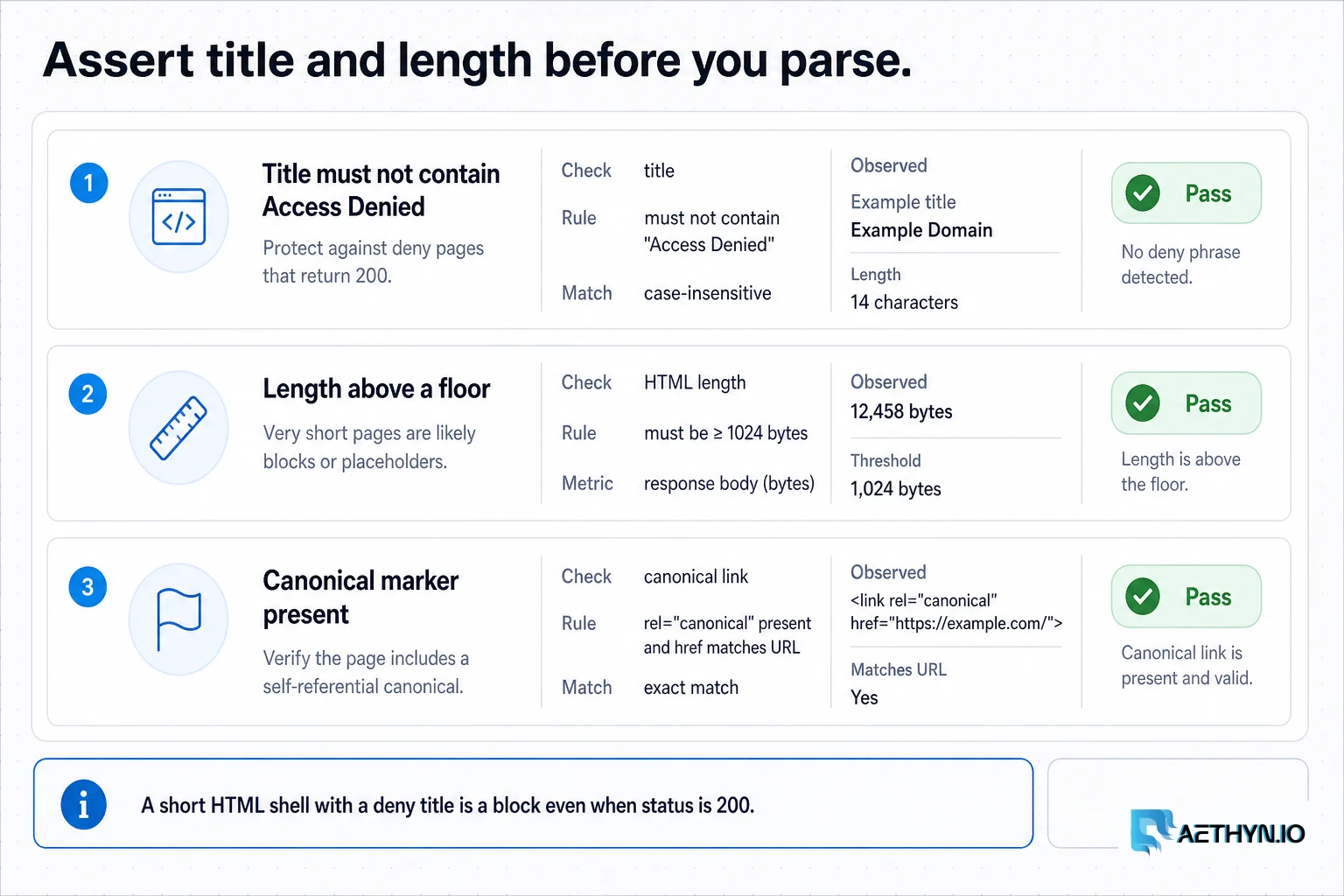
How to diagnose and fix this scraper failure
- 1
Log status, Server, title, and byte length together
For one failing URL, capture status, Server, the HTML title element text, Content-Length or len(body), and a 300-byte prefix. Soft blocks announce themselves in that tuple long before your parser notices missing JSON keys.
- 2
Reproduce the known soft-block shapes (dated observations)
On 2026-08-09 probes: www.lowes.com returned HTTP 200 with an Access Denied TITLE and entity-encoded Reference material; www.autotrader.com returned 200 from Server: AkamaiNetStorage with an unavailable title and /akamai-block/ assets. Re-run before you cite either in a ticket — live edges change.
Field note: If lowes returns real HTML today, keep the assert logic anyway — the failure class is what matters.
- 3
Three-way probe: plain, Chrome UA, residential
Compare the title and length across three transports. If only residential flips a deny title to a real catalog, IP was implicated. If all three share Access Denied or page unavailable, fix the client or accept the soft template.
bashUA='Mozilla/5.0 (Windows NT 10.0; Win64; x64) AppleWebKit/537.36 (KHTML, like Gecko) Chrome/128.0.0.0 Safari/537.36' URL='https://TARGET/' PX='http://aethyn-XXXXX-country-us:PASSWORD@proxy.aethyn.io:2099' summarize() { local f="$1" python - "$f" <<'PY' import sys,re,html from pathlib import Path b=Path(sys.argv[1]).read_text(errors="ignore") t=re.search(r"<tit" + r"le[^>]*>(.*?)</tit" + r"le>", b, re.I|re.S) title=html.unescape(t.group(1)).strip() if t else "(no title)" print(f"len={len(b)} title={title[:80]!r}") print("access_denied", "access denied" in title.lower()) print("akamai_block_path", "/akamai-block/" in b.lower()) PY } curl -sS -D /tmp/h1 -o /tmp/b1 "$URL" -w "plain %{http_code}\n" summarize /tmp/b1 curl -sS -D /tmp/h2 -o /tmp/b2 "$URL" -A "$UA" -w "ua %{http_code}\n" summarize /tmp/b2 curl -sS -D /tmp/h3 -o /tmp/b3 "$URL" -x "$PX" -A "$UA" -w "res %{http_code}\n" summarize /tmp/b3 grep -iE '^(HTTP/|server:)' /tmp/h1 /tmp/h2 /tmp/h3 - 4
Install a content gate before storage
Reject Access Denied titles, px-captcha meta, Just a Moment, page unavailable, and below-baseline lengths. Unescape HTML before Reference matching.
Pythonimport html, re from bs4 import BeautifulSoup # optional; regex enough for titles DENY_TITLE = re.compile( r"access denied|page unavailable|just a moment|attention required", re.I, ) def content_ok(status: int, body: str, min_len: int = 2500) -> bool: if status != 200: return False text = html.unescape(body or "") if len(text) < min_len: return False m = re.search(r"<tit" + r"le[^>]*>(.*?)</tit" + r"le>", text, re.I | re.S) title = (m.group(1) if m else "").strip() if DENY_TITLE.search(title): return False if "/akamai-block/" in text.lower() or "px-captcha" in text.lower(): return False return True - 5
Only then decide if residential helps
When the soft shell disappears on Elite/Premium residential but not on direct egress, keep country-targeted exits. When it does not, move to curl_cffi or Playwright and keep asserting content on every navigation response.
What goes wrong when this scraper fails
Collectors and uptime checks that key only on HTTP status will green-light poison. Retail and classified edges increasingly return deny or unavailable documents with 200 so naive clients keep writing rows. The failure mode is quiet: dashboards fill with Access Denied titles, empty product grids, or AkamaiNetStorage “unavailable” pages that never raise.
When residential proxies fix this — and when they cannot
Residential exits help when the soft shell is reputation- or geo-shaped and flips under a clean ASN. They do nothing when the same Access Denied title appears on plain curl, Chrome-UA curl, and residential curl alike — that pattern is fingerprint or always-on substitution. Use proxies to isolate the IP variable, not as a content validator.
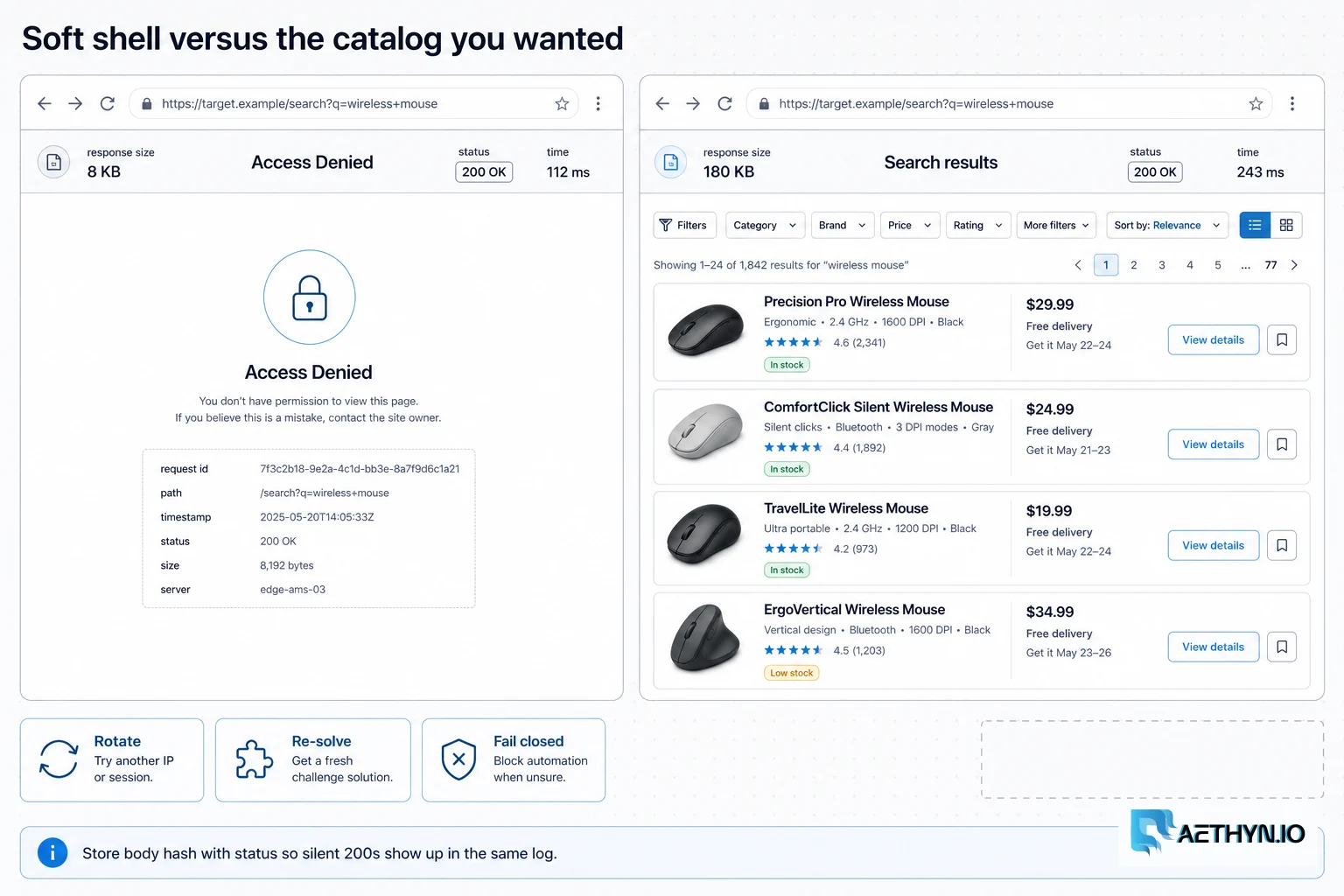
How Aethyn residential proxies help here
Run the same URL through Premium or Elite residential while your assert layer rejects deny titles. Sticky sessions keep a passing client on one exit once content checks are green.
- Premium HTTP 2099 / SOCKS5 1099 for volume diagnostics
- Elite HTTP 5499 / SOCKS5 3499 when Bot Management–class soft shells punish commodity ASNs
- Country and ISP suffixes so geo matches the catalog you expect
- Documented username form for reproducible three-way tests
- No implication that a proxy turns a deny shell into HTML by itself
Best practices that keep scrapers reliable
- Pair every status check with title + length + selector asserts
- Unescape HTML before vendor string greps
- Date-stamp live example captures
- Keep three-way diagnostics in the runbook
- Stay in public-data / Terms-safe collection — no CAPTCHA solving
Common mistakes that burn proxy budget
- Trusting 200 alone
- Grepping Reference # without html.unescape
- Burning exits on an identical soft shell
- Skipping Server: AkamaiNetStorage as a tell
- Celebrating flaky real HTML without asserts