

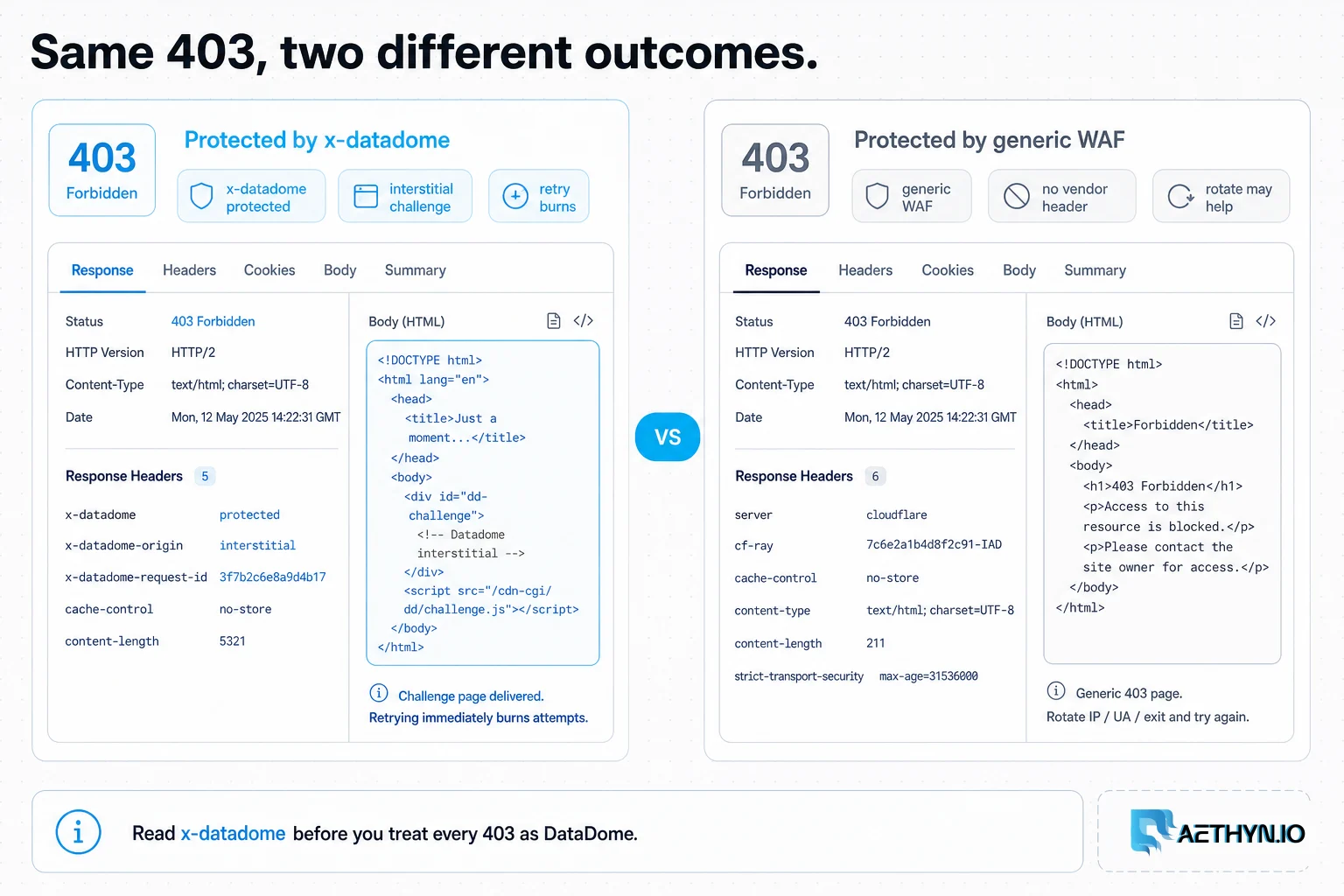
Signal observed → what it means for your scraper
Match the signal you captured, then decide whether a residential proxy can change that layer before you rotate.
| Signal observed | What it indicates | Which layer | Does a proxy change it |
|---|---|---|---|
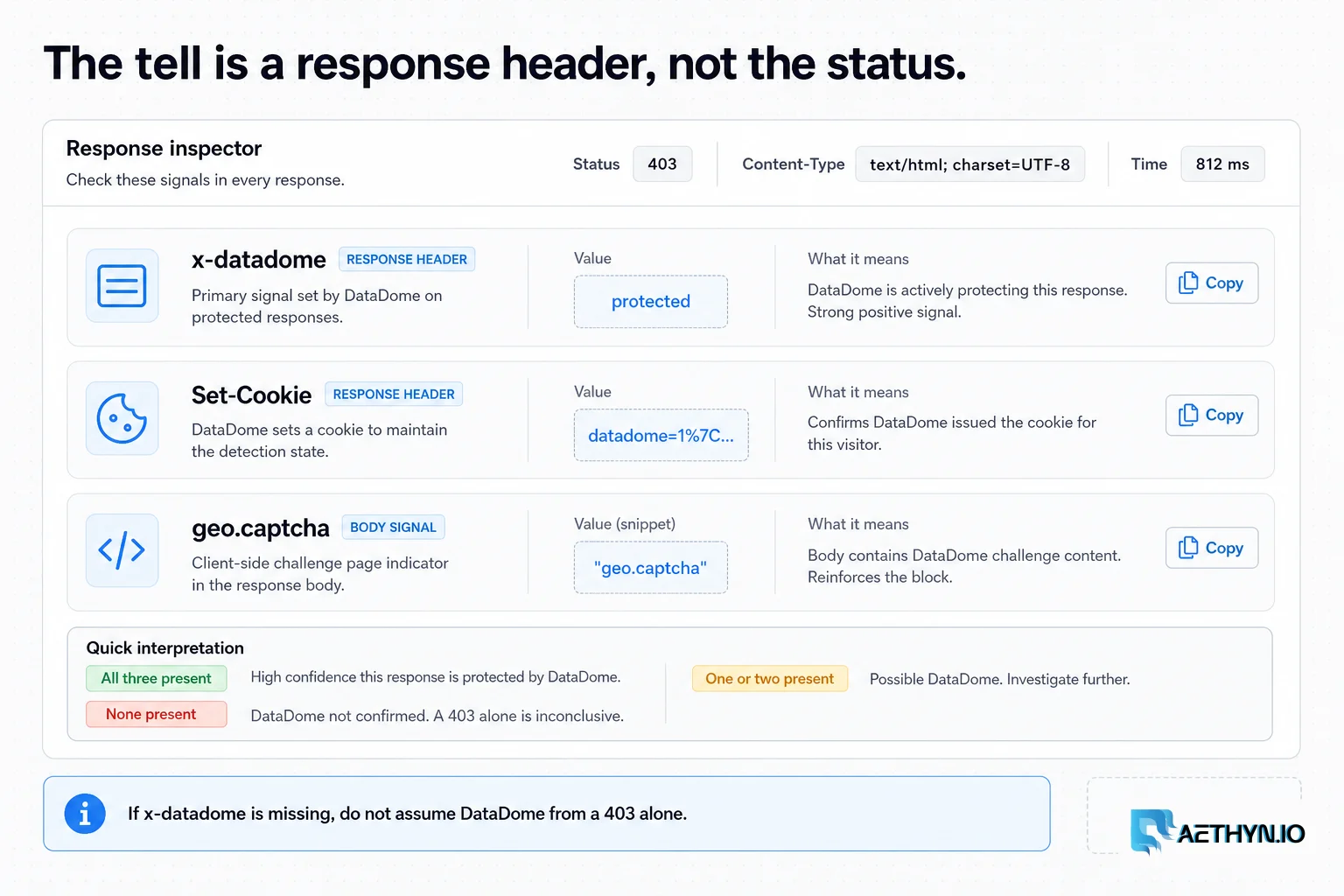
| x-datadome: protected | Custom response header with literal value protected | DataDome integration active on the property | Confirm datadome Set-Cookie and/or captcha-delivery URL; classify body before rotating. |
| 403 HTML ~please enable JS… | Nearly unbranded block/challenge HTML | Device check, CAPTCHA, or ban sharing one envelope | Parse embedded dd object or links to geo.captcha-delivery.com; do not branch on status alone. |
| 403 JSON {"url": "https://geo.captcha-delivery.com/..."} | resp.json() succeeds with one url key | API-shaped client Accept header received a challenge payload | Reject single-key challenge JSON in validators; inspect t= in the query string as a hint only. |
| Set-Cookie: datadome=… | Long-lived Secure cookie, typically not HttpOnly | Session cookie minted for DataDome JS tag read/write | Do not forge it. Mirror browser cookie policy; pair with sticky residential if you continue in a real browser. |
| Intermittent 200 then 403 | Same client sometimes passes | Possible fail-open / policy drift — not proof your code got smarter | Keep content assertions on; do not celebrate flaky 200s as a durable fix. |
| 403 unchanged across fresh residential IPs | Every exit gets the same challenge shell | Client/TLS/JS layer dominates for this tenant path | Move to curl_cffi or Playwright; stop burning clean exits on a failing fingerprint. |
How to diagnose and fix this scraper failure
- 1
Detect DataDome from headers and cookies, not vibes
Look for x-datadome: protected (literal value protected), Set-Cookie: datadome=…, and script references to js.datadome.co/tags.js. Optional headers such as x-datadome-cid may appear on challenges. Confirm before you assume Cloudflare or Akamai.
Python (detect)def is_datadome(resp) -> bool: h = {k.lower(): v for k, v in resp.headers.items()} if h.get("x-datadome", "").lower() == "protected": return True sc = h.get("set-cookie", "") if "datadome=" in sc.lower(): return True body = resp.text or "" return "js.datadome.co/tags.js" in body or "captcha-delivery.com" in body - 2
Classify HTML vs JSON 403 bodies safely
Never treat a 403 JSON object with a single url key as business data. Extract the challenge URL and log query parameters for diagnosis. Values such as t=bv appear on some captcha URLs and correlate with hard IP pressure on that tenant — use them as hints, not as a guarantee that another IP will pass.
Python (classify body)import json from urllib.parse import urlparse, parse_qs def classify_datadome_body(resp): text = (resp.text or "").strip() if text.startswith("{"): try: data = json.loads(text) except json.JSONDecodeError: data = None if isinstance(data, dict) and set(data) == {"url"}: q = parse_qs(urlparse(data["url"]).query) return {"kind": "json_challenge", "t": (q.get("t") or [None])[0], "url": data["url"]} if "captcha-delivery.com" in text or "var dd=" in text or "Please enable JS" in text: return {"kind": "html_challenge_or_block"} return {"kind": "other", "status": resp.status_code}Field note: Interstitial vs captcha field sets differ — do not assume every HTML 403 embeds a full dd object with a t field.
- 3
Three-way curl before you rewrite the scraper
Plain curl, Chrome-UA curl, and residential-proxied curl separate UA triggers from IP reputation. Record x-datadome and body class for each.
bashPROXY="http://aethyn-XXXXX-country-fr:PASSWORD@proxy.aethyn.io:5499" URL="https://TARGET/" for label in plain ua res; do case $label in plain) extra=();; ua) extra=(-A "Mozilla/5.0 (Windows NT 10.0; Win64; x64) AppleWebKit/537.36 (KHTML, like Gecko) Chrome/128.0.0.0 Safari/537.36");; res) extra=(-x "$PROXY" -A "Mozilla/5.0 (Windows NT 10.0; Win64; x64) AppleWebKit/537.36 (KHTML, like Gecko) Chrome/128.0.0.0 Safari/537.36");; esac echo "=== $label ===" curl -sS -D - -o "/tmp/dd-$label.body" "$URL" "${extra[@]}" -w "\nHTTP %{http_code}\n" | grep -iE "HTTP/|x-datadome|set-cookie: datadome|server:" done - 4
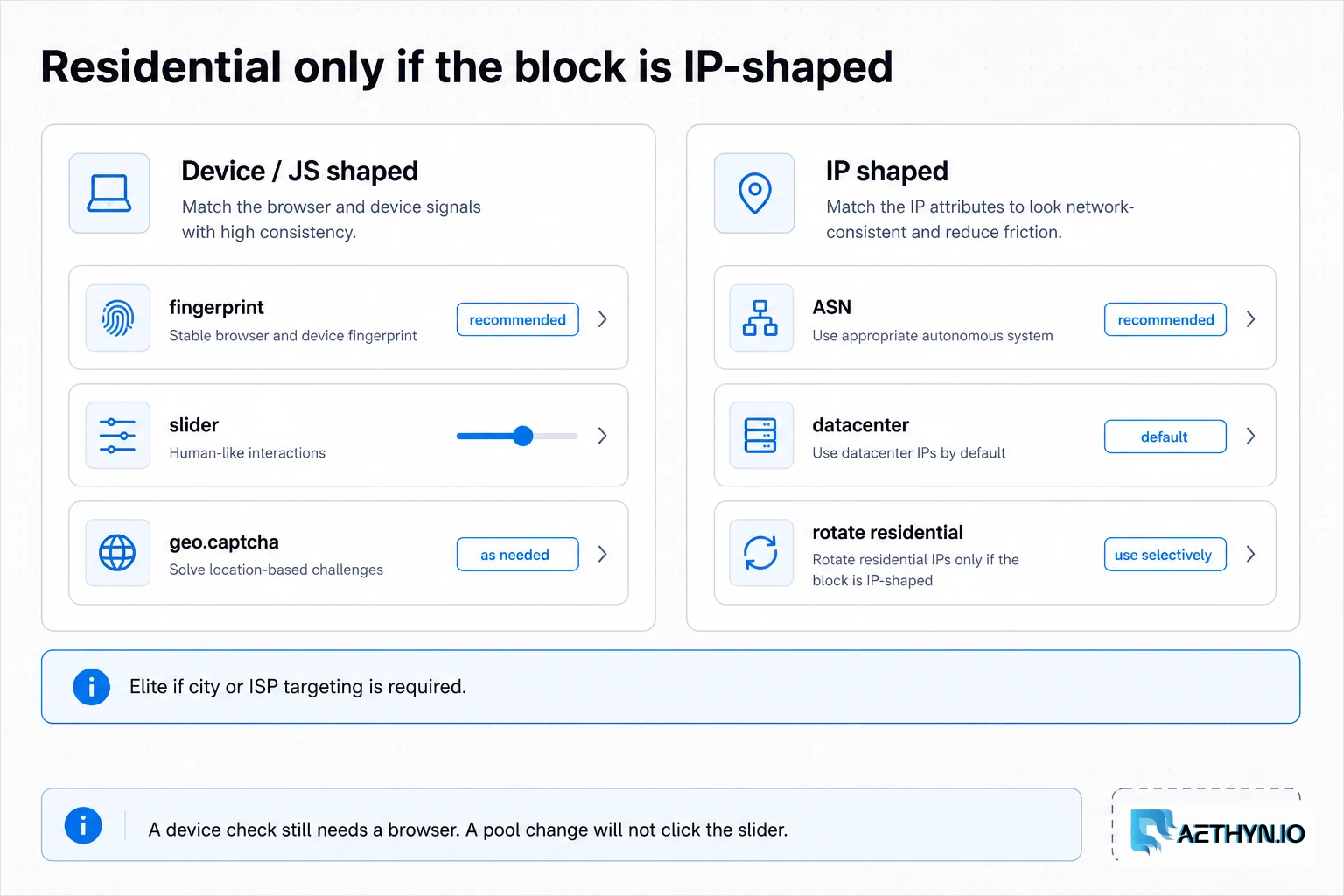
Branch: rotate residential only for IP-shaped pressure
When fresh residential exits change the outcome, keep rotation or sticky sessions in Python via the proxy URL. When they do not, switch to curl_cffi or Playwright through the same proxy instead of expanding concurrency.
Python (requests + proxy)import requests PROXY = "http://aethyn-XXXXX-country-fr:PASSWORD@proxy.aethyn.io:5499" proxies = {"http": PROXY, "https": PROXY} headers = { "User-Agent": "Mozilla/5.0 (Windows NT 10.0; Win64; x64) AppleWebKit/537.36 (KHTML, like Gecko) Chrome/128.0.0.0 Safari/537.36", "Accept": "text/html,application/xhtml+xml", } r = requests.get("https://TARGET/", headers=headers, proxies=proxies, timeout=45) print(r.status_code, r.headers.get("x-datadome"), is_datadome(r)) - 5
Assert success on content — DataDome can fail open
Intermittent 200 responses can mean protection degraded or a custom allow path, not that your scraper is correct. Require expected selectors and reject challenge titles before writing rows.
What goes wrong when this scraper fails
Python scrapers talking to DataDome-protected classifieds, travel, and luxury retail properties often see a wall of HTTP 403s with almost no vendor logo. Because device check, CAPTCHA, and ban share that envelope, teams either rotate proxies forever or parse the JSON challenge as if it were API data. Correct handling starts by identifying DataDome explicitly, then reading the body.
When residential proxies fix this — and when they cannot
Residential proxies help when the failure is reputation or velocity shaped — including cases where challenge URLs show t=bv on a given tenant. They also spread request rate so you trip fewer rate/timebox policies. They do not run the DataDome JS tag or fix a Python TLS fingerprint that the edge dislikes. If every clean exit gets the same challenge shell, stop rotating and fix the client.
How Aethyn residential proxies help here
Use Aethyn to control the IP variable deliberately while your Python code classifies DataDome responses. Sticky Elite sessions support browser-backed flows; rotating Premium covers volume on softer paths.
- Elite HTTP 5499 for higher-trust exits on hard tenants
- Per-request rotation on Premium 2099 for velocity-sensitive catalogs
- Country targeting for geo-differentiated properties
- Documented username grammar for reproducible experiments
- Honest positioning: proxy ≠ DataDome bypass
Best practices that keep scrapers reliable
- Detect x-datadome before generic 403 handlers
- Reject single-key captcha-delivery JSON as data
- Run three-way diagnostics on each new tenant
- Prefer sticky Elite exits for browser-backed sessions
- Stay in public-data / ToS-safe scope — no CAPTCHA solve recipes
Common mistakes that burn proxy budget
- Ingesting challenge JSON as API payloads
- Forging or replaying datadome cookies across IPs
- Assuming tags.datadome.co is the script host
- Celebrating flaky 200s without content asserts
- Rotating forever on a pure client fingerprint failure