AI Mode citation pipeline
Pin the market
Country (and city when needed) on the Elite username matches gl, hl, and Accept-Language so the answer is the one a household in that market would see
Launch a browser context
Playwright Chromium with credentials in username/password fields and a per-context residential proxy — not a user:pass URL, not requests
Render AI Mode
Wait for the conversational surface and citation chips; treat DOM drift as expected and extract stable citation hrefs rather than generated class names
Classify the document
Soft 200 with no AI Mode, challenge/consent interstitial, or a populated answer — three labels, never one empty bucket
Key the citations
Store query, market, collected_at, resolved exit country, answer text, and citation URLs. Empty is not written as not cited
How to collect Google AI Mode citations with Playwright
- 1
Pin Elite and make locale agree
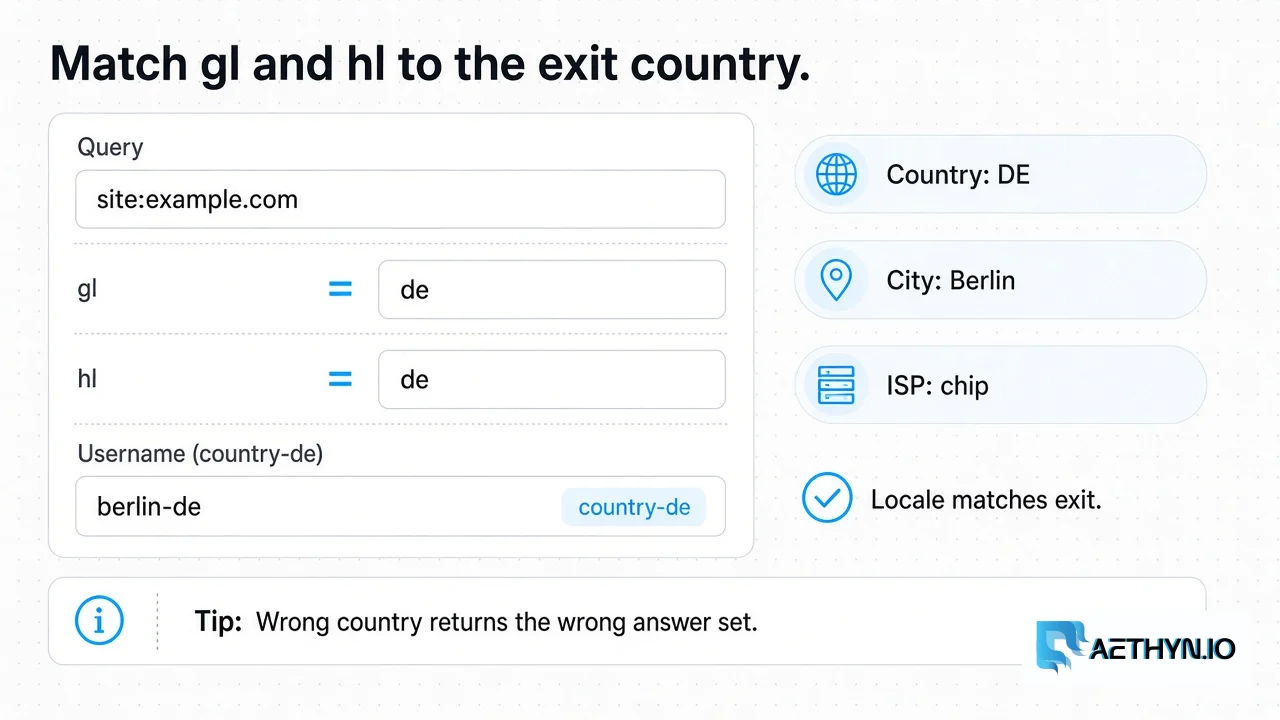
Start on Elite (proxy.aethyn.io:5499). Encode the market on the username (-country-de) and pass matching gl, hl, and Playwright locale. A country-de exit with gl=us is a contradictory session and a wrong answer set. For local-language or local-pack prompts, add Elite city targeting and verify the city you landed in before you trust the row.
cURLcurl -x "http://aethyn-XXXXX-country-de:PASSWORD@proxy.aethyn.io:5499" \ "https://www.google.com/search?q=best+residential+proxies&hl=de&gl=de"Field note: cURL here is only to prove the exit and locale. Do not parse AI Mode from this response — the conversational UI will not be in it.
- 2
Launch Playwright with a per-context residential proxy
Put credentials in username and password fields. Chromium strips user:pass from a proxy URL and answers 407. Launch with Playwright’s per-context placeholder, then set the real Elite proxy on each newContext. One context per independent prompt so cookies never leak onto the next exit.
Python (Playwright)from playwright.sync_api import sync_playwright PROXY = { "server": "http://proxy.aethyn.io:5499", "username": "aethyn-XXXXX-country-de", "password": "PASSWORD", } def new_context(browser, locale="de-DE"): return browser.new_context(proxy=PROXY, locale=locale) with sync_playwright() as p: browser = p.chromium.launch(proxy={"server": "per-context"}, headless=True) context = new_context(browser) page = context.new_page() page.goto("https://www.google.com/?hl=de&gl=de", wait_until="domcontentloaded") # Drive the AI Mode UI from here — entry chrome changes; classify the document. context.close() browser.close()Field note: If per-context proxies are ignored, you launched Chromium without the placeholder. See the Playwright residential guide — launch proxy: { server: 'per-context' }, then set the real gateway on newContext().
- 3
Render AI Mode and extract citations, not class names
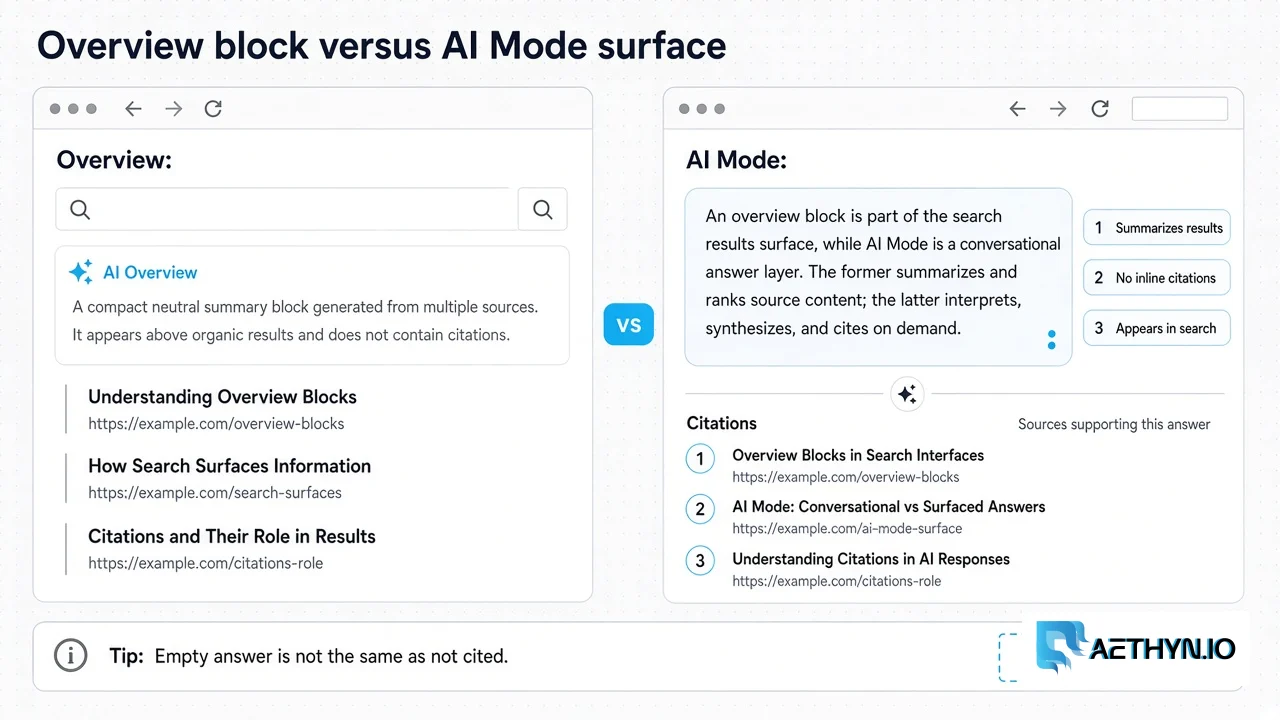
Wait for the conversational surface and for citation chips to settle. Google rotates generated class names; treat them as decoration. Stable enough signals are: an answer container that is not a SERP #rso list, numbered citation pills, and outbound hrefs that look like publisher URLs rather than google.com/search internals. Store those hrefs. If the Overview block is present on a classic SERP, that is a different product — see the AI Overviews post and do not merge the rows.
Python (classify + extract)CHALLENGE_MARKERS = ("unusual traffic", "sorry/index", "cf-challenge", "verify you are human") def classify_ai_mode(html: str, citation_hrefs: list[str]) -> str: low = html.lower() if any(m in low for m in CHALLENGE_MARKERS): return "challenge" if citation_hrefs: return "cited" # Rendered shell, no citations — could be "no AI Mode for this query/IP" return "soft_empty" # Never write soft_empty as cited=False. Write status=soft_empty instead.Field note: Entry URLs for AI Mode drift (query params, app chrome, consent). Keep a small adapter around navigation; keep classification and citation keying stable.
- 4
Classify missing answers before you store them
A 200 with no citations is not automatically “this brand was not cited.” It may be a consent wall, a /sorry/ interstitial, a challenge page, or a genuine empty — Google did not attach AI Mode to this query from this IP. Those four outcomes must not share one boolean. Fail closed: if you cannot name the document, do not persist a GEO metric.
Python (record shape)record = { "query": "best residential proxies", "market": "de", # gl/hl + intended exit country "collected_at": "2026-09-12T12:00:00Z", "resolved_country": "DE", # from an IP lookup at session start "status": "cited", # cited | soft_empty | challenge | consent "answer_text": "...", "citations": ["https://example.com/a", "https://example.com/b"], }Field note: Assert resolved_country (and city, if you asked for one) before the first Google request. A mis-typed username is a silent wrong market, not a block.
- 5
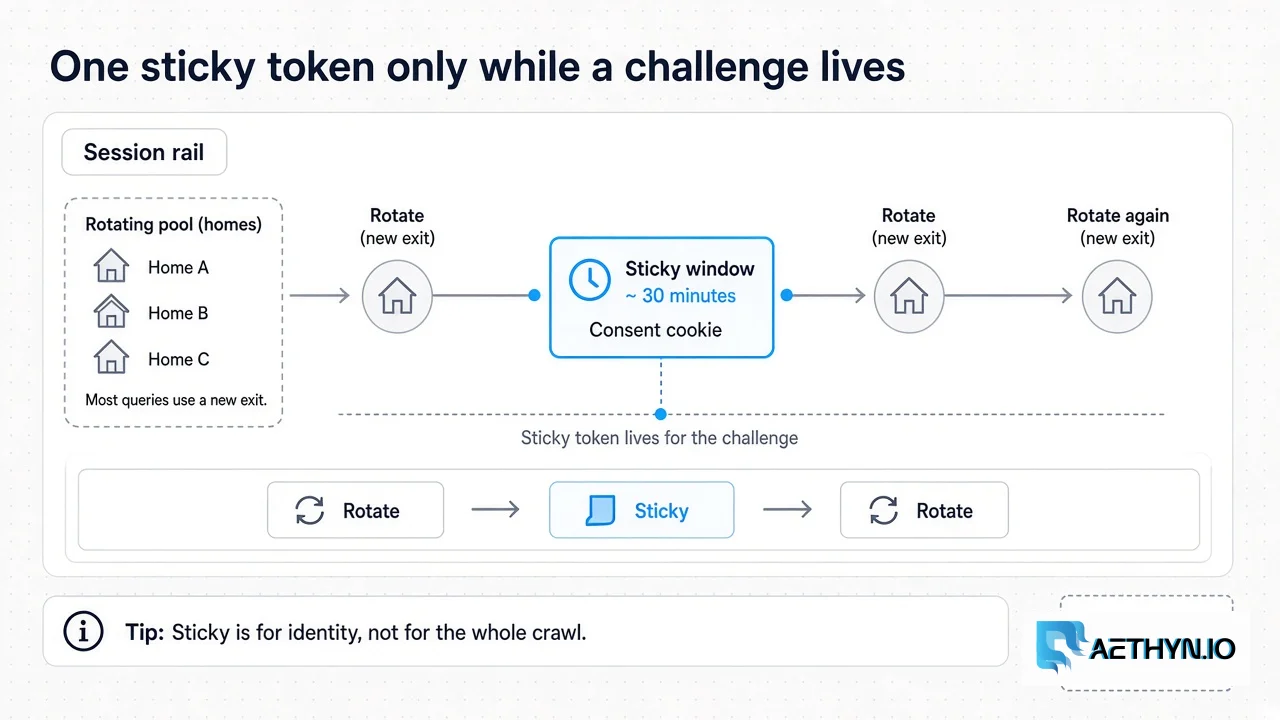
Rotate per prompt; sticky only for consent
Close the context when the prompt is done so the next prompt gets a new exit. Use a sticky session only while a consent or challenge cookie must stay on the IP that earned it — typically well inside the default 30-minute window — then drop the session id. Do not pin one IP for a 5,000-keyword morning run.
Python (sticky username)# Same rotating-pool IP for ~30 minutes while a consent cookie lives user = "aethyn-XXXXX-country-de-session-aimode42-lifetime-30" proxy = { "server": "http://proxy.aethyn.io:5499", "username": user, "password": "PASSWORD", }Field note: Sticky holds a rotating-pool residential IP. It is not a static, dedicated, or ISP product. Elite ISP suffixes are targeting, not a different SKU.
Why scrape Google AI Mode instead of the Overview block
GEO teams now buy measurement of citations in AI answers, not only blue-link rank. Otterly, Cloro, and Profound sell the dashboard; someone still has to collect the raw conversation from the market the buyer cares about. Google AI Overviews sit above organic results on a classic SERP. Google AI Mode is a different surface: a Gemini conversational UI that streams an answer and attaches numbered citations. Collecting the Overview HTML and labeling it “AI Mode” silently mixes two products. Collecting AI Mode with requests — or from a US datacenter while reporting a DE market — writes a 200 that describes nobody. The failure is quiet: dashboards stay green, “not cited” rates look decisive, and a brand lead in Berlin says that answer has never been what they saw. This guide is the collector for AI Mode citations. The Overview block has its own post. Classic rank still lives under SERP tracking.
What breaks AI Mode citation collection
- AI Mode is a rendered conversation — there is no stable public JSON endpoint to poll
- Entry URLs and DOM chrome change; generated class names are not a parser contract
- Answers localize by exit geography and language; a wrong country is a wrong dataset
- Soft 200s (no AI Mode for this query/IP) look like “not cited” if you do not classify them
- Consent walls and challenges bind cookies to the IP and browser that earned them
How Aethyn Elite fits Google AI Mode collection
AI Mode collection is a high-defense, geo-true workload. Aethyn Elite maps onto that: city and ISP on the username, HTTP and SOCKS5 on the same residential pool, sticky lifetime encoded next to the session id. Premium remains the cheaper country pool when you are sampling Overviews at keyword scale rather than driving the conversational UI.
- Elite port 5499 (HTTP) / 3499 (SOCKS5) with -country-XX and optional -city- / ISP for local answers
- Per-request rotation by omitting a session id so each independent prompt gets a fresh household exit
- Sticky 1–1440 minutes (default 30) as -session-…-lifetime-N only while a consent or challenge lives
- Premium port 2099 when the job is high-volume AI Overview sampling on a milder SERP
- One credential, many markets — change the username, not the gateway
Google AI Mode citations FAQ
Is Google AI Mode the same as AI Overviews?
Can I scrape Google AI Mode with Python requests?
Why Elite instead of Premium?
How do I match the proxy to Google’s locale?
What should I store when AI Mode does not appear?
Should I rotate or use a sticky session?
Do you scrape ChatGPT Search in this guide?
HTTP or SOCKS5?
Best practices for AI Mode citation pipelines
- Collect public AI Mode answers only. Do not log in, do not solve CAPTCHAs, and do not treat a proxy as a license to ignore Google’s terms.
- Match exit country, gl, hl, and Playwright locale on every context. Contradictory locale is both a bad dataset and a bot tell.
- Verify the exit with an IP lookup at the start of the context and store resolved_country next to the citations.
- Key rows on query + market + timestamp. Citations are the GEO metric; organic rank belongs in a different table.
- Classify challenge vs consent vs soft_empty vs cited before insert. Empty-as-absent is how GEO dashboards lie.
- One Playwright context per independent prompt. Reusing a context across prompts leaks cookies onto a new identity.
- Reserve sticky (~30 min default) for the identity that holds a consent or challenge cookie; rotate again when that flow ends.
- Keep Overview collection on its own pipeline. Merging Overview HTML into an AI Mode table poisons both products.
Common mistakes when scraping Google AI Mode
- Using requests or httpx and parsing a SERP as if it were AI Mode.
- Reporting a US datacenter crawl as a DE (or any other) market’s citations.
- Storing a 200 with zero citations as cited=false instead of status=soft_empty or challenge.
- Embedding user:pass in the Playwright proxy server URL and debugging the resulting 407 as a Google block.
- Rotating the IP while a consent cookie is still required, then calling the next empty page “not cited.”
- Pinning one sticky IP for the entire keyword list and recreating a per-IP velocity problem.
- Scraping ChatGPT.com as the first GEO how-to — login, Cloudflare, and terms make that a different, worse project.