

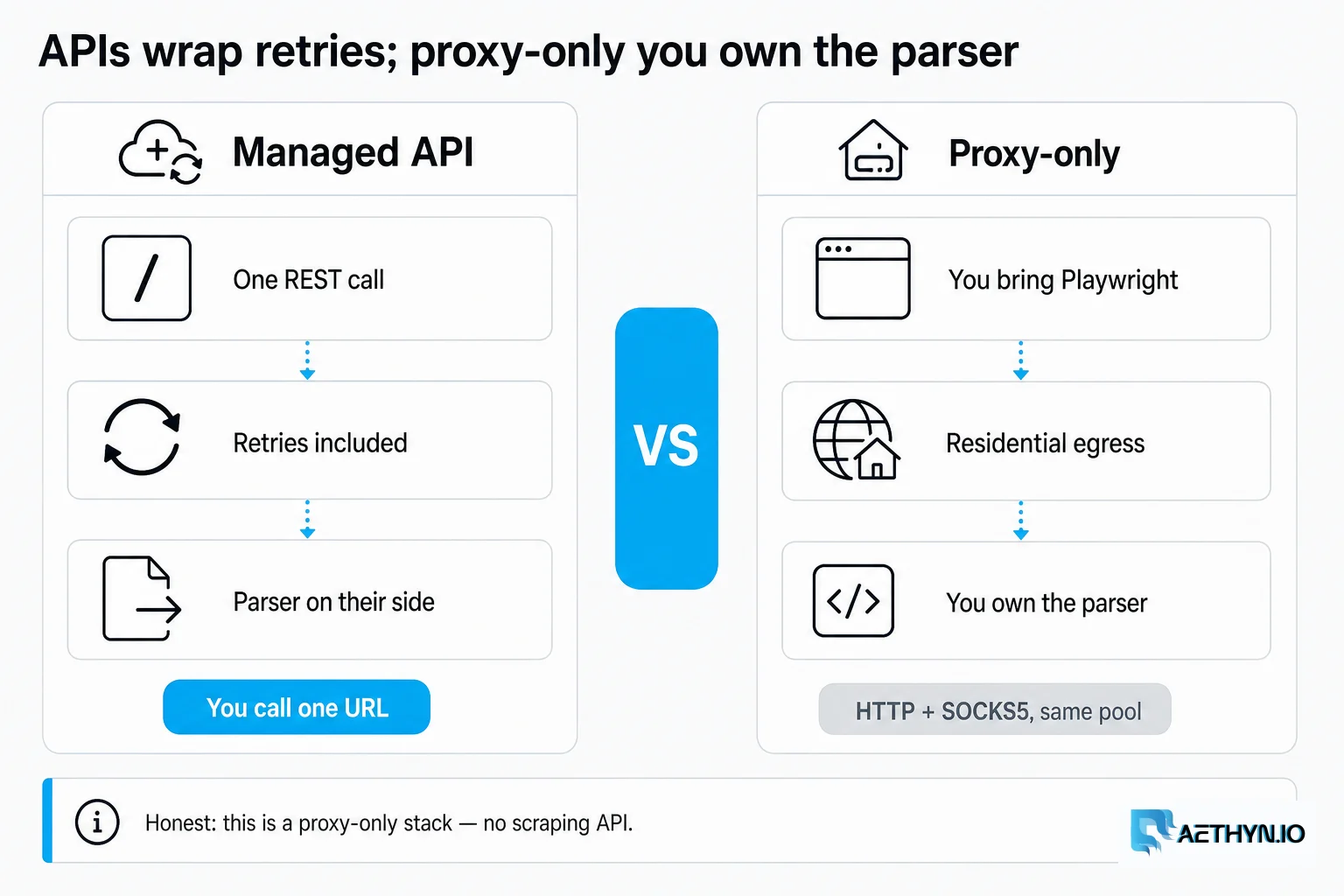
Short answer: Choose a scraping API (ScraperAPI, ZenRows, ScrapingBee) when you need speed-to-market and lack infra to manage browsers and bans. Choose proxy-only (Aethyn, Bright Data proxies, Smartproxy) when you run custom Playwright/Scrapy at scale and want the lowest per-page cost.
[!IMPORTANT] Honest caveat: Aethyn sells proxy-only infrastructure — not a managed scraping API. We are biased toward proxy-first architectures, but this guide explains when APIs genuinely win.
TL;DR — Quick Rankings
- ScraperAPI — Best all-in-one API for teams without scraping engineers.
- ZenRows — Strong European anti-bot API with good docs.
- ScrapingBee — Developer-friendly API with headless tiers.
- Bright Data Web Scraper — Enterprise IDE + datasets + proxies.
- Oxylabs Scraper API — Enterprise parsed-output API.
- Aethyn proxy-only — Best $/GB for teams with existing crawlers.
- Bright Data proxies only — Maximum pool, you bring the parser.
- Smartproxy proxies only — Mid-market proxy-first alternative.
- Decision rule: <5 targets and no DevOps → API; >50 targets and CI pipelines → proxy-only.
- Hybrid: API for long-tail sites, Aethyn residential for core catalog.
- Compare: Aethyn vs Oxylabs.
How We Compared APIs vs Proxy-Only
Scoring rules, claim limits, and how we date sources: comparison methodology.
We scored the buy-vs-build decision on four architectural criteria — not a vendor grid.
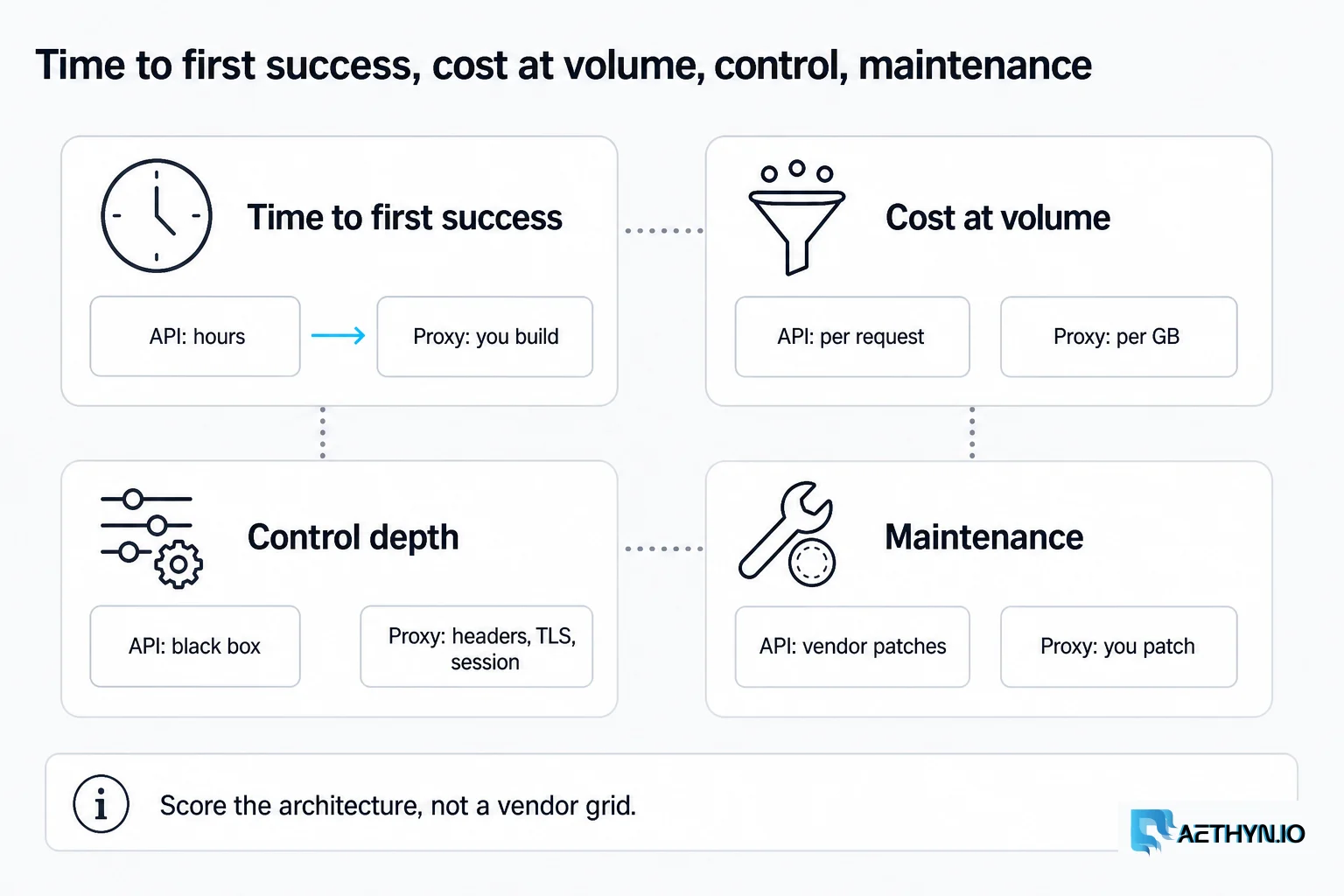
| Criterion | Weight | Notes |
|---|---|---|
| Time to first success | 20% | Hours to first 200 OK on protected page |
| Cost at 1M pages/mo | 25% | Normalized $/1k successful pages |
| Control depth | 20% | Headers, TLS, session, IP type visibility |
| Maintenance burden | 20% | Who patches selectors and anti-bot |
| Geo flexibility | 15% | Country/city targeting options |
Master Comparison Table
Benchmark period: June 2026. Outcomes vary by target site, pool tier, and request pacing.
| Solution | Model | JS rendering | You own parser? | Typical buyer | Cost curve |
|---|---|---|---|---|---|
| ScraperAPI | API | Yes (tiers) | No | Startups | Per request ↑ |
| ZenRows | API | Yes | No | EU dev teams | Per request ↑ |
| ScrapingBee | API | Yes | No | Indie devs | Per request ↑ |
| Bright Data Web Scraper | API + IDE | Yes | Partial | Enterprise | Platform ↑ |
| Oxylabs Scraper API | API | Yes | Partial | Enterprise | Premium |
| Aethyn | Proxy-only | No (you bring) | Yes | Engineering teams | Per GB → |
| Bright Data proxies | Proxy-only | No | Yes | Large infra | Per GB ↑ |
| Smartproxy | Proxy-only | No | Yes | Mid-market | Per GB mid |
Detailed Reviews
1. ScraperAPI
ScraperAPI wraps proxies, headless rendering, and retry logic behind a single REST API. Teams without dedicated infra engineers often ship faster because api.scraperapi.com handles CAPTCHA retries and IP rotation opaquely. For a side-by-side of credit multipliers, rendering, and per-GB cost, see Aethyn vs ScraperAPI.
You pay a premium per successful request and cede fine-grained control. When Amazon changes markup weekly, vendor latency to update parsers can block your pipeline.
ScraperAPI optimizes time-to-first-scrape — budget for vendor lock-in and per-request pricing as volume grows.
Pros
Cons
2. ZenRows
ZenRows targets developers who want anti-bot bypass with competitive European support and clear docs. Good for mid-complexity ecommerce pages where generic APIs struggle.
Like peers, you trade engineering control for convenience. High-volume catalog scraping may cost more than raw residential GB.
ZenRows targets teams that want managed rendering without building browser farms; compare per-page cost at your URL count.
Pros
Cons
3. ScrapingBee
ScrapingBee emphasizes developer experience with straightforward pricing tiers and Playwright-backed rendering. Startups running dozens of targets appreciate the predictable REST model.
Very large heterogeneous crawls still need custom orchestration. Compare per-request math against €2.00/GB proxy-only models.
ScrapingBee fits small teams shipping fast; proxy-only stacks usually win on unit economics once engineers own anti-bot logic.
Pros
Cons
4. Bright Data Web Scraper
Bright Data's Web Scraper IDE and dataset products combine their proxy network with managed extraction templates. Enterprises already on Bright Data extend into scraping without new vendors.
Platform weight and pricing reflect enterprise positioning. Small teams may drown in features they never touch.
Bright Data Web Scraper bundles infra you may already own — compare total platform cost against proxy-only Playwright stacks.
Pros
Cons
5. Oxylabs Scraper API
Oxylabs pairs its residential network with a Scraper API that returns parsed HTML or JSON for supported targets. Strong choice when legal review demands a single vendor contract.
Premium pricing and enterprise assumptions. Proxy-only teams may not need the API layer.
Oxylabs Scraper API trades control for managed retries; map migration cost before you embed vendor URL schemas.
Pros
Cons
Our recommended proxy-only option
6. Aethyn (proxy-only)
Aethyn is proxy-first: you bring Scrapy, Playwright, or your own parser and route through proxy.aethyn.io:2099 at €2.00/GB. Engineers who want full control over fingerprints, headers, and retry policies prefer this model.
You must own anti-bot logic — Aethyn does not render JavaScript or solve CAPTCHAs for you. That is the trade-off: lower cost and zero black box, more engineering responsibility.
Proxy-only on Aethyn trades managed rendering for €2.00/GB bandwidth and full control over retries, headers, and browser fingerprints.
Pros
Cons
7. Bright Data (proxies only)
Using Bright Data proxies without their API gives maximum flexibility for teams with existing Playwright farms. Pool depth is unmatched for global geo.
You still pay enterprise rates and navigate zone configuration. Compare Aethyn vs Bright Data if proxy-only is your path.
Bright Data wins when pool breadth, datasets, and enterprise SLAs matter more than per-GB simplicity.
Pros
Cons
8. Smartproxy (proxies only)
Smartproxy's residential endpoints integrate cleanly with open-source stacks. Mid-market sweet spot for teams graduating from ScraperAPI but not ready for Bright Data.
No built-in CAPTCHA solving — pair with your own solvers or slower pacing.
Smartproxy is a solid mid-market default when you want dashboard polish without Bright Data's contract overhead.
Pros
Cons
Total Cost of Ownership at Three Scales
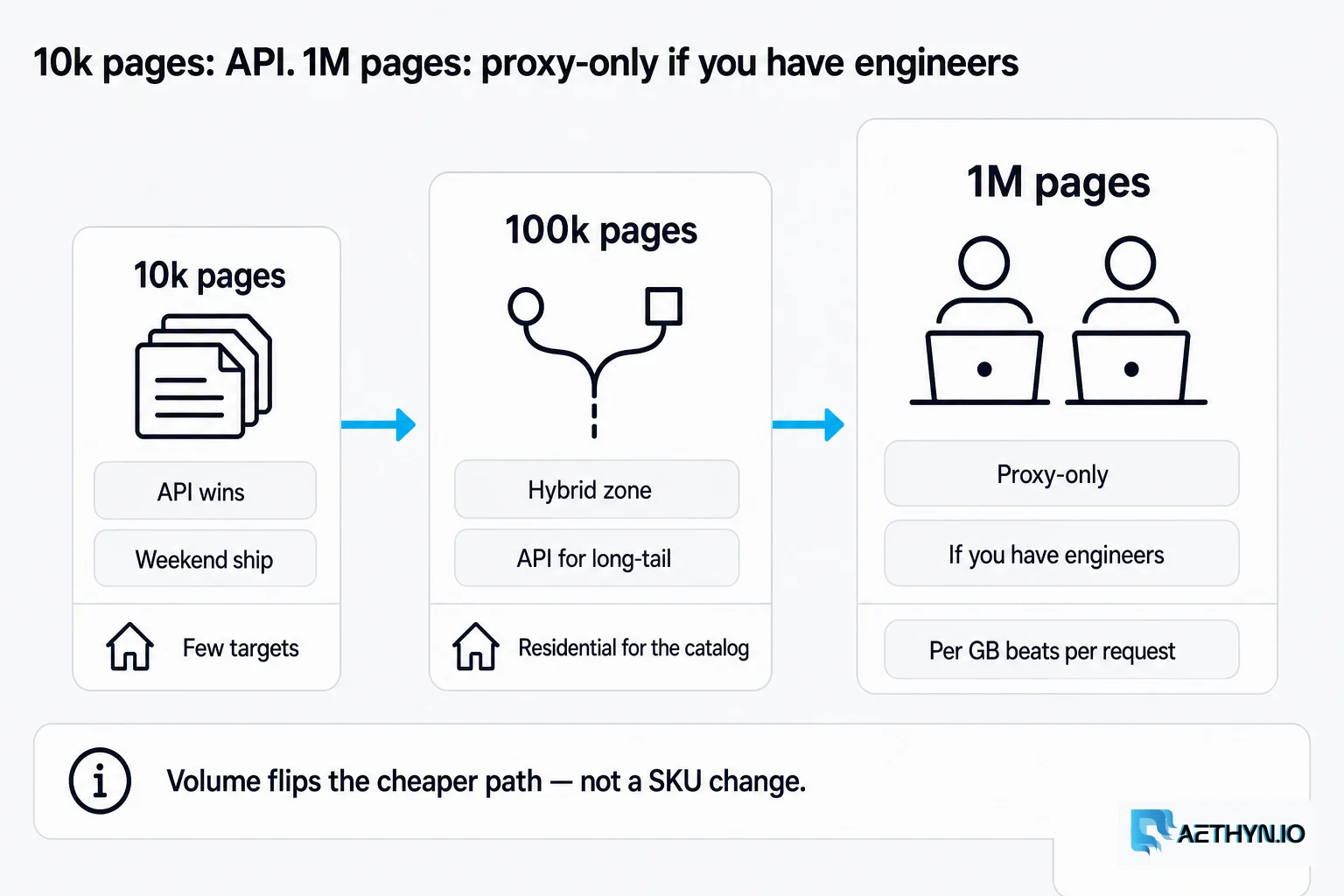
10k pages/month, 5 targets: A scraping API wins. Engineer time to maintain Playwright for five URLs exceeds API fees. Budget €50–150/month on entry API tiers and ship in a weekend.
100k pages/month, 30 targets: Hybrid zone. APIs for long-tail JS-heavy pages; Aethyn residential for stable JSON/API endpoints and catalog HTML you already parse with Scrapy. Expect €200–600/month blended.
1M+ pages/month, 200+ targets: Proxy-only almost always wins if you have two or more scraping engineers. At €2.00/GB, even 500 GB/month is €1,000 — often less than per-request API math. You invest in CI, selector tests, and fingerprint rotation instead of vendor markup.
Maintenance: Who Patches Selectors?
API vendors absorb some DOM breakage — until they do not. When Amazon moves a price field, your API may return null for 48 hours while they patch. Proxy-only teams patch selectors themselves in hours but need on-call ownership. Choose based on who wakes up at 3 AM: your engineer or their support ticket queue.
Data Residency and Logging
Enterprise buyers ask whether page HTML transits vendor logs. Proxy-only routes let you keep extraction on your VPC; APIs necessarily see URLs and sometimes response bodies. For competitive intelligence with NDAs, that architectural difference drives procurement — not marginal per-GB savings.
Building a Proxy-First Stack on Aethyn
A minimal production architecture: Scrapy or Playwright workers in Kubernetes, secrets from your vault, egress through proxy.aethyn.io:2099, metrics on 403 rate per domain, auto-throttle when error budgets exceed 5%. Add a dead-letter queue for URLs that need manual API fallback — hybrid without full API lock-in.
Framework: API vs Proxy-Only
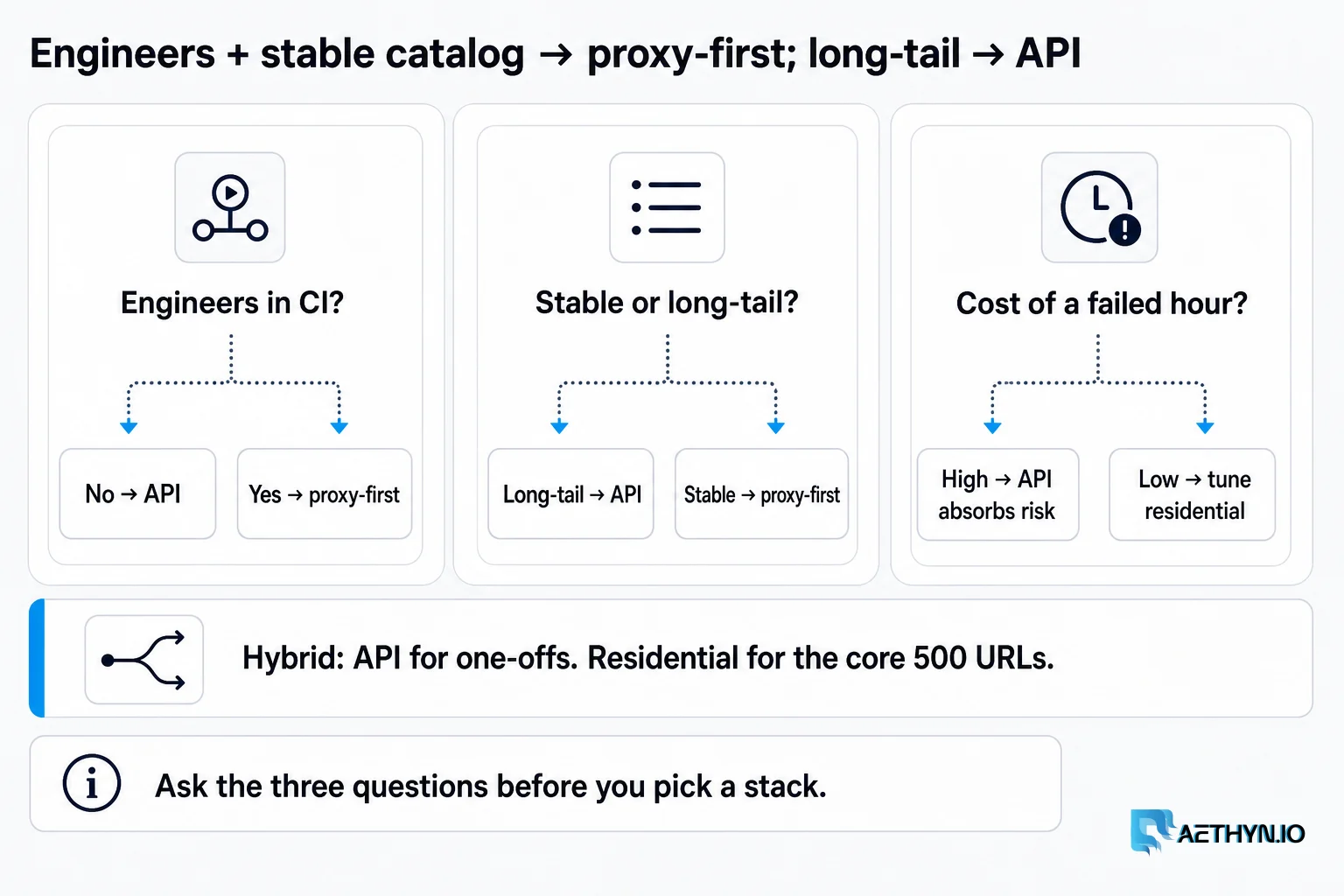
Ask three questions:
- Do you have engineers to run Playwright/Scrapy in CI? No → API. Yes → proxy-only likely cheaper.
- Is your target list stable or long-tail? Long-tail → API convenience wins. Stable catalog → invest in proxy-first infra.
- What is your cost of a failed hour? High → API vendor absorbs some risk. Low → tune Aethyn residential yourself.
[!TIP] Hybrid architectures are common: ScraperAPI for one-off competitor sites, Aethyn residential for your core 500 URLs scraped every hour.
Sample Cost Scenarios (Illustrative)
Assume 200 KB average page weight after compression. 100k pages ≈ 20 GB if fetched once. At Aethyn €2.00/GB proxy-only, bandwidth ≈ €40 plus engineer maintenance. A scraping API at €1.50 per 1k successful requests on the same volume ≈ €150 — proxy-only wins on bandwidth math alone, before counting retries.
Add JavaScript rendering and the gap widens: APIs bundle headless cost; proxy-only teams pay for browser compute separately but control instance sizing. At 1M rendered pages, browser farm cost dominates — APIs can win again if you lack spare DevOps capacity.
When APIs Hide Technical Debt
Founders sometimes choose APIs to defer hiring. That is rational for six months. Past roughly 200k pages/month on repeating URLs, technical debt flips: API bills rise linearly while proxy-only marginal cost stays near bandwidth. Plan a migration trigger in your business plan, not as a panic rewrite.
Observability Differences
Proxy-only stacks expose per-status metrics in your Prometheus: 403 rate, latency histograms, GB per domain. APIs collapse those into vendor dashboards you cannot always export. Debugging a spike in null fields is faster when you own HTTP traces end-to-end.
Contract and Lock-In Considerations
Scraping APIs create vendor dependency: URL schemas, pagination helpers, and retry semantics differ per vendor. Migrating off ScraperAPI means rewriting client code, not just swapping proxy hostnames. Proxy-only on Aethyn uses standard HTTP libraries — migration is credential rotation plus pool tuning.
Rendering Depth: When You Need a Browser
Neither APIs nor proxies magically execute React server components. If HTML arrives empty without JavaScript, you need Playwright/Puppeteer somewhere. APIs hide that browser; proxy-only makes it explicit. Budget Chrome memory and CPU when choosing proxy-only — hidden browser farms are not free.
Rate Limits vs Anti-Bot
Public APIs rate-limit by key; scraping targets rate-limit by IP and behavior. Scraping APIs sometimes conflate both — you hit their platform rate limit before the target's. Proxy-only separates concerns: you throttle against target responses directly. Instrument 429 Retry-After headers in your worker loop instead of relying on vendor backoff heuristics you cannot inspect.
Decision Matrix
| Profile | Pick |
|---|---|
| Solo founder, 3 sites | ScraperAPI or ScrapingBee |
| EU startup, moderate anti-bot | ZenRows |
| Enterprise compliance single vendor | Bright Data or Oxylabs API |
| Engineering team, 1M+ pages/month | Aethyn proxy-only |
| Already on Smartproxy | Stay proxy-only before adding API tax |
Extended Guidance
The API vs proxy-only debate is really a debate about where you want engineering leverage. APIs buy calendar time; proxies buy unit economics. Most mature data products converge on hybrid architectures — APIs for the chaotic long tail, residential proxies for the revenue-critical core.
Revisit the decision every six months. Scraping APIs add features (AI parsers, new anti-bot modules) that can shift the math; proxy vendors drop per-GB pricing or add managed features that blur the line. Stay pragmatic, not ideological.
Document your migration triggers in writing: "If monthly API spend exceeds €X for Y consecutive months, allocate Z engineering days to proxy-first pilot." That prevents both runaway API bills and premature platform builds nobody maintains.
Include legal review in the API vs proxy decision when PII might appear in HTML responses. APIs that log URLs can create GDPR processor relationships you did not intend; proxy-only keeps rendering inside your VPC boundary.
ScraperAPI and ZenRows both publish SDKs — evaluate whether your team will maintain those SDK versions or raw REST. SDK drift breaks builds; REST with your own thin client ages more slowly but requires you to track API changelog emails.
For machine learning training pipelines harvesting public text, proxy-only often wins because you store raw HTML snapshots with your own provenance metadata — useful when auditors ask whether training data was collected ethically and reproducibly.
Procurement teams should request a written data-flow diagram from API vendors showing whether URLs, headers, or response bodies are persisted. Proxy-only vendors like Aethyn typically see only connection metadata and bandwidth accounting — a meaningful difference for GDPR Article 28 processor assessments.
If your roadmap includes real-time scraping (sub-five-minute freshness), model API rate limits separately from target rate limits. APIs may queue your job behind other tenants during peak hours; proxy-only lets you scale workers horizontally until you hit either target defenses or your own infra ceiling.
Common questions about this article
What is a web scraping API?
When is proxy-only cheaper than a scraping API?
Can I use Aethyn like ScraperAPI?
Do scraping APIs work on Amazon and LinkedIn?
What is a hybrid scraping architecture?
Guides, integrations & docs
Continue reading
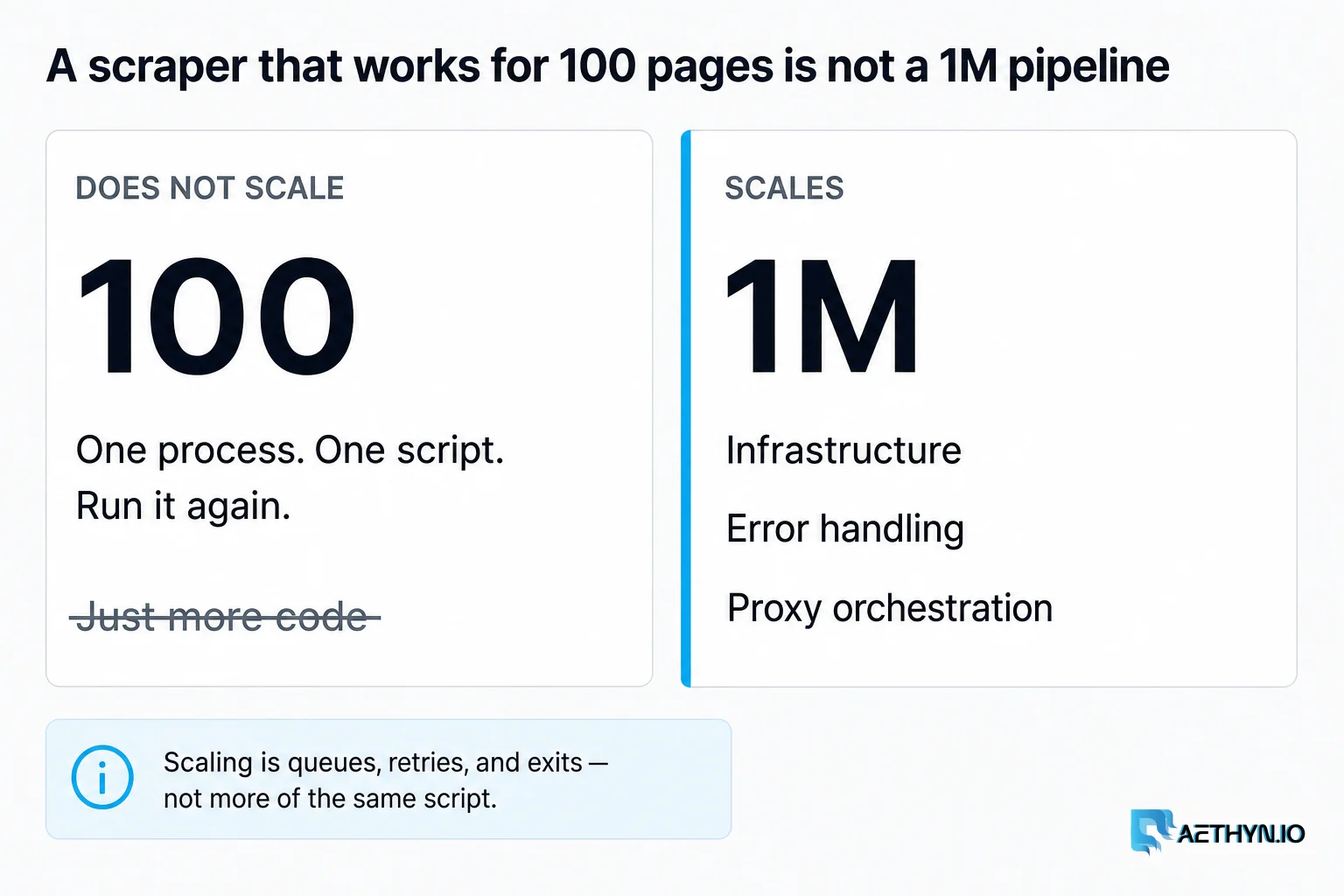
Scaling Web Scraping with Residential Proxies
Ready to go from 1,000 to 1,000,000 requests per day? Learn the architecture of a scalable scraping system.
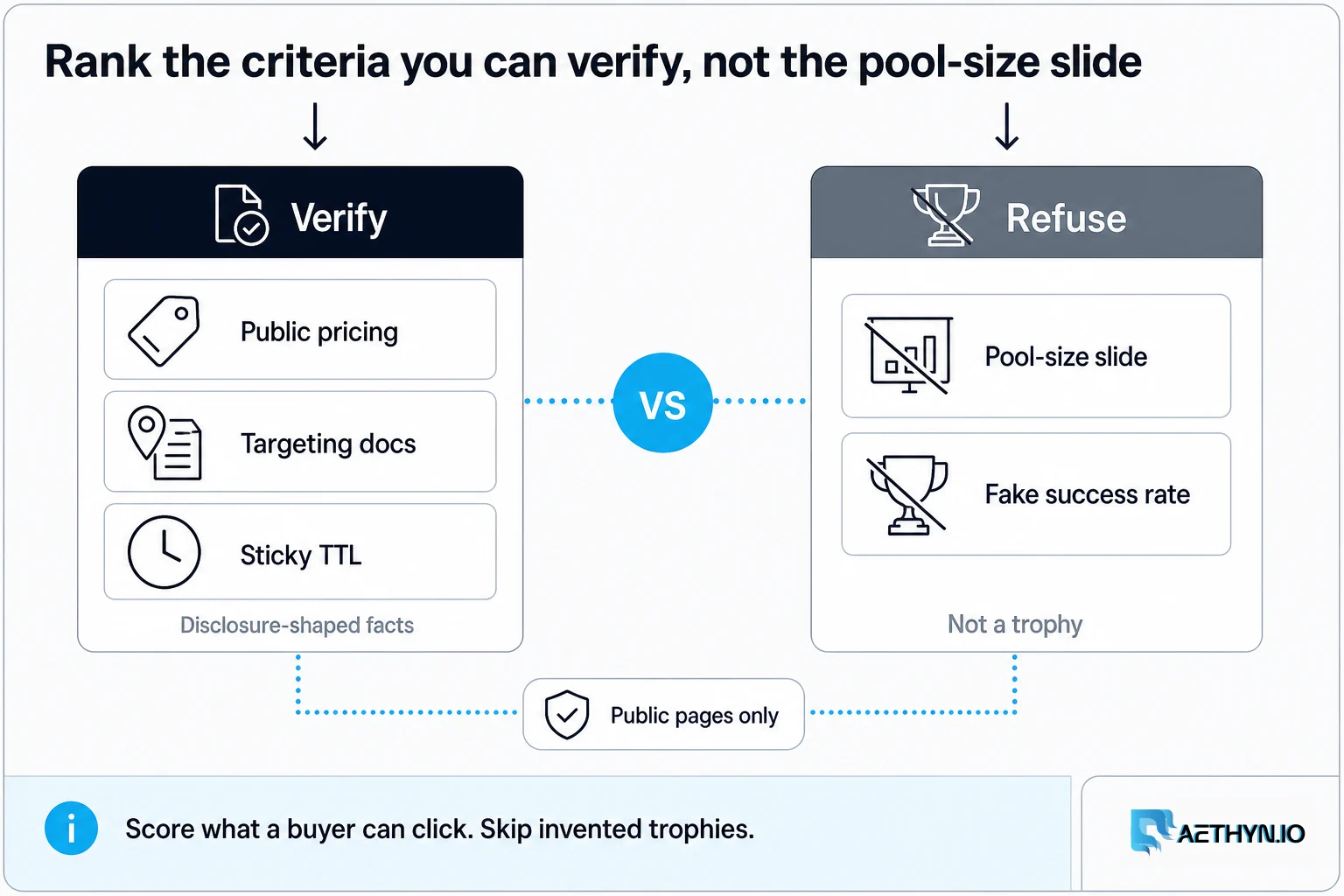
Best Residential Proxies for Web Scraping in 2026 (Tested Criteria, Published Sources)
Nine residential proxy vendors ranked for web-scraping buyers on pricing transparency, documented targeting, session control, and self-serve access — every competitor fact linked and dated.
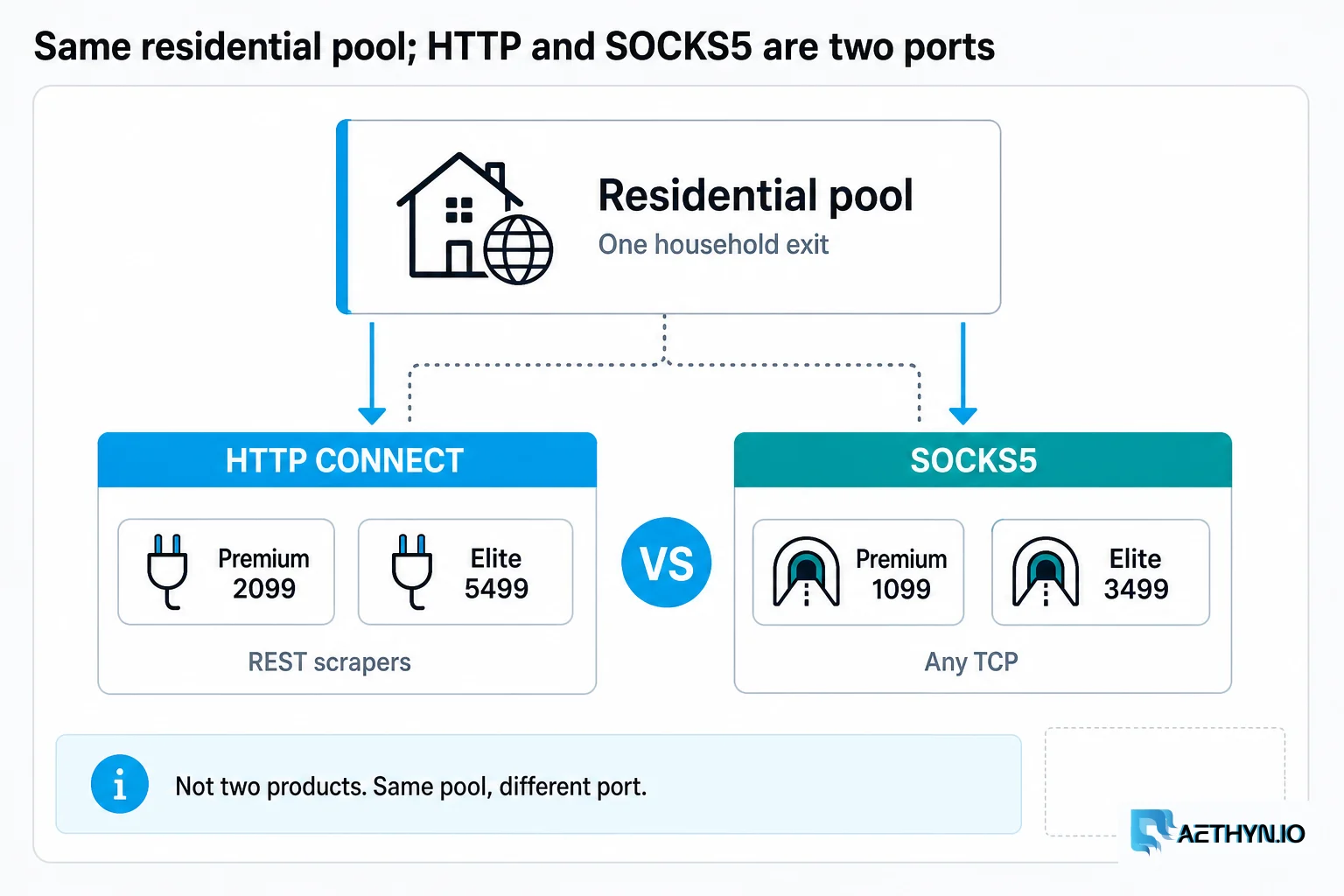
Best SOCKS5 Proxy Providers in 2026 (Comparison)
SOCKS5 proxies power scrapers, bots, and tunnel tools that do not speak HTTP CONNECT. We ranked 10 providers on protocol support, residential reputation, and pricing for 2026.
Ready to test on your stack?