

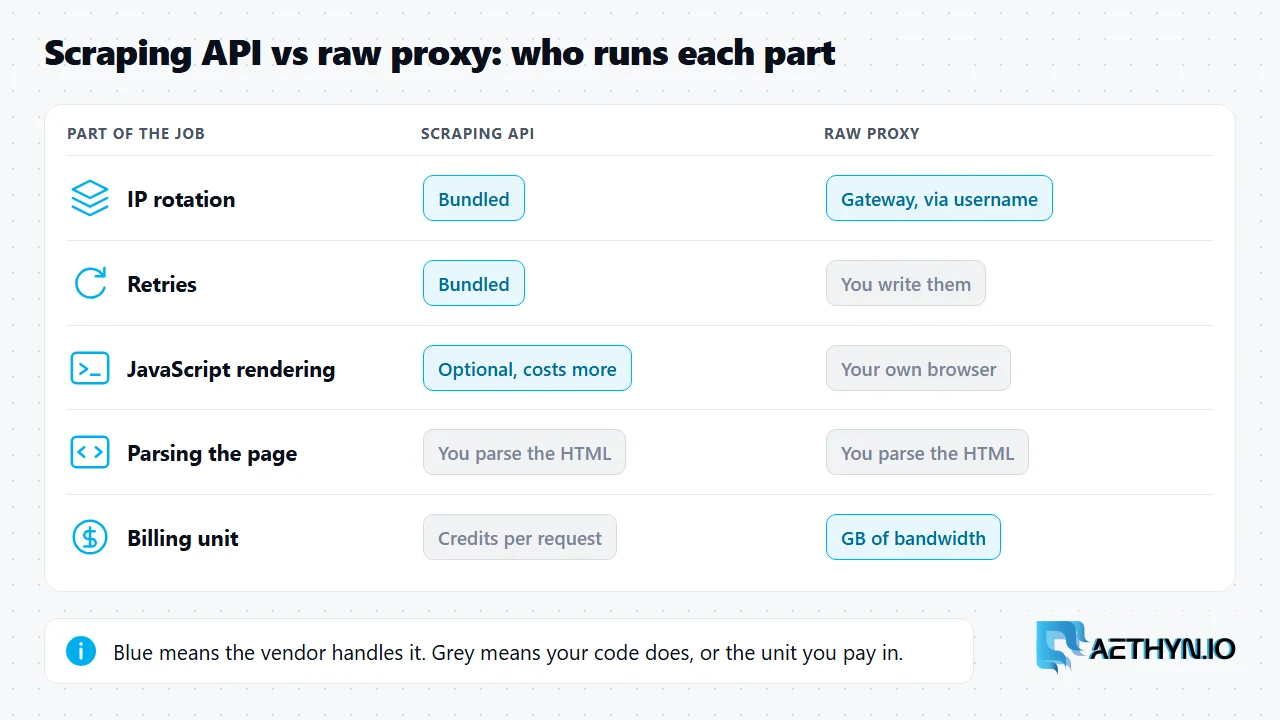
A scraping API is a service that fetches a URL for you and returns the page, bundling proxies, rotation, retries and, optionally, JavaScript rendering behind one request. A proxy is only the network path: your own code sends the request through it and the site sees a residential IP address. The choice is not about which exits are better. It is about which parts of the job you want to run yourself. Aethyn sells the proxy layer and does not sell a scraping API, so this page is a decision guide rather than a pitch for one side. If you already know you want a specific vendor's numbers, the ScraperAPI comparison has them.
What each one runs for you
With a scraping API you send a URL and get HTML back. IP rotation, retries and, when you ask for it, a headless browser all happen on the vendor's side. What you still do is parse the page and decide what to do when the answer is wrong. With a proxy, the gateway rotates the exit for you through the username, and everything else is yours: the retry logic, the browser for pages that need one, the headers and the TLS handshake your client sends, and the parser. That is more work, and it is also control. You can run Playwright, Scrapy or plain requests through the same pool, change the fingerprint when a target changes, and see exactly which request failed. The trade-offs on the client side are covered in curl_cffi vs requests vs Playwright, and TLS fingerprinting explains why a proxy alone does not fix a client that looks automated.
How each one bills
A scraping API bills in credits per request, and the credit cost depends on the options you turn on. On our ScraperAPI comparison, last verified 2026-08-14, a basic fetch is 1 credit, rendering raises it to 10, a Google results page costs 25, and ultra-premium proxies with rendering reach up to 75. Unused credits expire at the end of each billing cycle. Vendors change these figures, so check the current pricing page before you plan around them.
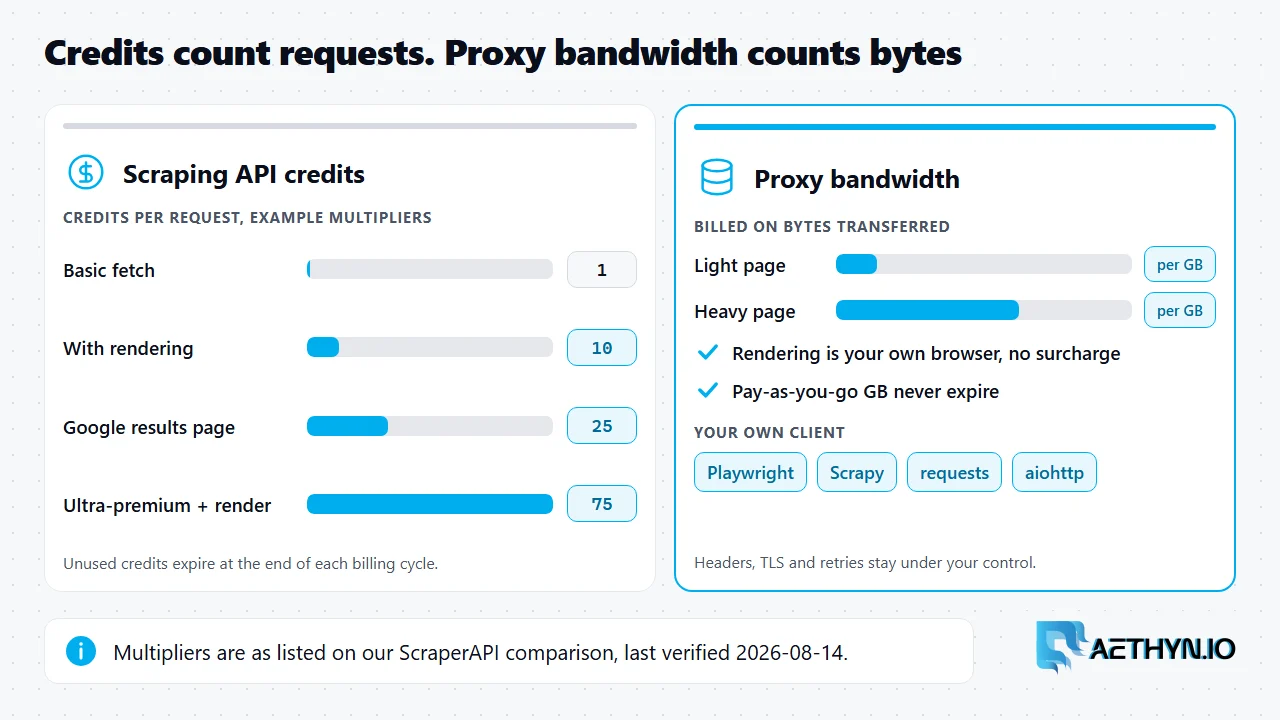
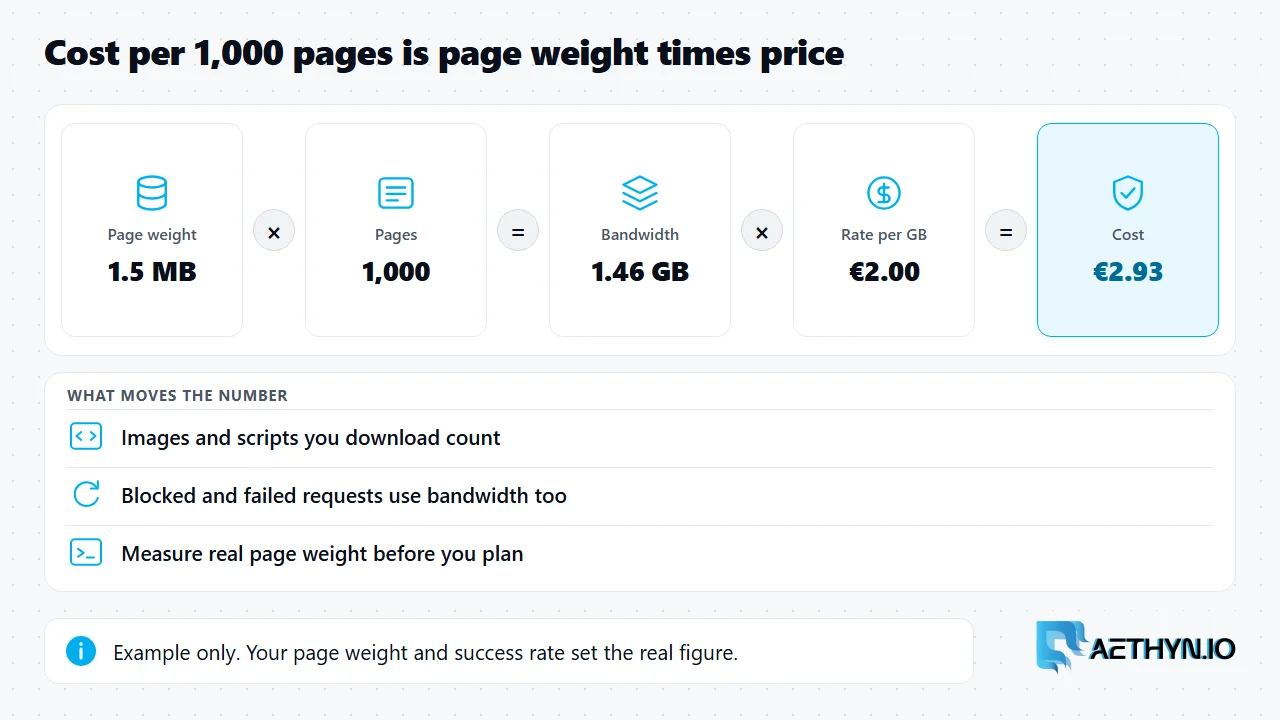
A proxy bills bytes. A request costs the bandwidth it transfers, rendering happens in your own browser so it adds no per-request surcharge, and pay-as-you-go gigabytes do not expire. To estimate it, multiply the page weight by the volume: cost per 1,000 pages is the page size in GB times 1,000 times the price per GB. A 1.5 MB page is about 1.46 GB per 1,000 pages, which is about €2.93 at €2.00/GB. Measure your real page weight, because images and scripts you download count, and blocked or failed requests use bandwidth too. The longer version of that arithmetic is in the residential proxy pricing guide.
Three questions to choose
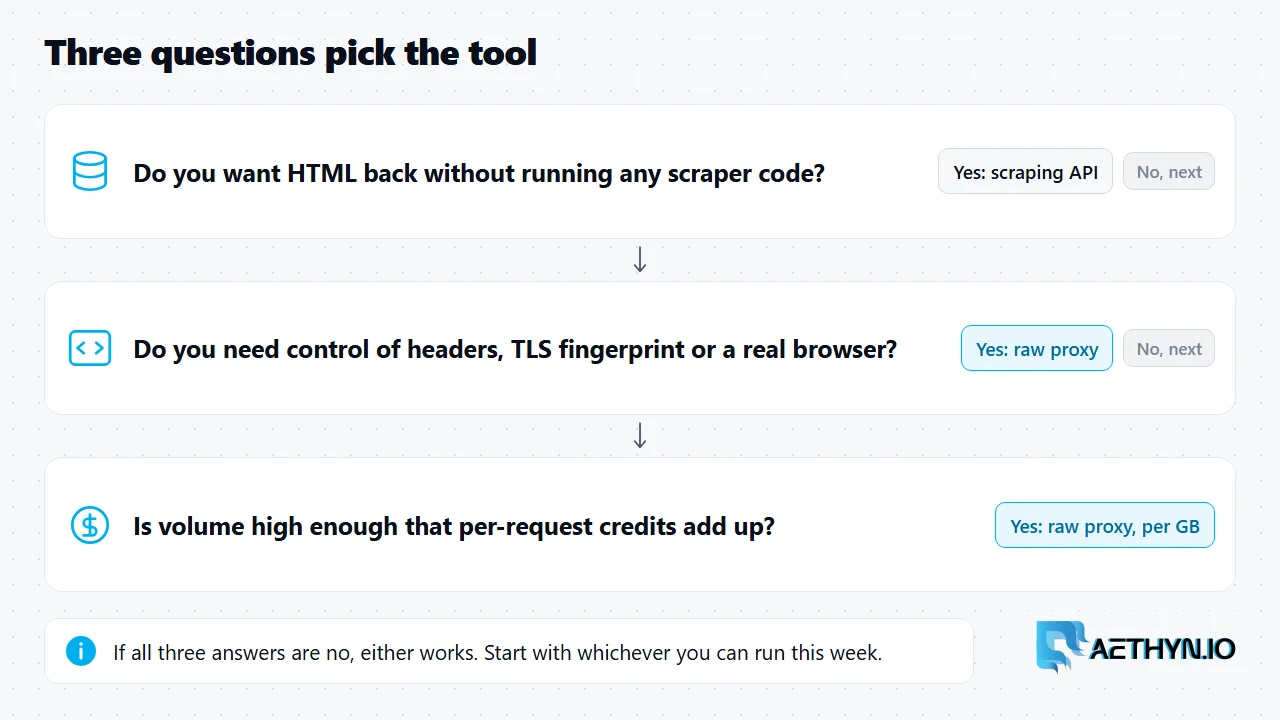
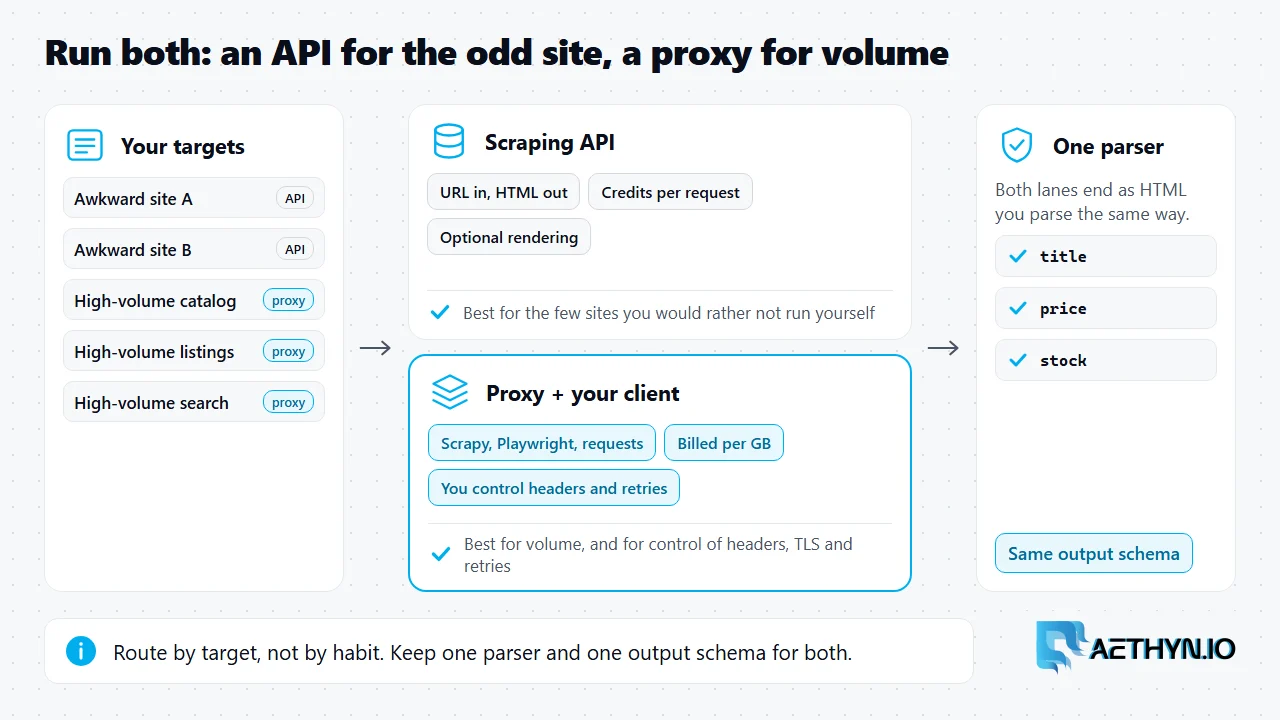
Pick a scraping API when you want the HTML without running scraper code, when you have a few targets, and when nobody on the team wants to maintain retries or a browser pool. That is a reasonable fit for a small team that needs data this week. Pick a proxy when you need control of headers, the TLS fingerprint or a real browser, when the volume is high enough that per-request credits add up, or when you need SOCKS5 and sticky sessions. If all three answers are no, either works, and the cheaper mistake is the one you can reverse. Many teams run both: an API for a handful of awkward sites, and a proxy for the volume. Reading a public page and saving its fields is the job either way, which what web scraping is covers from the start.
Where Aethyn fits
Aethyn is rotating residential proxies over HTTP and SOCKS5 on one gateway, proxy.aethyn.io. Premium starts from €2.00/GB with country targeting. Elite starts from €4.50/GB and adds city and ISP targeting for stricter targets. Sticky sessions are a suffix on the username, and pay-as-you-go bandwidth never expires. The rotation behaviour is explained in how rotating residential proxies work. For a vendor-specific side-by-side, see Aethyn vs ScraperAPI and ScraperAPI alternatives, and for rates see pricing.
Scraping API and proxy questions
What is a scraping API?
Is a proxy cheaper than a scraping API?
Can I use a scraping API and a proxy together?
Does Aethyn offer a scraping API?
Guides, integrations & docs
Continue reading
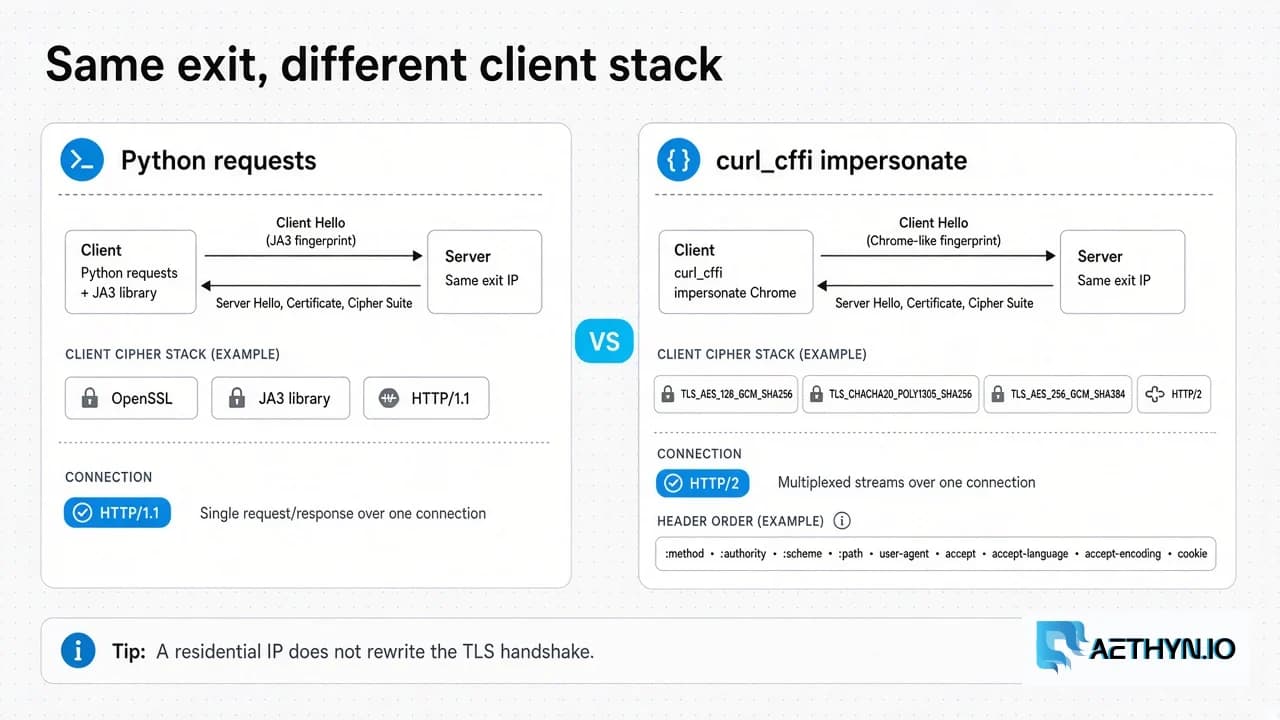
curl_cffi vs Requests vs Playwright for Web Scraping (2026)
Use the least expensive client that reliably produces the required document. A three-client test — requests, curl_cffi, Playwright — on one residential exit. Record status and body class, not a pass-rate table.
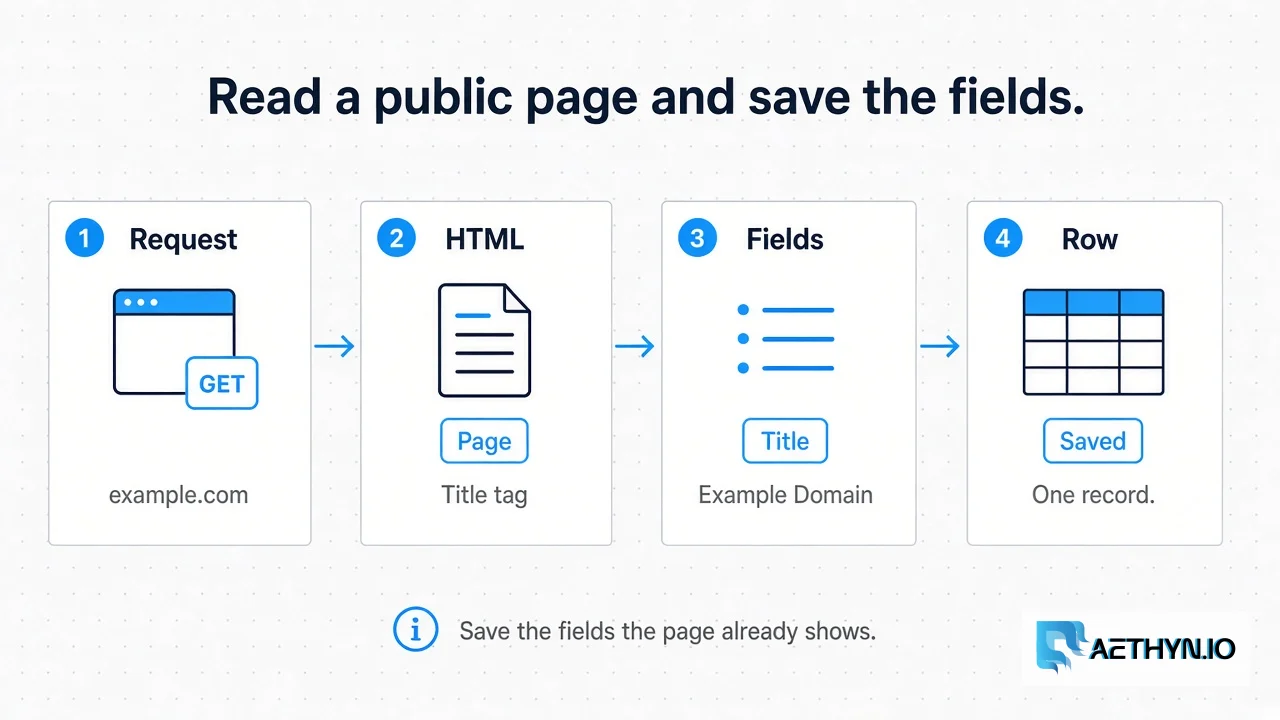
What Is Web Scraping? (2026)
Web scraping is reading a public page and saving the fields you need. The request, the parser, and a residential exit are three separate steps.
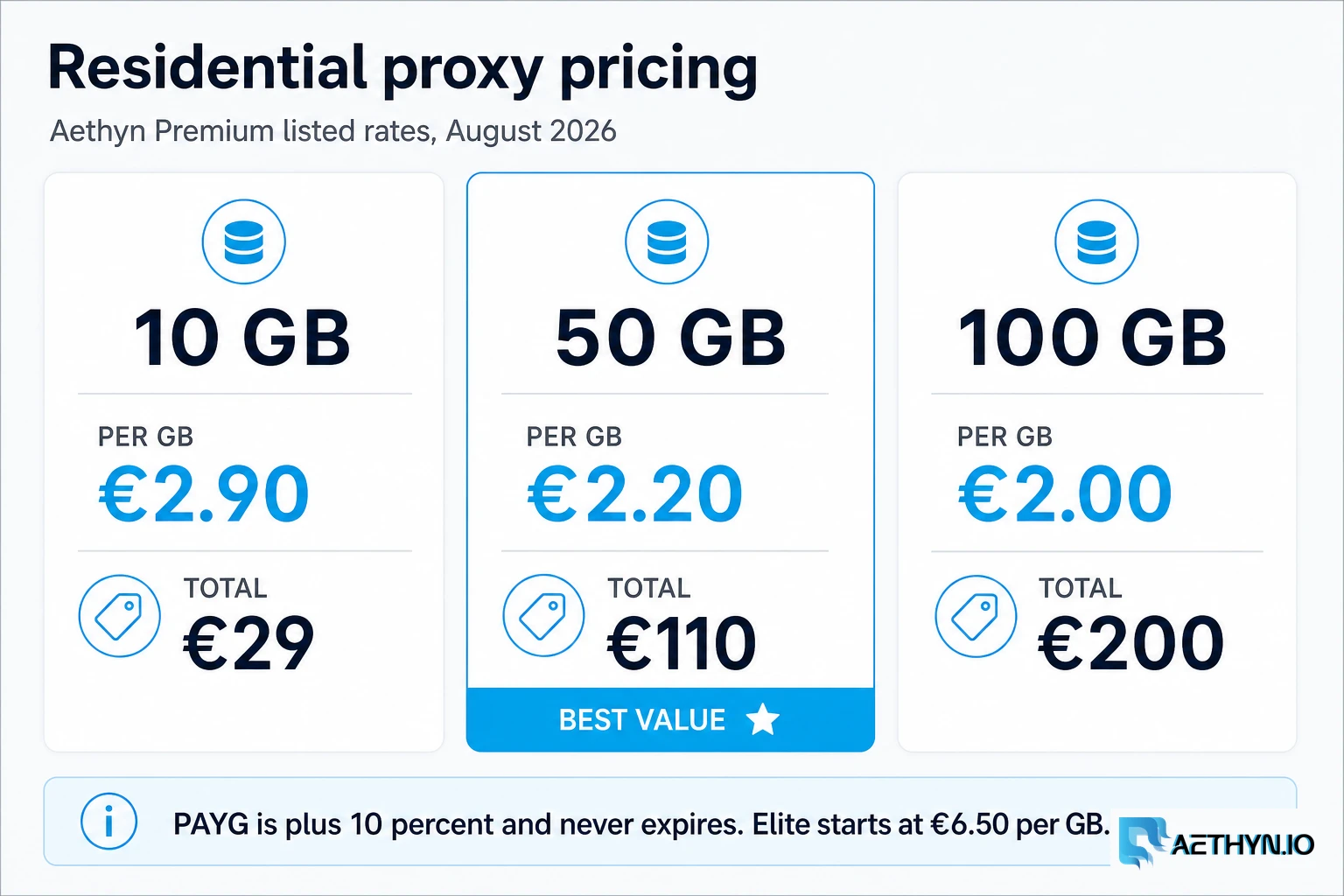
Residential Proxy Pricing in 2026: What You Actually Pay per GB
Residential proxy pricing is the published euros or dollars you pay per gigabyte of household-ISP traffic. Here is a dated 10 / 50 / 100 GB sticker table — then why sticker is not the bill.
Keep your own client, pay for bytes
Rotating residential on Premium HTTP 2099 or SOCKS5 1099. Pay-as-you-go GB never expire. Free trial, no card.