

What goes wrong when this scraper fails
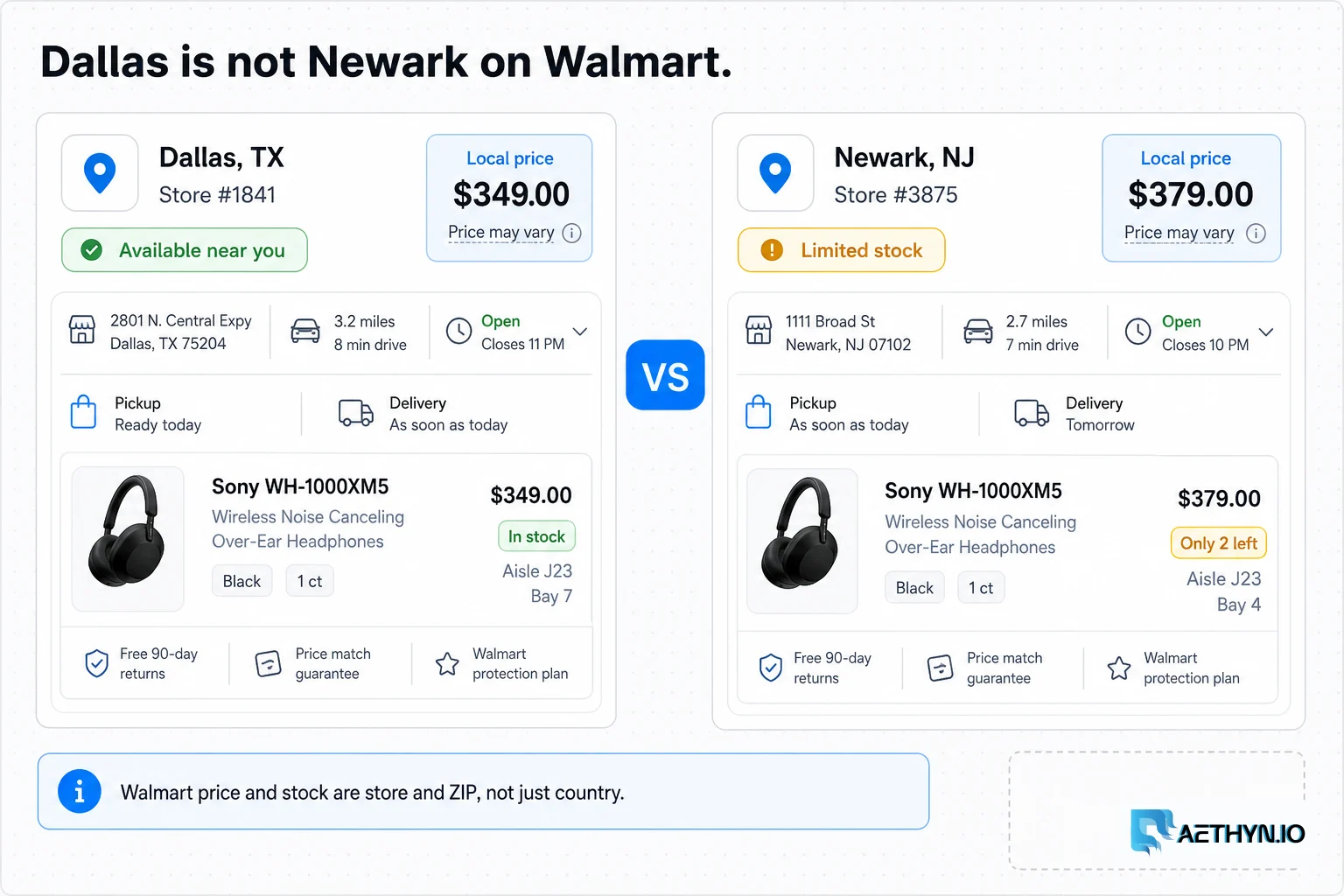
A repricer or brand wants Walmart's live price, who's winning the offer, and whether an item is in stock — across thousands of item IDs and multiple regions. The naive crawler breaks twice over: Walmart serves the PerimeterX 'Press & Hold' challenge to datacenter and low-trust IPs, and when a page does load, the price shown depends on the store/ZIP Walmart inferred from the IP, so a request from the wrong location returns a price and 'in stock' status no real shopper in your target market sees. The data quietly reflects the wrong store.
Why this failure mode happens
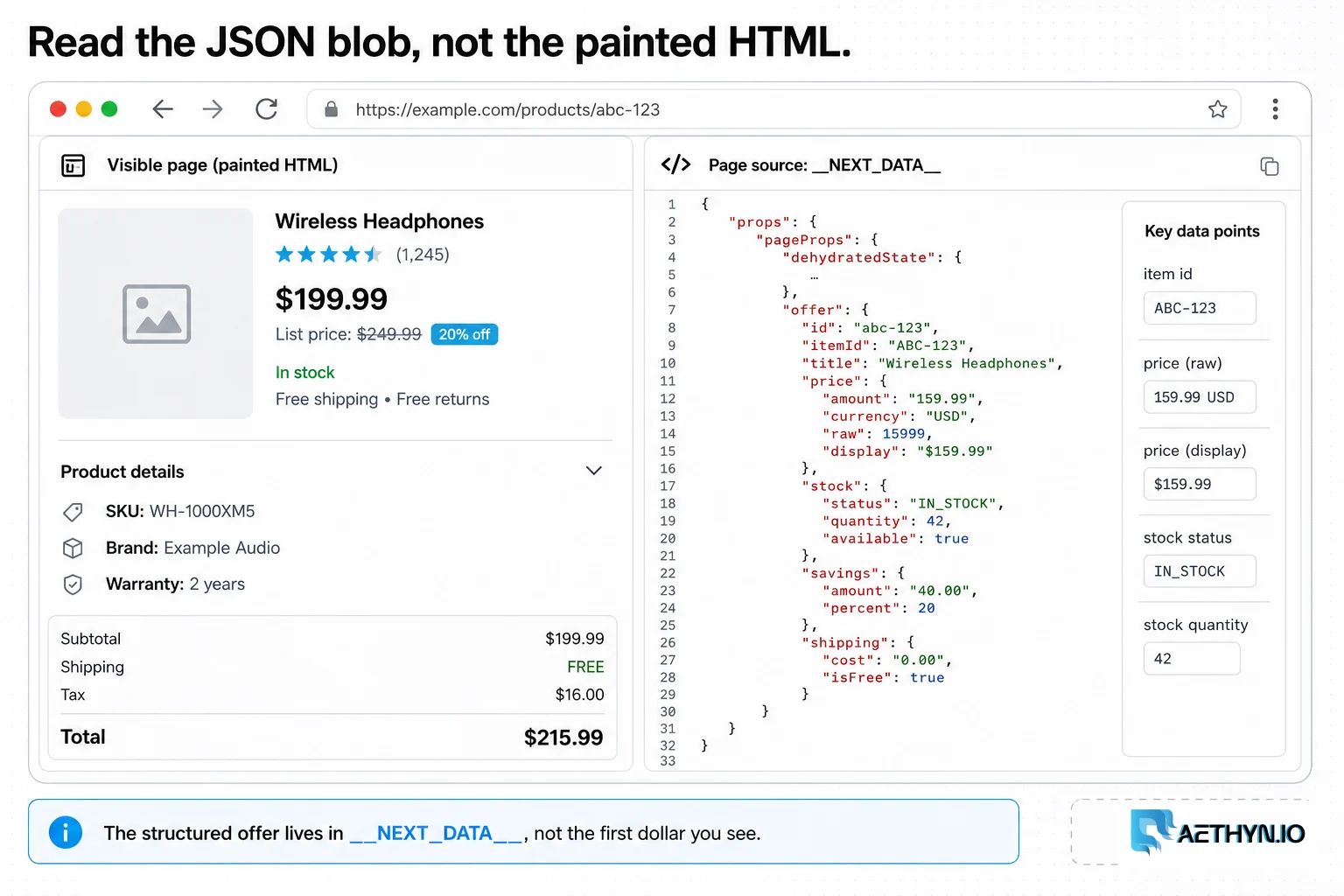
Walmart.com is a Next.js application that hydrates from a large __NEXT_DATA__ JSON object, and it localizes price, fulfillment, and availability to a specific store derived from the visitor's location. It protects those pages with PerimeterX/HUMAN bot management layered over Akamai, which scores IP reputation, TLS/HTTP fingerprint, and behavior. Datacenter IPs are flagged immediately, and even when a page loads from the wrong region, the embedded data is internally consistent but wrong for your market.
Challenges that make this hard to automate
- Price, fulfillment, and stock are store/ZIP-specific, not just country-specific
- PerimeterX/HUMAN 'Press & Hold' challenges on low-trust or fast traffic
- Content lives in a __NEXT_DATA__ JSON blob, not the rendered DOM
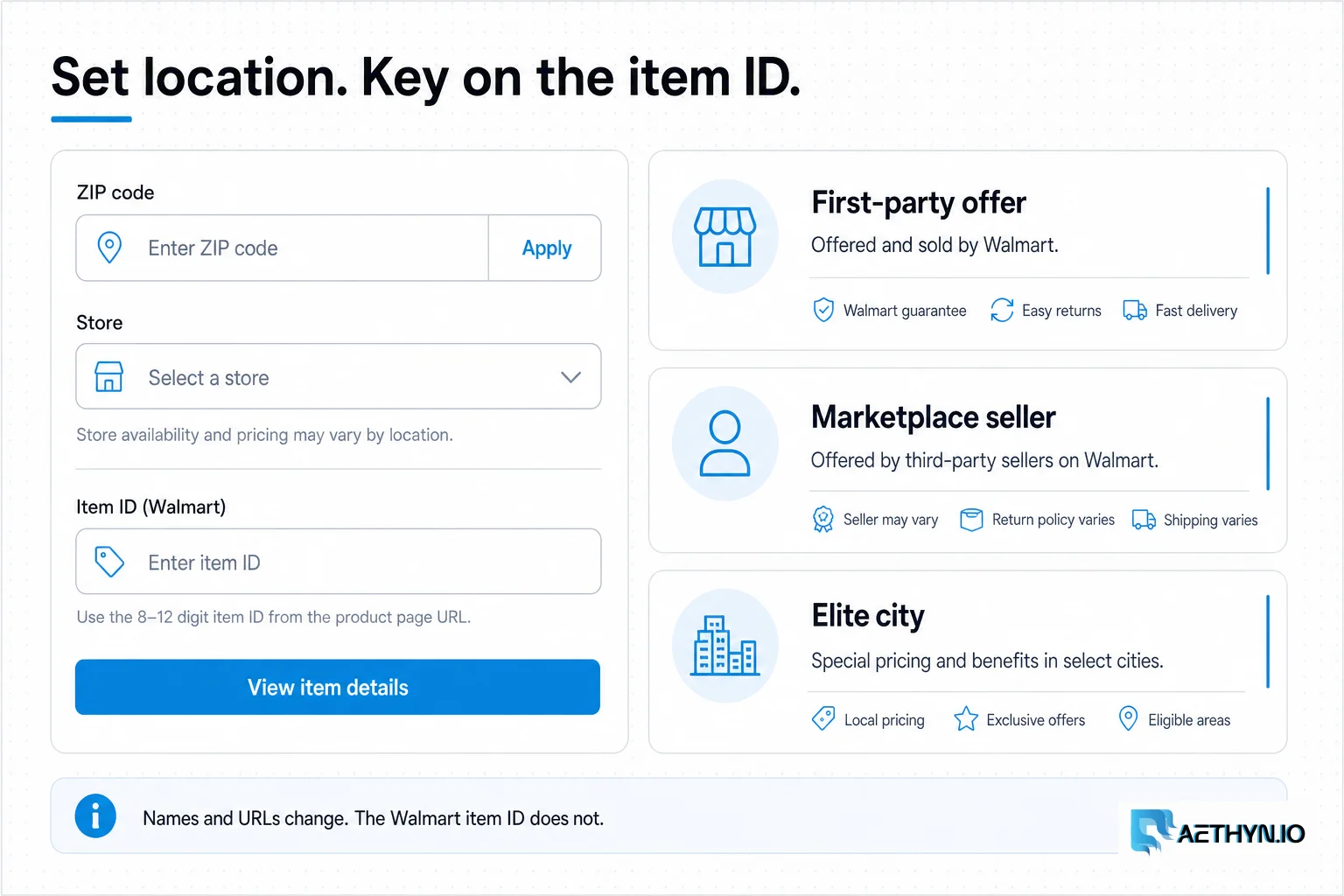
- First-party vs Marketplace seller offers must be distinguished
- Item layouts and the JSON shape differ across categories
Approaches that usually fail
- Datacenter proxies — challenged by PerimeterX almost immediately
- Scraping the visible HTML — brittle and missing the structured price/stock data
- A single residential IP — fine for spot checks, blocked once velocity rises
- Manual store-by-store checks — accurate but impossible across thousands of items
When residential proxies fix this — and when they cannot
Residential IPs in the target region read as real local shoppers, so Walmart resolves a plausible nearby store and returns the price and availability that store actually shows — and they carry the reputation needed to get past PerimeterX. Spreading a large item-ID crawl across a rotating pool keeps per-IP velocity below the thresholds that trigger the challenge.
How Aethyn residential proxies help here
Walmart is a high-security, geo-sensitive target, so reputation and location both matter. Aethyn handles both through the username on a single endpoint.
- Elite high-trust residential IPs to get past PerimeterX/HUMAN bot management
- City-level targeting (-city-) so Walmart resolves the store you mean to measure
- Per-request rotation to spread a large item-ID crawl thin across IPs
- Sticky sessions for multi-step flows like setting a store then reading items
- Per-byte metering so a recurring catalog crawl stays cost-predictable
How to implement this with residential proxies
- 1
Target the region whose store you want to price
Walmart's price and 'available for delivery/pickup' depend on a store tied to the visitor's location. Use an Elite city-targeted exit so Walmart infers a store in the market you're reporting on. Country alone is too coarse — prices and stock vary store to store within the US.
cURLcurl -x "http://aethyn-XXXXX-country-us-city-dallas:PASSWORD@proxy.aethyn.io:5499" \ -H "Accept-Language: en-US,en;q=0.9" \ "https://www.walmart.com/ip/0000000000"Field note: Keep a city → representative-ZIP mapping for the markets you track. Walmart's store assignment is ZIP-driven under the hood, so consistent geography is what makes day-over-day price history comparable.
- 2
Read price and stock from __NEXT_DATA__, not the DOM
Walmart hydrates from a JSON object in a <script id="__NEXT_DATA__"> tag. Parsing that gives you price, seller, and availability in structured form, immune to the visual redesigns that break HTML scrapers. Pull the script, json.loads it, and navigate to the product node.
Python (requests + __NEXT_DATA__)import json, requests from bs4 import BeautifulSoup PROXY = "http://aethyn-XXXXX-country-us-city-dallas:PASSWORD@proxy.aethyn.io:5499" proxies = {"http": PROXY, "https": PROXY} HEADERS = {"User-Agent": "Mozilla/5.0 ... Chrome/124.0 Safari/537.36", "Accept-Language": "en-US,en;q=0.9"} def get_item(item_id): r = requests.get(f"https://www.walmart.com/ip/{item_id}", headers=HEADERS, proxies=proxies, timeout=30) if "px-captcha" in r.text or r.status_code == 403: raise BlockedError("PerimeterX challenge") soup = BeautifulSoup(r.text, "html.parser") blob = json.loads(soup.find("script", id="__NEXT_DATA__").string) return blob["props"]["pageProps"]["initialData"]["data"]["product"]Field note: The __NEXT_DATA__ shape shifts occasionally and varies by category. Walk it defensively (.get() chains) and log when an expected key is missing — that's your signal Walmart changed structure, not that the item lost a price.
- 3
Separate first-party from Marketplace sellers
An item's offer can be sold by Walmart or by a third-party Marketplace seller, and they behave differently on price, shipping, and stock. Capture the seller identity and offer type alongside price so a 'price change' caused by a different winning seller isn't mistaken for Walmart repricing.
Field note: Treat 'sold by Walmart.com' versus a Marketplace seller as a first-class field. Brands tracking MAP compliance care specifically about which third-party sellers are listing and at what price.
- 4
Crawl many item IDs with rotation and block handling
Rotate per request across the item-ID list to keep per-IP velocity low, and detect the PerimeterX challenge explicitly — back off and rotate rather than retrying, which just hardens the block. Cap concurrency so neither Walmart nor your own egress spikes.
Python (block-aware crawl)import time, random def crawl(item_ids): out = {} for item_id in item_ids: for attempt in range(4): try: out[item_id] = get_item(item_id) # rotates IP per call break except BlockedError: time.sleep(min(60, 2 ** attempt) + random.random()) return outField note: If PerimeterX challenges spike across many fresh IPs at once, your global concurrency is too high — slow the whole crawl. A single greedy run can sour your hit rate for the rest of the job.
- 5
Store store-stamped history
Persist (item_id, store/ZIP, price, seller, availability, timestamp) so you can chart repricing, catch stockouts, and flag MAP violations per market. Re-crawl hot items more often than the long tail, and alert only on confirmed changes to avoid noise.
Best practices that keep scrapers reliable
- Set a city/ZIP so Walmart resolves a real store before reading price
- Parse __NEXT_DATA__ JSON, never the rendered HTML
- Key on the Walmart item ID and capture seller + offer type
- Rotate per request and detect PerimeterX explicitly, backing off on challenge
- Store store-stamped history and re-crawl by item priority
- Distinguish first-party from Marketplace offers in your schema
Common mistakes that burn proxy budget
- Pricing one store's data as if it were national
- Scraping visible HTML and breaking on every Walmart redesign
- Retrying through the 'Press & Hold' challenge instead of rotating
- Merging Walmart and Marketplace offers into a single price
- Keying on URL/name instead of the stable item ID
- Running the whole catalog from a few IPs until PerimeterX trips